Red meat in foodservice: The trends shaping today’s menus

Tuesday, 2 June 2026

The eating-out market has faced sustained pressure in recent years, and with household budgets still tight, consumers are being more selective about where they spend.

That is especially true for the third of consumers who say their finances have worsened in recent months, as 57% say they plan to cut back on eating out¹. The impact is already visible, with out-of-home food spend down 0.5% year-on-year².

Even so, people still want to eat out; they just need meals to feel worth the cost.

We explore the impact for red meat, as well as dairy.

Red meat: Adapting to shifting pressures

After several years of tighter menus, operators are beginning to expand their offerings, with menus now averaging 94 items, up 10.3% year-on-year³.

However, red meat has yet to recover its previous menu share, declining by 2.5 percentage points to 24.0% from its 2024 peak³.

This has contributed to continued volume declines across beef, lamb and pork⁴.

Table 1. Average volume and spend % change in foodservice year-on-year

% change year-on-year

Beef

Lamb

Pork

Volume⁴

-3.7

-3.4

-3.5

Spend²

-1.3

+5.5

-0.5

 Despite this, red meat remains an important driver of spend. Meals featuring beef or lamb command higher average prices³, reinforcing their role as quality and occasion-led choices that can help operators lift margins.

Table 2. Average spend for meal occasions⁵

Meal occasion

Average spend

All meal occasions

£15.11

Red meat meals

£15.31

Beef

£17.08

Lamb

£26.22

Pork

£11.99

 At the same time, red meat faces increasing competition. Poultry continues to gain share, supported by a lower price point and ongoing innovation that keeps it feeling accessible and versatile.

Positivity for pork

Within red meat, pork stands out as the only protein to have significantly grown its menu share over the past five years.

Operators are using it to anchor value, positioning pork as a more affordable alternative while driving menu innovation.

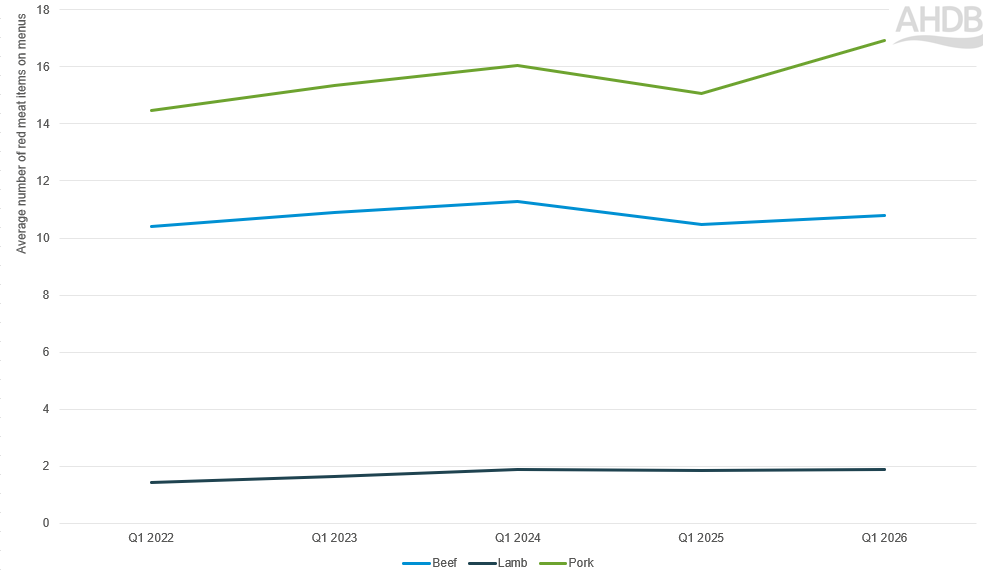
Figure 1. Average number of red meat items on menus, 2022–2026

Graph showing average number of red meat items on menus 2022-2026

Source: Lumina Intelligence Menu Tracker, 2022–2026

Figure 1 shows the average number of red meat items on menus from 2022 to 2026. Pork has the greatest number of menu items of average of the red meat items at 17, up from 14 in 2022, while beef has on average 11, and lamb 2, up from 10 and 1, respectively, in 2022.

This is particularly evident in burgers, where pork is gaining ground in a category long dominated by beef. Burgers are now the fastest-growing pork menu item³.

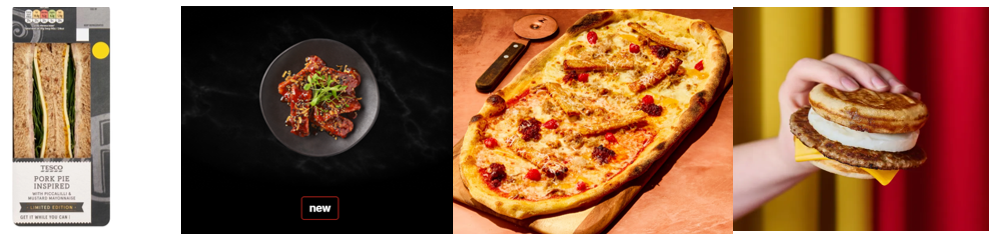
Innovation is focused on pushing flavour boundaries within familiar formats, such as gochujang tamarind pork ribs or sweet-and-savoury combinations like McDonald’s McGriddle and Zizzi’s sticky pig pizza.

Even comfort-led ideas are being reworked in new formats, such as Tesco’s pork pie-inspired sandwich.

Figure 2. Innovation for pork-based dishes on menus

Graphic showing examples of pigmeat innovation on menus

Figure 2 shows, from left to right: Tesco has taken a UK snack favourite (pork pie) and applied it to a sandwich format; Wagamama has combined gochujang and tamarin flavours to create an umami taste on pork ribs; Zizzi’s has added slow-cooked pulled pork, meatballs, ‘Nduja, crackling and hot honey to their sticky pork pizza; and McDonald’s has played on sweet and salty flavours with a pork patty between sweet pancake buns for their McGriddle.

This reflects both ongoing cost pressures and a growing willingness among diners to try something different, particularly when it feels like good value.

Lamb: Global flavours, premium comfort

Lamb is emerging as a versatile protein for innovation, used by operators to deliver global flavours and elevate comfort-led dishes.

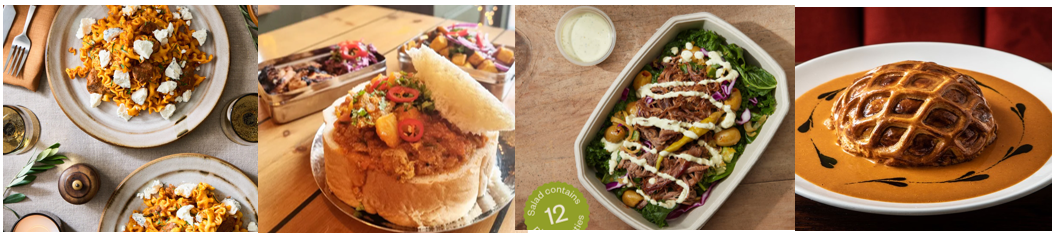
Cross-cultural formats such as bunny chow, shawarma bowls and caldereta pies highlight its adaptability to bold, contemporary profiles.

Figure 3. Images of how lamb dishes are being used and presented out-of-home

Graphic showing examples of lamb innovation on menus

Figure 3 shows, from left to right: images of lamb ragu with whipped Chevre goats cheese from Cote; an edible bread bowl containing South African lamb bunny chow from Mowgli Street Food; a lamb shawarma bowl from PYO; and finally a lamb shoulder caldereta pie on a bed of coconut sauce from Donia

At the same time, slow-cooked cuts are driving indulgent, premium-feeling dishes, like ragus and pies, offering strong value for both consumers and operators.

This is reflected in rising demand, with Asian cuisine (+36.1%) and lamb-centred meals (+1.7%) both increasing year-on-year⁴.

Beef: From centrepiece to flexible ingredient

Demand for beef has been impacted due to ongoing inflationary pressures, with out-of-home volumes down by 3.7m kg over the past year⁴. Alongside this, its role on menus is changing.

While burgers still account for the greatest share of volumes, demand is moving towards smaller formats such as cheeseburgers (+32.0%)⁴.

Growth in Asian (+5.9%) and Indian (+4.0%) cuisines is also contributing, as these dishes typically use less beef per serving than traditional centre-of-plate options like steaks (-10.3%), ribs (-9.3%) and mixed grills (-25.1%)⁴.

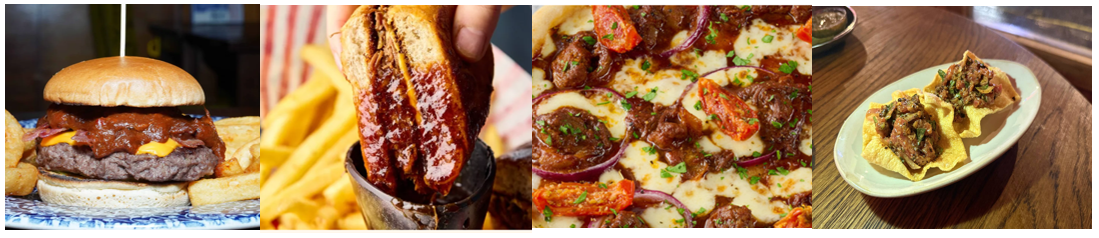
Figure 4. Examples for beef innovation on menus

  Graphic showing examples of beef innovation on menus  

Figure 4 shows, from left to right: a smoky brisket and goat’s cheese stack from Wetherspoons; a Bombay Haloumi Stack fusing halloumi, Indian spices and tzatziki with beef at Ember Inns; a Mediterranean-inspired mix of halloumi and beef for a protein-rich, gluten-free breakfast from LEON; and finally a Thai take on a beef tartare on a crispy base for a bitesize starter from Khoa Bird

As a result, innovation is increasingly positioning beef as an ingredient rather than the centrepiece.

This allows operators to retain beef on menus while managing costs, either by extending dishes with lower-cost ingredients or featuring it in smaller plates and starters.

Descriptors on menus

Menu language is also evolving. Descriptors such as crispy and smoked are among the most common for red meat.

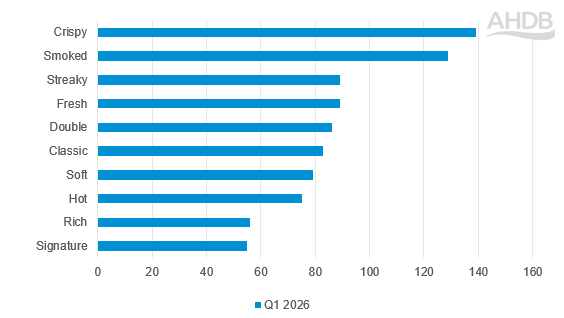
Figure 5. Total red meat top 10 descriptors on menus⁶

Graph showing top 10 red meat descriptors used on menus

Source: Lumina Intelligence Menu Tracker, 2026

Figure 5 shows the top 10 words used as descriptors for red meat on menus. Crispy is used the most, appearing 139 times, with smoked in second place at 129 times. Other descriptors in the top 10 include: streaky (80), fresh (89), double (86), classic (83), soft (79), hot (75), rich (56) and signature (55).

Smoked is one of the fastest-growing terms for pork, signalling crafted, premium flavours, while lamb leans into pickled, marinated and glazed profiles. For beef, indulgent cues like double and classic remain prominent⁶.

Texture-led words, such as crispy, are particularly effective at lunchtime, offering a simple way to elevate dishes and resonating with wider social media trends⁷.

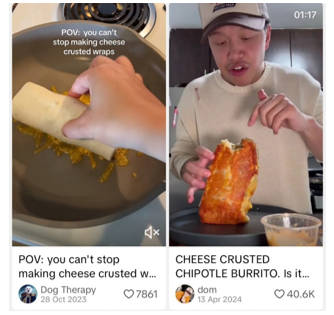
Figure 6. Social media content trends for cheese-crusted food

Graphic showing stills taken from social media for cheese crusted food

Figure 6 shows a split-screen collage of two social media clips showing cheese‑crusted wraps. On the left, a hand lifts a wrap from a frying pan, revealing a golden, crispy cheese layer underneath. On the right, a person.eats a large burrito wrapped in a crunchy cheese crust. Both posts highlight the trend of adding a melted cheese crust to wraps and burritos.

Provenance also plays an important role, with clear storytelling around origin and production helping to build perceptions of quality and trust⁸. As diners become more mindful, it offers a simple way to reassure and differentiate⁸.

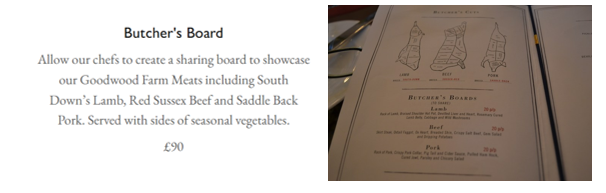
Figure 7. How the out-of-home market communicates provenance on menus

Grpahic showing how menus communicate provenance

Figure 7 shows the menu from Farmer, Butcher, Chef, where named breed beef, lamb and pork are showcased to justify the price point of the dish.

Descriptors such as high quality, seasonal, fresh and locally sourced support this, with 72% of consumers saying high-quality ingredients make a meal feel worth the cost, alongside 63% for seasonal and fresh produce and 57% for locally sourced items⁹.

These cues help build trust and signal care, qualities that matter even more when budgets are tight.

The consumer mindset: Mindful choices and growing health cues

A major shift shaping the out-of-home market is how consumers think about food. Diners are paying closer attention to ingredients, processing and health cues, with terms like ultra-processed and GLP-1 becoming part of everyday food conversations.

Rather than focusing on restriction, many are seeking added benefits. As GLP-1 use grows and health priorities evolve, messages around protein and fibre are gaining traction.

When defining a healthy diet, consumers now emphasise additions, such as fruit and vegetables, hydration and balance over cutting calories, fat or sugar¹⁰.

This mindset is influencing behaviour, with operators responding through dishes that feel lighter, simpler and more functional.

As a result, high-protein options and smaller portions are becoming more common across both red meat and dairy.

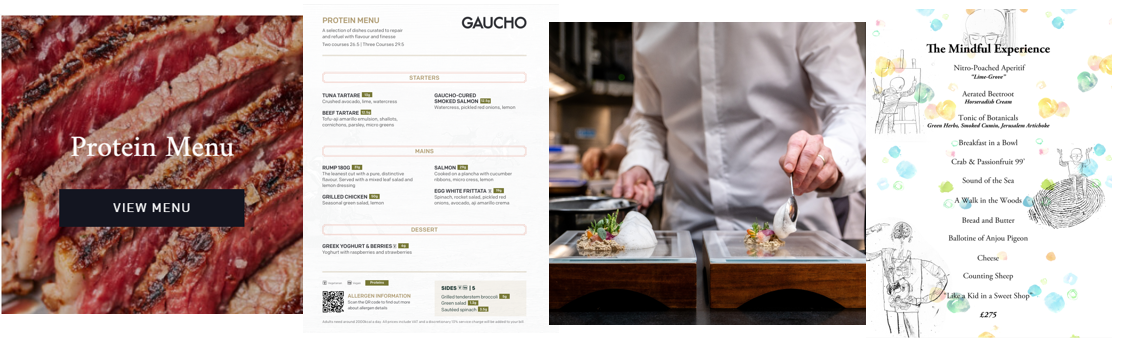
Figure 8. Examples of how protein and smaller portions are informing menus

Graphic showing examples of how high protein and small portion size is being used on menus

Figure 8 shows four images illustrating how menus are catering to smaller portions and mindful eating experiences, with an example of a protein menu which states the number of grams of protein each dish contains and a mindful eating menu with dishes named after mindfulness exercises

What this means for operators

For red meat:

  • Prioritise pork-led new product development and value-driven dishes to help grow red meat share on menus
  • Use pork to anchor value while positioning beef and lamb in targeted premium formats
  • Develop lamb dishes that lean into comfort and global cuisines, using cost-effective cuts that still deliver flavour and a premium feel
  • Expand lower-cost beef formats beyond burgers, such as breakfast, smaller plates, sides and starters
  • Lean into texture cues, like crispy and smoky, and use provenance to reinforce value and justify pricing
  • Develop small-plate options that highlight functional health benefits

Sources

¹ AHDB/YouGov, February 2026

²Worldpanel by Numerator UK OOH data, 52 w/e 22 March 2026

³Lumina Intelligence Menu Tracker, 2025–2026

⁴AHDB estimated volumes based on Worldpanel by Numerator UK OOH data, 52 w/e 22 March 2026

⁵Lumina Intelligence EDOP, 52 w/e 18 January 2026

⁶Lumina Intelligence, Menu Tracker 2026

⁷TikTok, Lumina Intelligence 2026

⁸Lumina Intelligence, Framer, Butcher, Chef

⁹Lumina Intelligence Psychographics Survey, 2025

¹⁰Lumina Intelligence & Food Navigator, Future Food Global Study, September 2025

Image of staff member Charlotte Forkes-Rees

Charlotte Forkes-Rees

Retail and Consumer Insight Analyst

See full bio


Sign up to receive the latest information from AHDB.


While AHDB seeks to ensure that the information contained on this webpage is accurate at the time of publication, no warranty is given in respect of the information and data provided. You are responsible for how you use the information. To the maximum extent permitted by law, AHDB accepts no liability for loss, damage or injury howsoever caused or suffered (including that caused by negligence) directly or indirectly in relation to the information or data provided in this publication.

All intellectual property rights in the information and data on this webpage belong to or are licensed by AHDB. You are authorised to use such information for your internal business purposes only and you must not provide this information to any other third parties, including further publication of the information, or for commercial gain in any way whatsoever without the prior written permission of AHDB for each third party disclosure, publication or commercial arrangement. For more information, please see our Terms of Use and Privacy Notice or contact the Director of Corporate Affairs at info@ahdb.org.uk  © Agriculture and Horticulture Development Board. All rights reserved. 

×