EU pig prices show renewed growth and 2025 market in review: Pork market update

Thursday, 19 March 2026

Key Points

  • EU pig prices have firmed, with average reference prices up 9.55p/kg equivalent since early February. Spanish ASF control and strong German slaughter are key drivers.
  • EU pig meat production increased by 3% in 2025, led by Spain and Poland, driven by higher slaughter and heavier carcase weights
  • EU pig meat exports grew by 2% in 2025 to 3.95 million tonnes, with strong gains to Taiwan, Ukraine and parts of Asia, despite declining shipments to China and the UK
  • EU pig meat imports fell by 3% to 131,600 tonnes, with Chilean volumes sharply lower and UK supply broadly stable

Prices

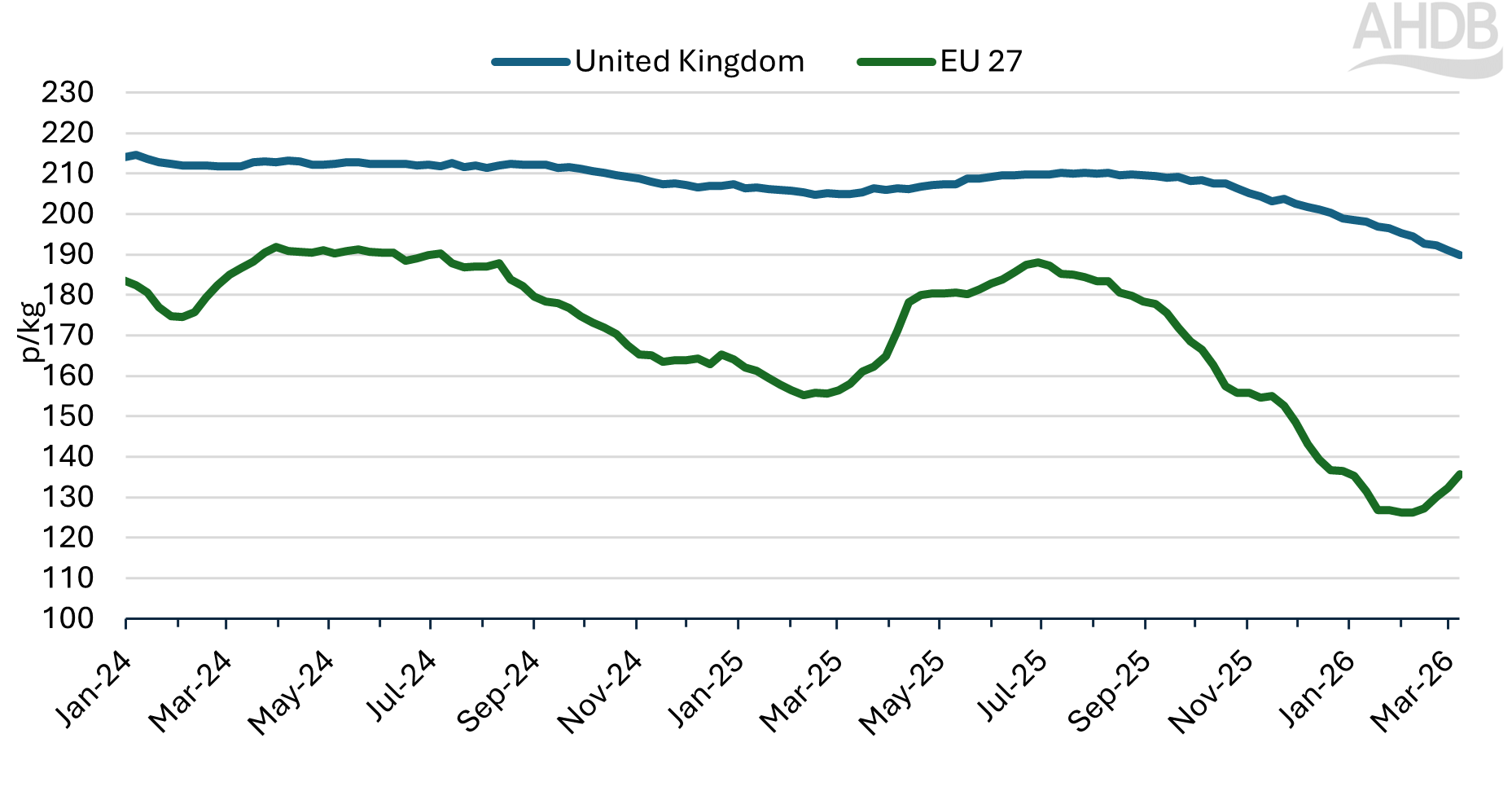
Following previous lows, EU reference pig prices have exhibited stability and have begun to strengthen in recent weeks. In the week ending 1 February, the EU grade S reference price reached a low of 126.21p/kg equivalent but has since increased by 9.55p/kg over the five weeks since.

Effective management of ASF in Spain and lower supply in Germany are key drivers.

Over the past month, the Spanish grade S reference price has risen by 12.05p/kg equivalent to 124.93p/kg in week ending 8 March. Prompt implementation of regionalisation agreements and swift biosecurity efforts have supported markets. More recently, additional ASF cases have been detected outside the original containment zone, although these have still only been reported in wild boar populations. In response, Spain has expanded the containment zone and introduced further biosecurity measures.

In the week ending 8 March, the German grade S reference price stood at 147.85p/kg, an increase of 11.95p/kg from the previous low recorded in the week ending 8 February. Earlier price pressure had been linked to the ASF outbreak in Spain and factory disruptions across Germany that caused processing backlogs. More recent reports suggest that extensive slaughtering has cleared this backlog and the market is firm.

Figure 1. Trends in UK and EU grade S reference pig prices (p/kg)

Source: Eurostat

Figure 1 shows trends in the EU and UK grade S reference prices from January 2024 to March 2026. The UK is shown in blue and the EU in green. Prices have generally declined since the start of 2026; however, EU prices have started to increase in recent weeks.

The price differential between the EU and UK has narrowed in recent weeks, standing at 54.03p for the week ending 8 March, a reduction of 15.87p over the past seven weeks.

Production Growth

EU pig meat production for the full year of 2025 stood at 21.8 million tonnes, a 3% (705,000 tonne) increase year on year (YoY).

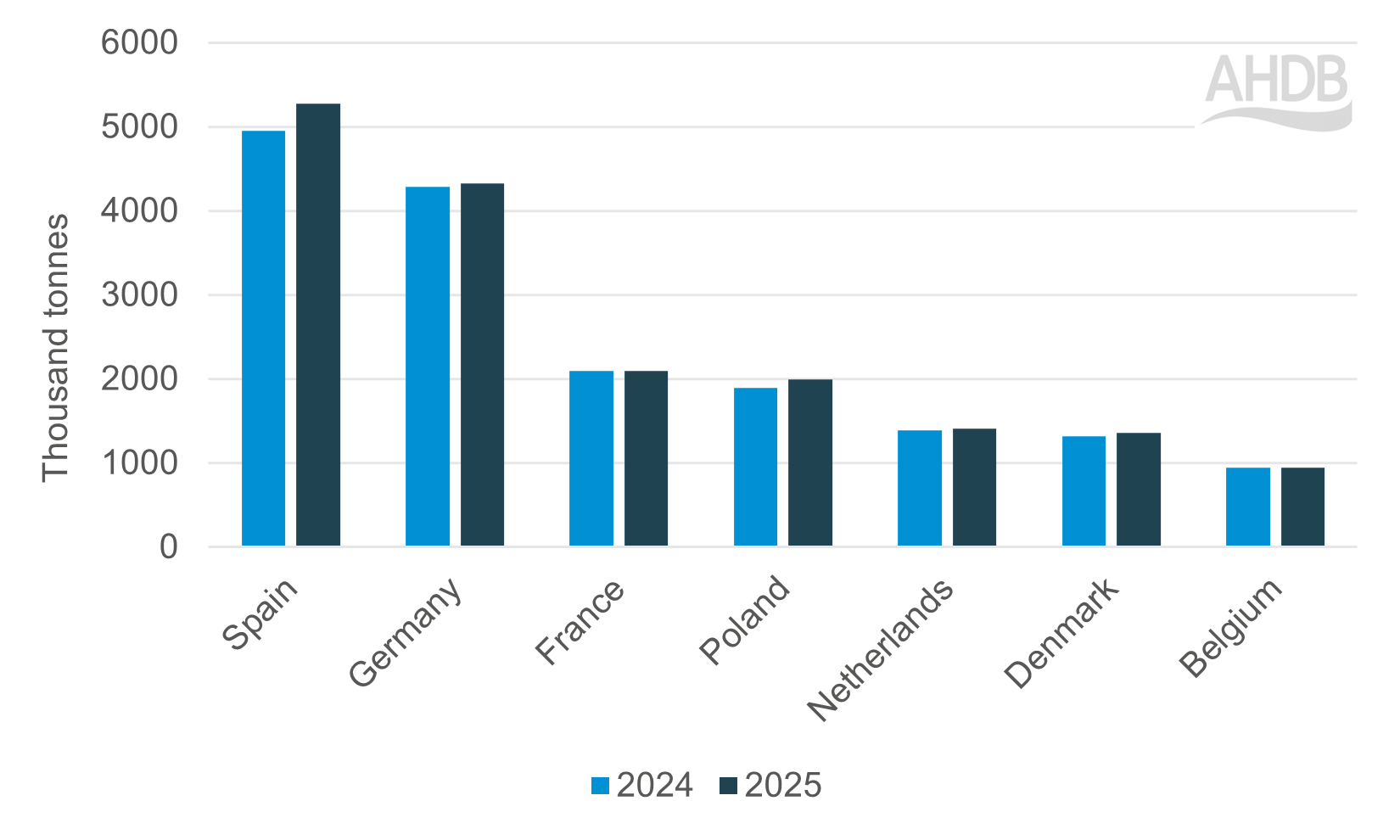
Growth was largely driven by Spain (+6%), and Poland (+5%). Denmark recorded a 3% increase, while Germany saw more modest growth of 1%. Belgium and France experienced marginal increases, rising 0.3% and 0.6%, respectively.

Higher production levels were supported by increases in both slaughter and carcase weights. EU clean pig slaughter increased by 2% YoY to total 227.2 million head.

Average EU carcase weights gained 1% (0.98 kg) YoY to average 95.9 kg.

Figure 2. Pig meat production of select EU27 countries 2024–2025

Source: European Commission

Figure 2 compares pig meat production across selected European countries in 2024 and 2025, expressed in thousand tonnes. 2024 is shown in light blue and 2025 in dark blue. The data highlights that Spain recorded the highest production levels in both years, surpassing all other countries featured.

Exports

Higher production supported EU pig meat exports to grow by 2% in 2025, totalling 3.96 million tonnes (including fresh, frozen, processed and offal).

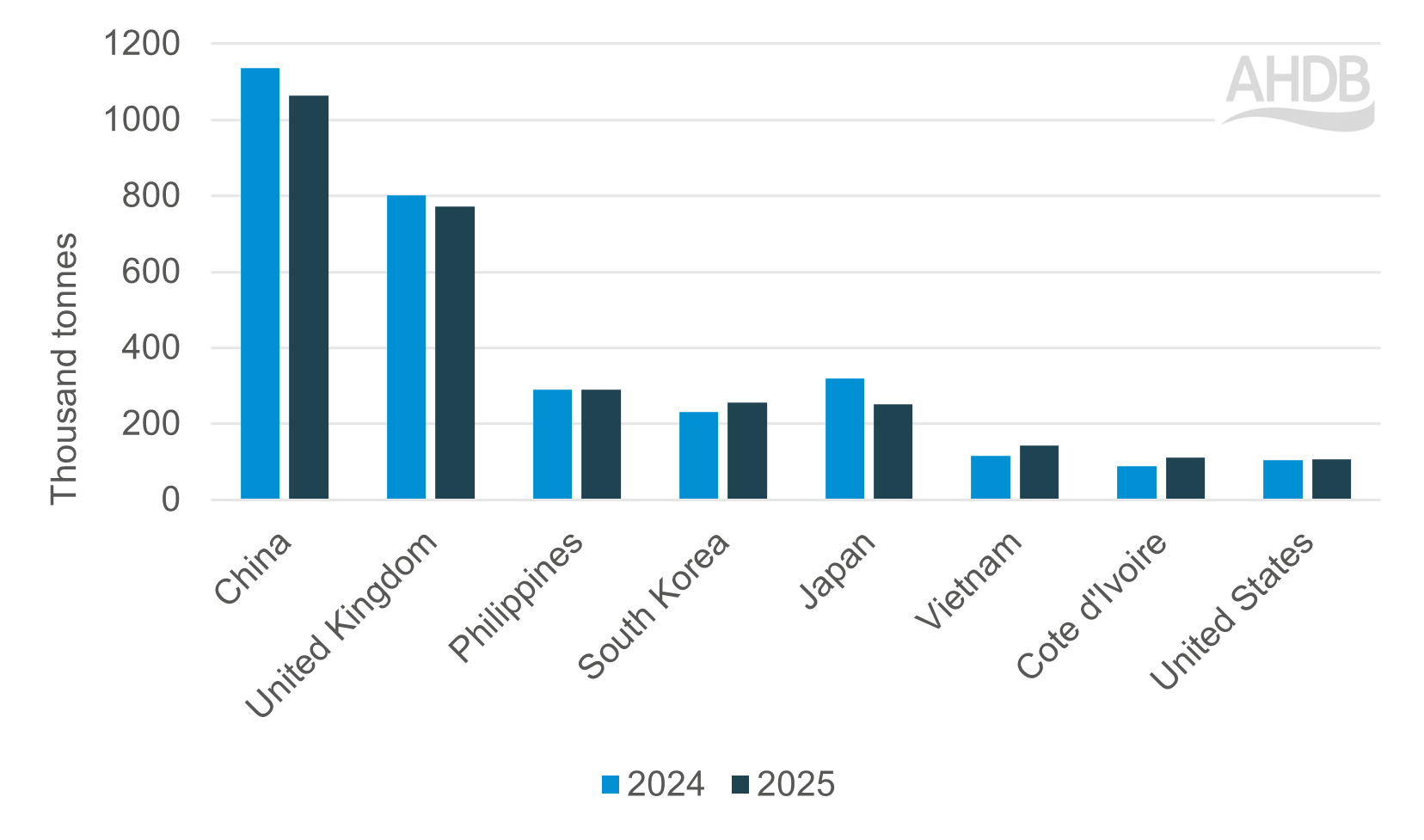
China remained the EU’s largest export destination but shipments declined 6% (72,200 tonnes) YoY, linked to China’s anti-dumping trade measures and focus on self-sufficiency.

The UK remained the EU’s second-largest export destination, but shipments declined by 4% (28,300 tonnes) YoY. The significant price differential in late 2025 did not translate into increased imports, signalling domestic support for British product.

Looking ahead to 2026, UK imports of pig meat from the EU fell by 3% YoY in January (1,700 tonnes), indicating a continuation of the softer import trend seen in 2025.

The main growth in EU exports during 2025 came from Taiwan and Ukraine. Shipments to Taiwan increased by 76% to 75,054 tonnes, while exports to Ukraine rose sharply by 273% to 44,354 tonnes.

Exports to South Korea and Vietnam also recorded gains, though to a lesser extent. This was largely due to domestic production challenges in both countries, caused by disease outbreaks and extreme heat during 2025.

Figure 3. Exports of pig meat (including offal) from the EU27 to non-EU countries between 2024 and 2025

Source: Eurostat compiled by Trade Data Monitor LLC

Figure 3 shows EU pig meat exports (including offal) between the years 2024 (light blue bars) and 2025 (dark blue bars), expressed in thousand tonnes.

Imports

EU pig meat imports totalled 131,600 tonnes in 2025, down 3% (3,800 tonnes) YoY.

The UK remained the largest supplier, with shipments reaching 100,900 tonnes into the EU, largely unchanged from the previous year.

The largest contributor to the decline in EU imports was a reduction in shipments from Chile. Imports from Chile totalled 8,400 tonnes, a 37.6% decrease (5,000 tonnes) compared with 2024.

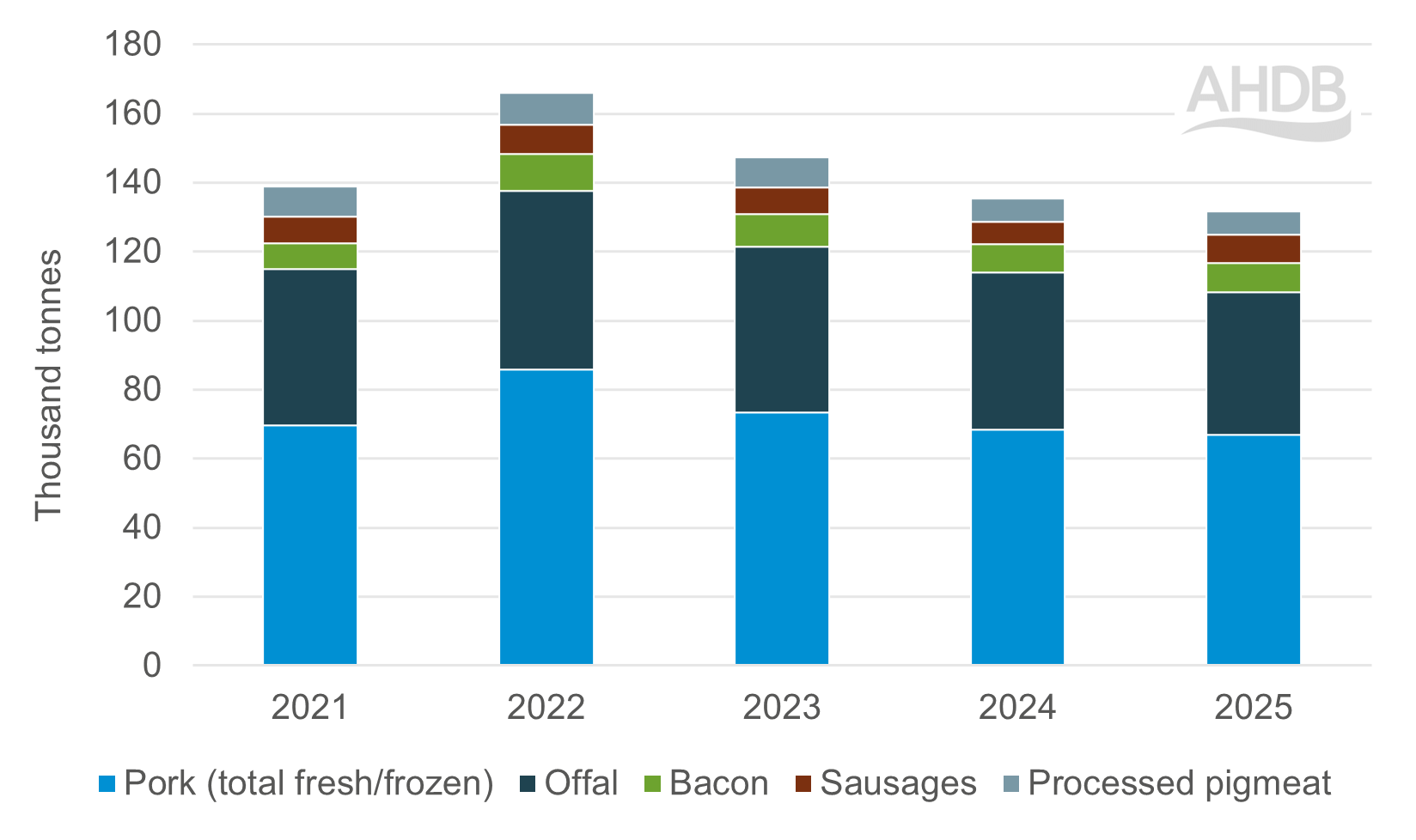
Looking at product categories, both offal and fresh/frozen pork experienced declines while other categories including bacon and sausages recorded growth.

Figure 4. EU annual pig meat imports by product ('000 tonnes)

Source: Eurostat, compiled by Trade Monitor LLC

Figure 4 shows EU pig meat imports by product from 2021 to 2025, expressed in thousand tonnes. The categories include fresh and frozen pork, bacon, sausages, processed pig meat, and offal. Although total import volumes fell over the period, the proportion contributed by each product type remained largely unchanged.

Looking Ahead

Looking ahead, several factors are expected to influence the EU pig meat market. EU pig meat production is forecast to decline gradually between 2026 and 2035, falling by around 0.75% per year. Structural changes, including environmental regulation, cost pressures and herd reductions in some member states, are likely to drive this trend.

Trade dynamics may also shift. China’s anti-dumping tariffs on EU pig meat, introduced in late 2025, could continue to weigh on export volumes as they remain in place. As China remains a key destination, prolonged restrictions may require exporters to diversify into alternative markets.

Competition on the global market is expected to intensify, particularly from Brazil. Brazilian producers benefit from lower production costs and are likely to increase output, strengthening their position in key Asian markets where both the EU and UK compete.

Disease risk remains another key uncertainty. African swine fever continues to affect parts of Europe, with a recent outbreak reported near Barcelona and around 227 cases identified in the area. While infections have so far been limited to wild boar, the risk of transmission to commercial herds remains a concern for regional production, export access and processing logistics.

Sign up for regular updates

Subscribe to receive pork market news straight to your inbox. Simply complete our online form.

Visit the Keep in touch page

While AHDB seeks to ensure that the information contained on this webpage is accurate at the time of publication, no warranty is given in respect of the information and data provided. You are responsible for how you use the information. To the maximum extent permitted by law, AHDB accepts no liability for loss, damage or injury howsoever caused or suffered (including that caused by negligence) directly or indirectly in relation to the information or data provided in this publication.

All intellectual property rights in the information and data on this webpage belong to or are licensed by AHDB. You are authorised to use such information for your internal business purposes only and you must not provide this information to any other third parties, including further publication of the information, or for commercial gain in any way whatsoever without the prior written permission of AHDB for each third party disclosure, publication or commercial arrangement. For more information, please see our Terms of Use and Privacy Notice or contact the Director of Corporate Affairs at info@ahdb.org.uk  © Agriculture and Horticulture Development Board. All rights reserved. 

×