Pork market update: Brazilian exports expand despite weaker Chinese demand
Wednesday, 4 March 2026
Key points
- Brazilian pork production increased by 4% year-on-year in 2025, driven by robust demand and low feed costs
- Per capita pork consumption in Brazil is projected at 19.5 kg in 2026, an increase of 2.5% year-on-year
- Brazilian pork exports hit a record high in 2025, with shipments from January to December rising 13% year-on-year to reach a total of 1.64 million tonnes
- Exports to Mexico grew by 79% in 2025, with Brazil benefiting from the introduction of a temporary duty-free tariff rate quotas for pork (and beef) imports from countries without a free trade agreement
Production
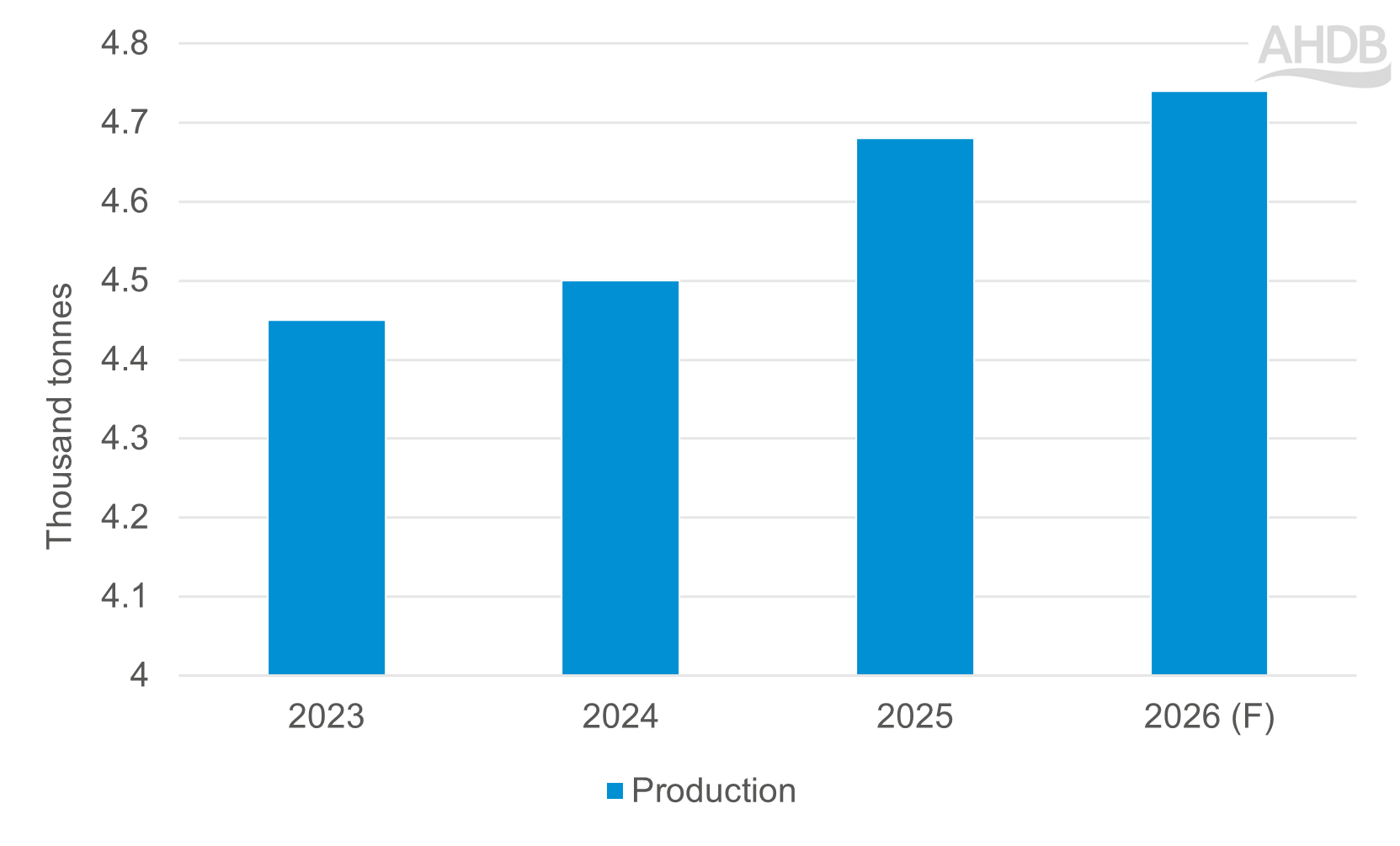
Brazilian pork production has shown consistent growth since 2022. According to data from the United States Department of Agriculture (USDA), production increased by 4% between 2024 and 2025. The USDA forecasts Brazilian pork output in 2026 at approximately 4.74 Mt, representing a year-on-year (YoY) increase of around 1%.
Brazil is currently the world’s fourth largest pork producer, behind China, the EU and the United States. Growth has been supported by firm demand, both domestically and internationally. Elevated beef prices have improved pork’s competitiveness in the domestic market, encouraging substitution.
Centre for Advanced Studies on Applied Economics (CEPA) projects feed costs are expected to rise in early 2026, driven by potential strength in global maize and soymeal markets.
However, larger crops and high inventories are likely to limit the scale and duration of any price increases. As a result, pork production is unlikely to see major contraction purely on feed cost grounds, though margins could tighten if pig prices also decline.
Figure 1. Annual Brazilian pork production volumes 2023–2026 (f)
Source: USDA
(F) = forecast
Figure 1 presents Brazilian pork production volumes between 2023 and the forecast for 2026, expressed in thousand tonnes. Production has increased each year across this period, with further growth anticipated in 2026.
Consumption
Brazilian pork consumption has trended upwards in recent years.
Brazilian association of animal protein (ABPA) data indicates that per capita pork consumption has increased steadily since 2019, driven in part by persistently high beef prices and consumer substitution towards cheaper proteins.
According to ABPA, per capita pork consumption is projected at 19.5 kg in 2026, an increase of 2.5% YoY.
USDA data shows pork continuing to rank as the third most consumed protein in Brazil, behind poultry and beef.
Poultry remains the preferred protein due to its lower price.
Trade
Brazilian pork exports reached record levels in 2025. Shipments increased by 13% (190,200 t) YoY, totalling 1.64 Mt. Since 2019, Brazilian pork exports have risen by 93%, highlighting Brazil’s growing global influence.
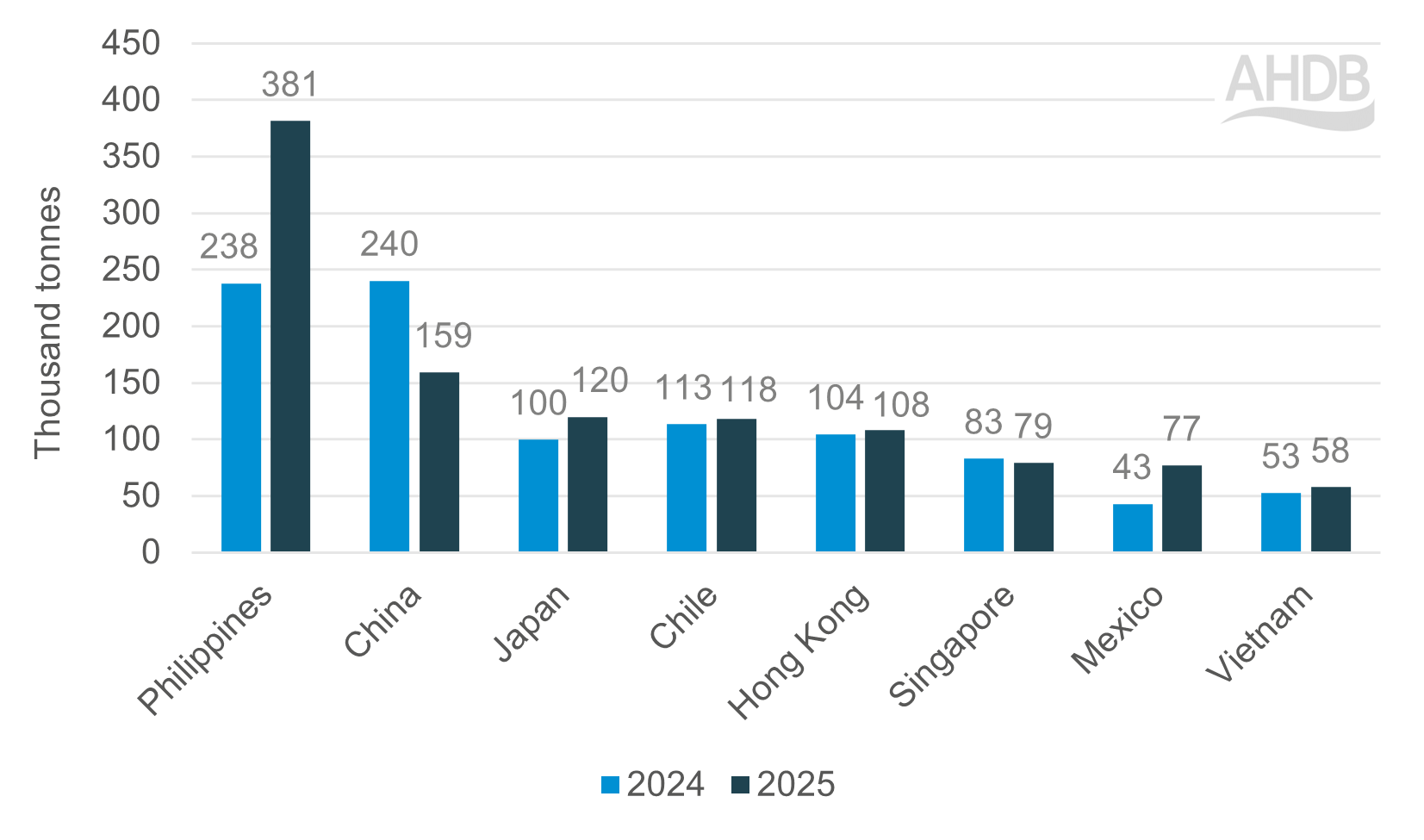
Lower production costs and competitive pricing in 2025 supported strong export demand. The Philippines was Brazil’s largest export destination, overtaking China in 2025. Shipments to the Philippines increased by 60% (143,200 t) YoY, driven by strong growth in both fresh/frozen pork and offal increasing by 56% and 100% respectively YoY.
Exports to China declined sharply, down 34% (81,000 t) YoY, reflecting weaker import demand amid the country’s self-sufficiency focus. This decline has been a key driver behind Brazil’s strategy to diversify its export destinations.
Shipments to Japan increased by 20% (20,100 t) YoY totalling 119,900t, supported by lower domestic supply. Exports to Mexico also rose strongly (+79% YoY), benefitting from Mexico’s duty-free import policy. However, for 2026, Mexico has applied temporary duty-free tariff rate quotas for beef and pork imports from countries without a free trade agreement.
This is most relevant for Brazil. The total TRQ of 51,000 t is below the volume Brazil shipped in 2025, with a tariff of 20% applying to any out-of-quota volume.
Overall, Brazil has actively reshaped its export plan to reduce reliance on a small number of key markets. ABPA has highlighted diversification as a strategy to reduce risk and expand export opportunities.
Early 2026 data suggest the diversification trend is continuing. Brazilian pork exports in January 2026 totalled 126,000 t, up 12% YoY.
The Philippines remained the largest destination, with volumes increasing 95% YoY to 35,600 t. Meanwhile, shipments to China fell 58% YoY to 8,400 t, ranking behind both Japan and Hong Kong.
While January data provides an early indication of market reorientation, it remains too early to draw firm conclusions regarding full year 2026 performance.
Trade policy developments, particularly in Mexico, and the pace of Chinese import demand recovery will be key for export direction in the coming months.
Figure 2. Brazil pig meat exports (including offal) between 2024 and 2025 (YTD Jan–Dec)
Source: Brazil Ministry of Development, Industry and Trade via Trade Data Monitor LLC
Figure 2 shows Brazilian pig meat exports (including offal) between the years 2024 and 2025, expressed in thousand tonnes.
The Philippines is now the largest export destination for Brazilian pig meat shipments.
Looking ahead
Brazil’s continued export expansion is likely to intensify competition in price-sensitive markets, particularly across Southeast Asia.
The redirection of product previously destined for China increases supply availability in alternative Asian destinations, potentially exerting downward pressure on regional prices.
For UK exporters, Brazil’s success highlights the importance of diversified market access and cost competitiveness.
As Brazil consolidates its presence in Southeast Asia and Latin America, competition for shared markets may increase, particularly for offal and secondary cuts.
Sign up for regular updates
Subscribe to receive pork market news straight to your inbox. Simply complete our online form.
While AHDB seeks to ensure that the information contained on this webpage is accurate at the time of publication, no warranty is given in respect of the information and data provided. You are responsible for how you use the information. To the maximum extent permitted by law, AHDB accepts no liability for loss, damage or injury howsoever caused or suffered (including that caused by negligence) directly or indirectly in relation to the information or data provided in this publication.
All intellectual property rights in the information and data on this webpage belong to or are licensed by AHDB. You are authorised to use such information for your internal business purposes only and you must not provide this information to any other third parties, including further publication of the information, or for commercial gain in any way whatsoever without the prior written permission of AHDB for each third party disclosure, publication or commercial arrangement. For more information, please see our Terms of Use and Privacy Notice or contact the Director of Corporate Affairs at info@ahdb.org.uk © Agriculture and Horticulture Development Board. All rights reserved.
Topics:
Sectors:
Tags: