What is El Niño, and what are the potential effects on the UK livestock markets?

Friday, 31 July 2026

El Niño is a periodic warming of the tropical Pacific Ocean that can have significant implications for agriculture worldwide. We explore how El Niño may affect meat and dairy production and what this could mean for UK farmers.

Key points

  • Many forecasts have a ‘Super El Niño’ on the horizon. El Niño events have previously been associated with a wetter, windier and milder start to winter in the UK, followed by a colder and calmer late winter period.
  • Agricultural production across the globe is affected by drought in some areas, and intense rainfall in others. This affects livestock production and cropping yields.
  • The impact of El Niño for UK farmers may be felt more strongly though changes to global agricultural commodity prices rather than direct weather patterns.

What is El Niño?

El Niño is a naturally occurring climate pattern that happens when sea surface temperatures in the central and eastern tropical Pacific Ocean become warmer than normal, while the trade winds that usually blow from east to west weaken. It is the warm phase of the El Niño–Southern Oscillation (ENSO) cycle. El Niño is declared when the sea surface temperature in the tropical Eastern Pacific rises 0.5 °C along the long-term average. A rise of 2°C creates a ‘Super El Niño’, which is what is forecast this year.

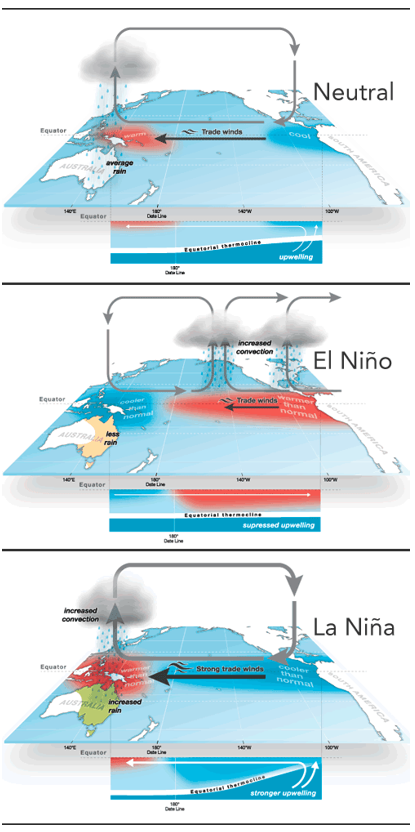
Under normal conditions, strong trade winds push the warm surface water towards Asia and Australia, and the cooler water upwells to rise near South America. During El Niño, the trade winds weaken causing the warm waters to spread easterly towards South America. This changes the ocean and atmospheric circulation patterns, which in turn alters the weather around the world.

Figure 1: Diagram of the effect of El Niño and La Nina

Diagram of the effect of El Niño and La Nina.

Source: Australian Bureau of Meteorology via IRL

What effects does it have on the climate?

El Niño can influence:

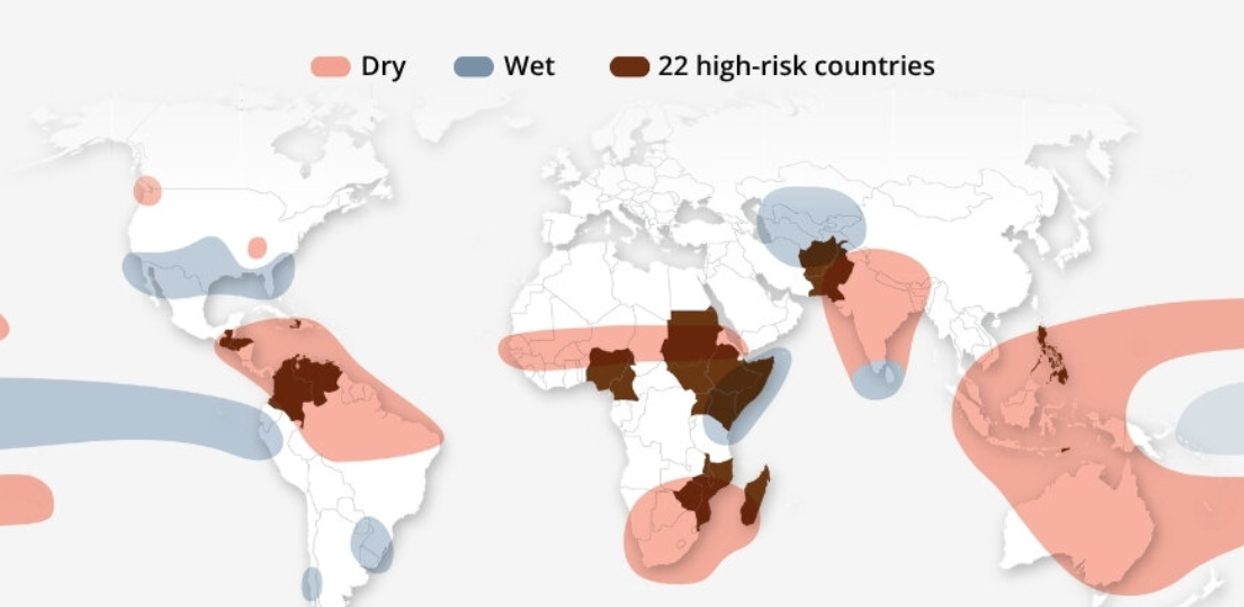
  • Rainfall patterns – causing floods in some regions and droughts in others.
  • Australia, Indonesia and parts of Southeast Asia often experience below-average rainfall and an increased risk of drought.
  • Parts of North and South America can see wetter-than-average conditions and flooding.
  • Temperatures – often raising global average temperatures.
  • Storm activity – changing hurricane and cyclone patterns.

Figure 2: Impact of El Niño rainfall around the world

Impact of El Niño on the world in terms of temperature and rain.

Source: UN WFP adapted from IRL, Columbia Climate School

As a result, El Niño can have significant implications for agriculture worldwide.

How El Niño affects UK weather

The impacts of El Niño on the UK are generally indirect and less predictable than in regions around the Pacific Ocean. However, El Niño can influence atmospheric circulation patterns that affect European weather.

Historically, El Niño has been associated with a wetter, windier and milder start to winter in the UK, followed by a colder and calmer late winter period. These effects often occur with a time lag and can vary considerably between events.

For example, the strong El Niño of 2015/16 coincided with one of the wettest and mildest UK winters on record. While El Niño was not solely responsible, it is thought to have contributed to conditions that strengthened the jet stream and increased the frequency of Atlantic weather systems reaching the UK.

Similarly, the flooding associated with Storm Babet in autumn 2023 occurred during a strong El Niño period. However, such events cannot be directly attributed to El Niño alone, as many other atmospheric factors influence UK weather.

For UK farmers, the most significant impacts of El Niño are often felt indirectly through changes in global agricultural production, feed availability and commodity prices.

Potential effect on global meat and dairy production

Drought risk

Strong El Niño conditions often bring prolonged dry weather, drought and an increased risk of wildfires to major livestock-producing regions such as Australia, parts of North America, Indonesia and Southeast Asia.

These conditions can affect livestock production in several ways:

  • Reduced pasture growth and lower forage availability.
  • Increased feed costs as farmers rely more heavily on supplementary feeding.
  • Greater heat stress in all livestock, reducing feed intake, productivity and fertility, and even causing mortality.
  • Increased risk of disease and malnutrition where feed and water supplies become limited.
  • Earlier slaughter of animals due to feed shortages.

When drought conditions persist, deteriorating pasture quality can lead producers to reduce herd or flock numbers. This often increases the number of animals sent to slaughter in the short term, temporarily boosting meat supplies and placing downward pressure on prices. However, the resulting reduction in breeding stock can lead to lower production and tighter supplies in subsequent years.

Heat stress can also reduce milk yields, lower conception rates and slow livestock growth rates, further affecting production.

Wet conditions and flooding

Meanwhile, El Niño events can bring exceptionally wet conditions to regions including parts of South America, the southern United States, East Africa and Central Asia. Excessive rainfall and flooding can create a different set of challenges for livestock producers, including:

  • Waterlogged grazing land and reduced forage quality.
  • Disruption to feed production and harvesting.
  • Increased prevalence of livestock diseases and parasites.
  • Displacement of animals during flood events.
  • Livestock losses resulting from severe flooding.

Both drought and flooding can therefore disrupt livestock production systems, affecting global meat and dairy supplies and, ultimately, influencing market prices.
El Niño and livestock prices

While El Niño can have wide-reaching impacts on global agricultural production systems, supply and demand are often the key drivers of more immediate changes in commodity prices.

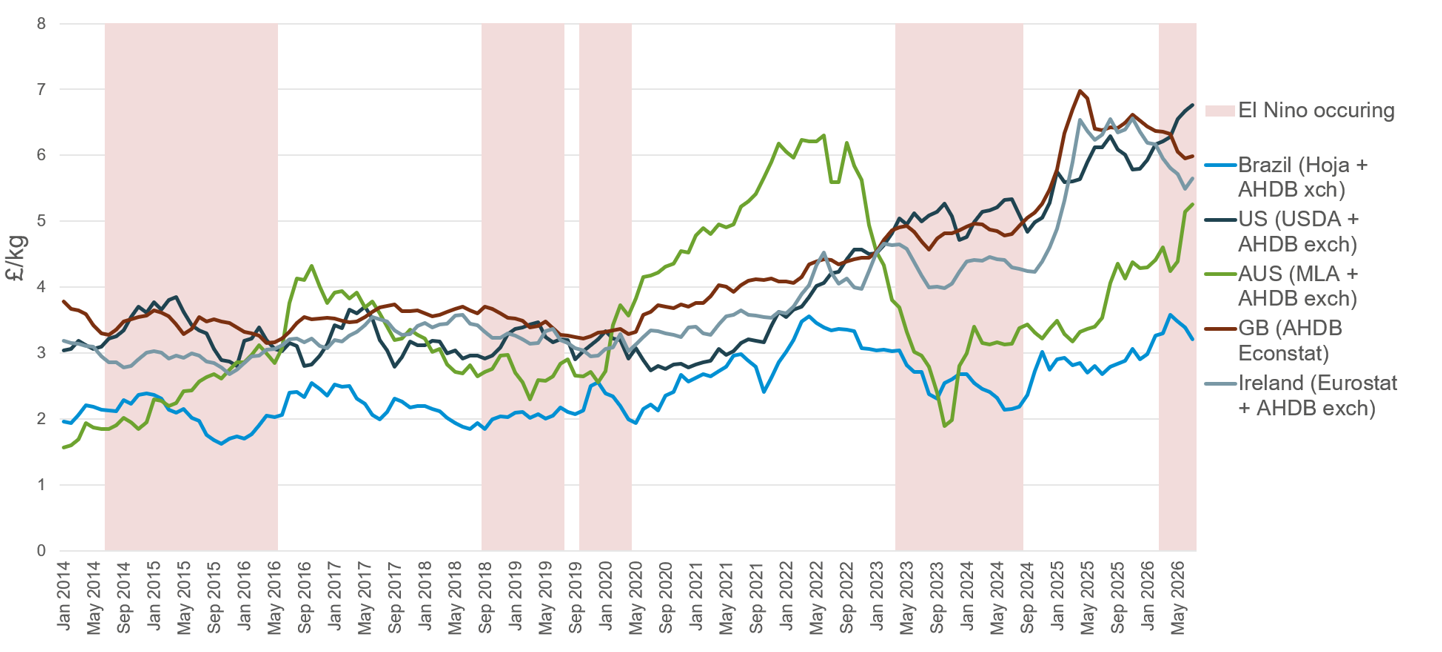
Figure 3 shows that there is no clear relationship between previous El Niño events and deadweight cattle prices around the world.

Figure 3: Global beef price with El Niño events overlapped

Figure 3 shows select deadweight cattle prices from key regions of the world, with past El Niños.

Source: prices collated by AHDB, Golden Gate Weather Services

Figure 3 shows select deadweight cattle prices from key regions of the world, with previous El Niño events overlaid. The chart covers January 2014 to July 2026.

Consider Australia as an example. Ahead of the last El Niño event in 2023/24, Australia was already facing severe drought and weak producer sentiment meant many were offloading cattle into the market. The announcement of a forecast El Niño event further weakened producer confidence.

Large national herd inventories facilitated widespread destocking and weather forecasts dampened buyer demand, leading to a historic drop in the beef price. Destocking of breeding stock later caused supplies to tighten, and stronger global export beef demand has helped prices to rise again.

Although El Niño is an indication that drought will occur in Australia’s cattle country, it is not a fact. On this occasion, the late spring rains for most of the country meant the event ended up being relatively mild.

Australia is currently not experiencing the same drought conditions, with good water resources available going into this El Niño period. If there is to be a destocking phase, it may be more likely to happen later into next year if water availability reduces.

Conclusion

While UK agriculture may not experience the most extreme weather impacts associated with El Niño, changes in global production can have important consequences for domestic markets. Changing output from major exporting regions can tighten global supplies and support prices, while shifts in feed, fertiliser and energy costs may also affect farm profitability. We will continue to monitor and analyse market developments as the climate shifts, as the indirect market impacts can often be more significant than the direct weather effects experienced at home.

Image of staff member Molly Corbett

Molly Corbett

Analyst (Livestock)

See full bio


Sign up for regular updates

You can subscribe to receive Beef and Lamb market news straight to your inbox. Simply fill in your contact details on our online form.

Visit the Keep in touch page

While AHDB seeks to ensure that the information contained on this webpage is accurate at the time of publication, no warranty is given in respect of the information and data provided. You are responsible for how you use the information. To the maximum extent permitted by law, AHDB accepts no liability for loss, damage or injury howsoever caused or suffered (including that caused by negligence) directly or indirectly in relation to the information or data provided in this publication.

All intellectual property rights in the information and data on this webpage belong to or are licensed by AHDB. You are authorised to use such information for your internal business purposes only and you must not provide this information to any other third parties, including further publication of the information, or for commercial gain in any way whatsoever without the prior written permission of AHDB for each third party disclosure, publication or commercial arrangement. For more information, please see our Terms of Use and Privacy Notice or contact the Director of Corporate Affairs at info@ahdb.org.uk  © Agriculture and Horticulture Development Board. All rights reserved. 

×