Why are finished cattle prices falling and will this continue? Beef market update

Friday, 29 May 2026

GB finished cattle prices have been steadily falling since the start of the year. We explore what’s driving the market and take a look ahead.

Key points

  • Finished cattle prices have come under sustained pressure, while firmer store and calf values are causing uncertainty for margins through the production chain.
  • Last year’s cattle price rises have gradually worked through to the consumer, which have contributed to weakened beef demand across retail and foodservice. There are however emerging signs that consumption is beginning to stabilise.
  • While cattle kill has been lower, heavier carcase weights have offset this, increasing overall beef supply and adding downward pressure to the market.
  • A shift towards more competitive non-EU imports is adding further pressure, while strong export demand is helping to support carcase balance but not fully offset domestic challenges.
  • Looking ahead, while cattle supply is expected to remain structurally tight, price direction will depend on how consumer confidence improves and how production adjusts through the year.

Where are we now?

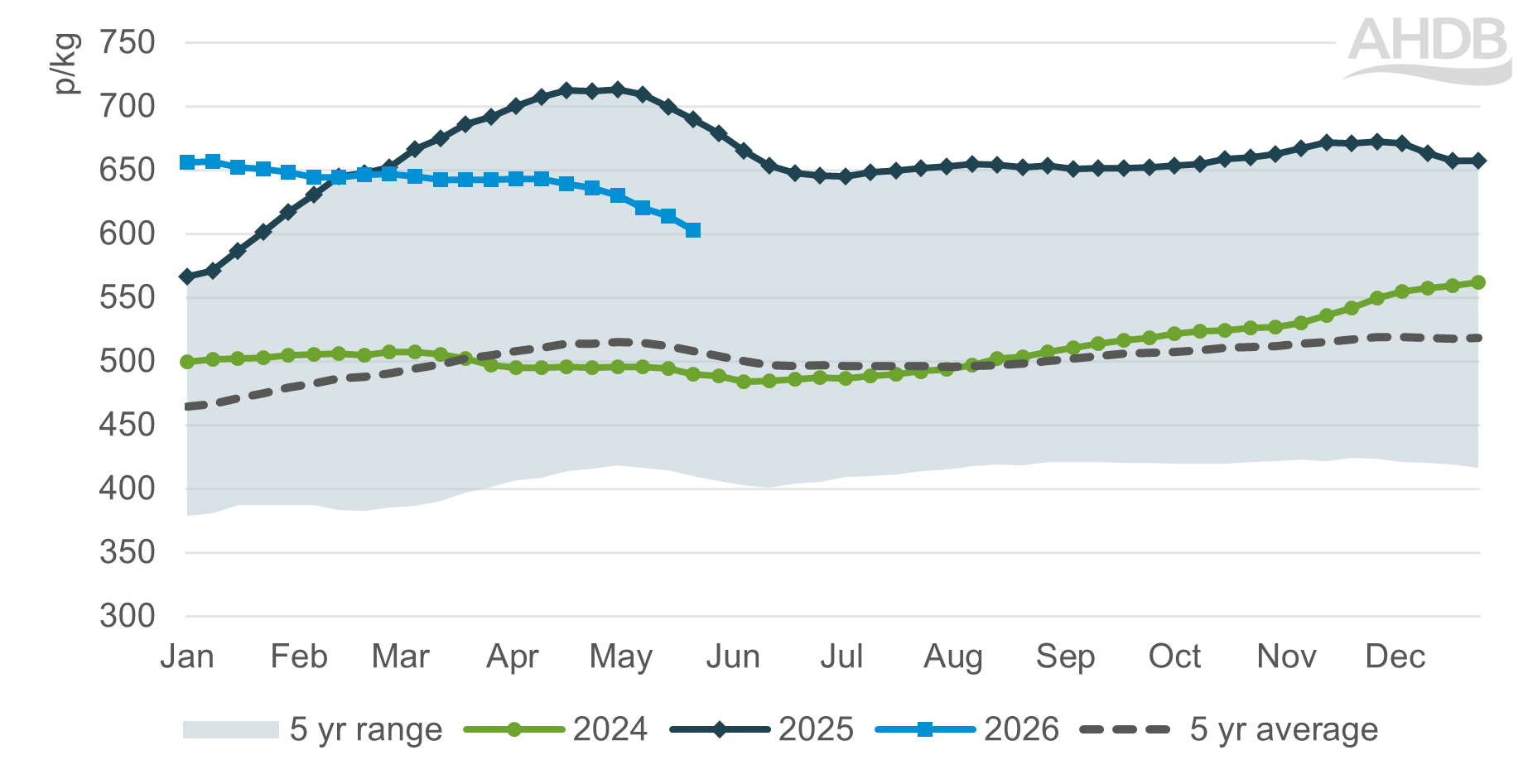
Finished cattle prices have been on a downward trajectory since the beginning of the year. The average GB deadweight R4L steer price averaged 603p/kg for the week ending 23 May, down 53p from the first week of January and down 87p on the same week a year ago.

Cull cow prices have been in a relatively stronger position compared to 2025 but have also experienced sharp downward movement recently. The overall GB overall deadweight cow price lost 48p in the six weeks to the week ending 23 May, averaging 482p/kg.

Figure 1: Weekly average deadweight R4L steer price in Great Britain, 2024 – 2026

Chart showing trends in weekly GB deadweight R4L steer prices

Source: AHDB

The line chart in Figure 1 shows weekly trends in the GB average deadweight R4L steer price for 2024 (light blue line), 2025 (dark blue line) and 2026 (green line). Comparisons are drawn to the five-year average (grey dashed line) and the five-year range (shaded area).

Indeed, while finished cattle prices fall, the rate of decline is not equal across the store market, and indeed average calf values have remained in annual growth1. This points to margin pressure across the finishing chain.

How did we get here?

Consumer demand weaker following price inflation

Domestic sales of beef have been particularly pressured of late, due in part to steep price rises experienced in the category across retail and foodservice. Consumers have managed their spend by switching to cheaper proteins, reducing the amount of beef they buy or leaving the category all together.

The average retail price across the whole beef category grew to a peak of £10.72/kg in the 12 weeks to 22 February, up 16% on the year. More recently, prices have steadied, averaging £10.50/kg in the 12 weeks to 17 May, but still up 12% year-on-year2.

The price increases follow steep rises seen in farmgate cattle prices in 2024 – 2025. It’s worth noting that when farmgate cattle prices were rising it took months for changes to make their way through to retail, pressuring supply chain margins.

Beef sales have suffered as a result of price rises - overall retail volumes were down around 7-8% year-on-year in late 2025. In the foodservice sector, beef has also lost share on menus due to price growth3.

Volume declines are evident across most cuts in retail compared to a year ago, particularly in mince, steaks and burgers. However, overall value losses have been the steepest for more expensive cuts, such as steaks. This has a disproportionate impact on the value of a carcase.

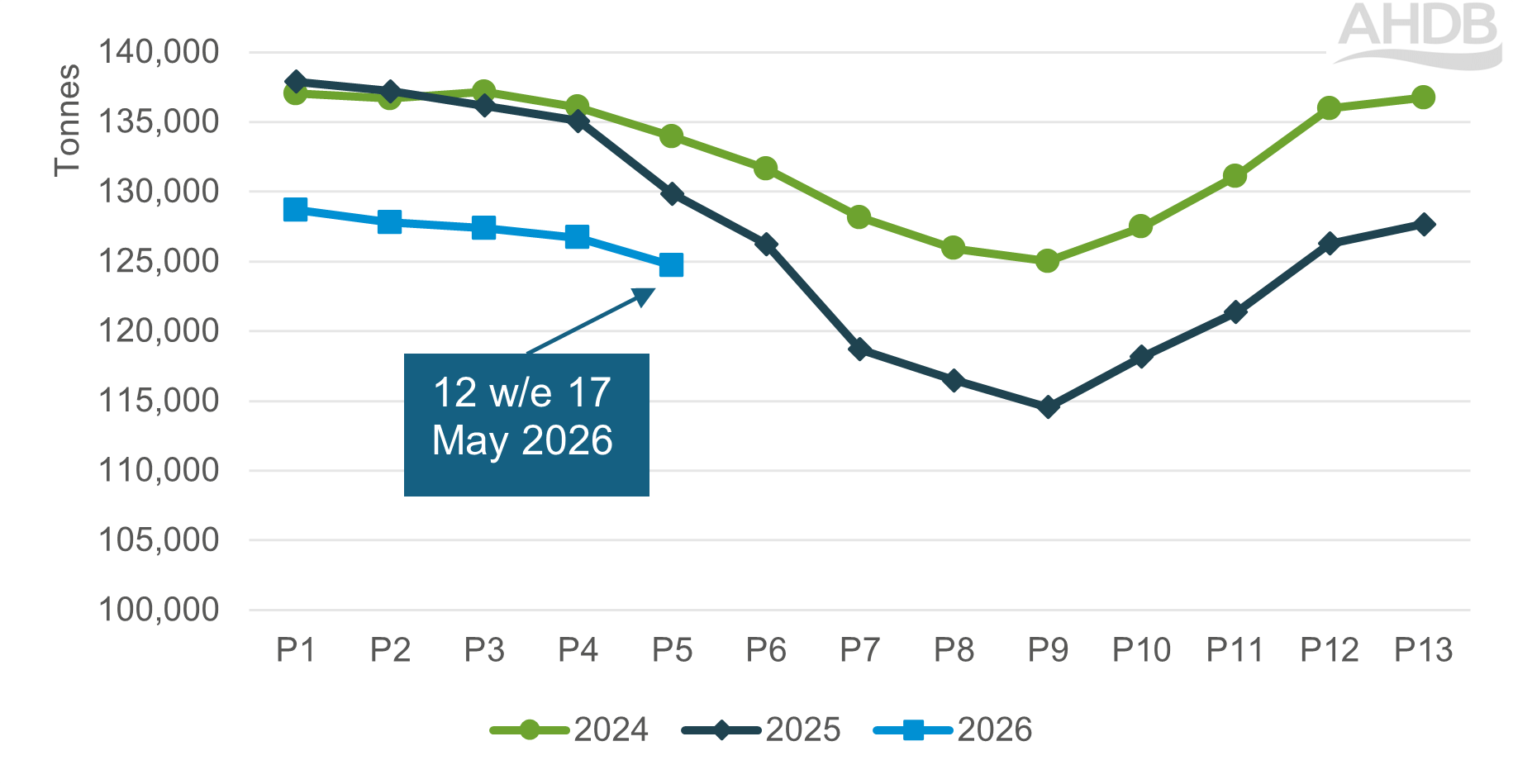
Figure 2: Total volume of beef (tonnes) sold in GB retail between 2024 and 2026, rolling 12-week totals

Chart showing trends in beef retail volume sales in Great Britain between 2024 and 2026

Source: Worldpanel by Numerator UK, 12 w/e 28 January 2024 to 17 May 2026

The line chart in Figure 2 shows rolling 12-week totals for beef retail sales in GB. 2026 is shown in light blue, 2025 in dark blue, and 2024 in green. The volumes cover all cuts within the beef category.

While consumer beef price inflation remains elevated, the rate at which prices are rising across the category has eased in recent months4. This means price changes may not be as noticeable to consumers, which may help future demand.

Indeed, Figure 2 shows that retail volume declines are softer than they were at the same point a year ago, and more in-line with typical trends. This suggests a settling in demand as shoppers adjust to a new price level. The current hot weather and sporting events in the summer are expected to boost demand. Of course, cost-of-living pressures remain a key risk.

More beef on the market

While the number of cattle slaughtered in the UK remains lower than last year, heavier carcase weights have facilitated greater beef production.

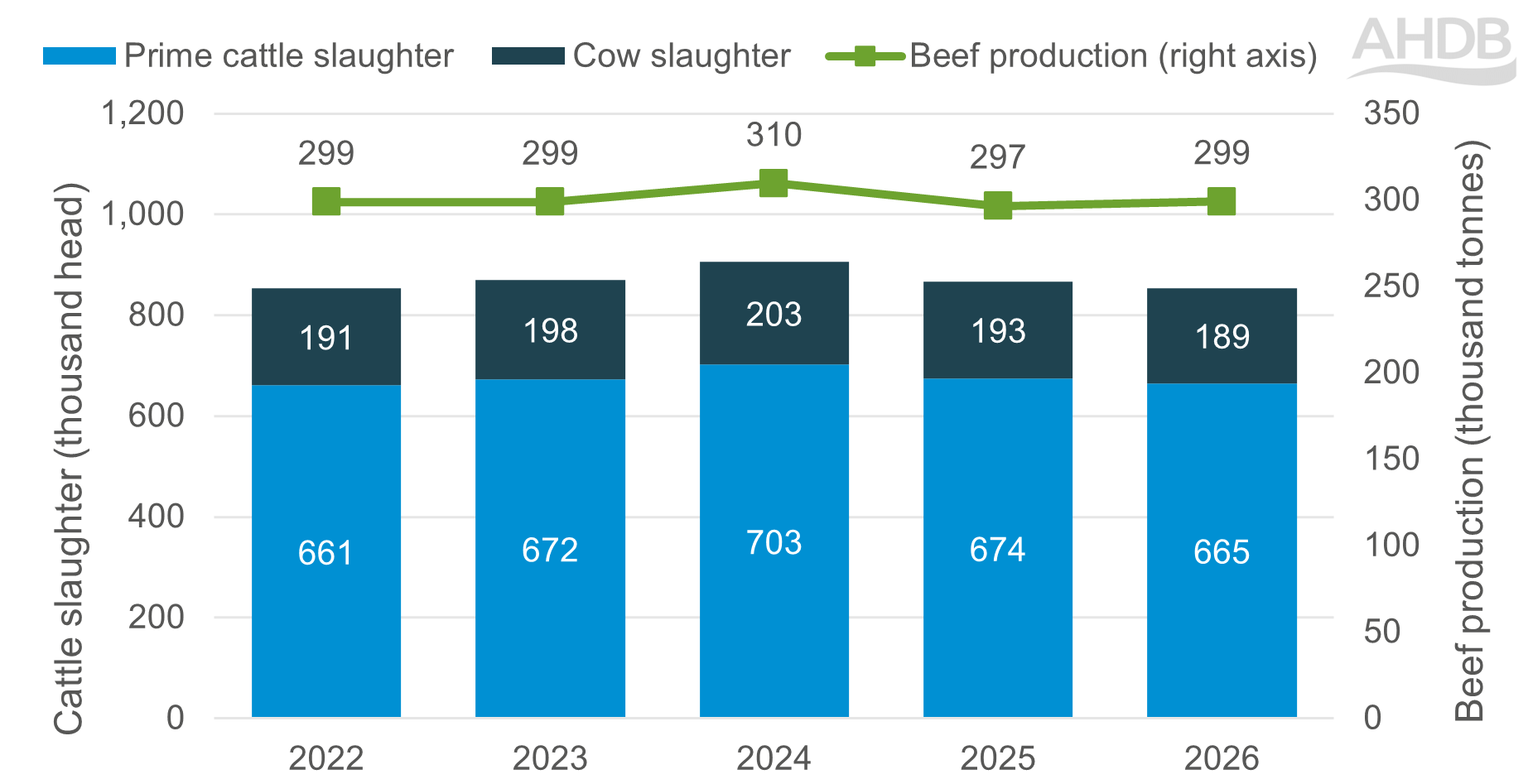
For the first four months of 2026, Defra figures showed that total cattle and calf slaughter reached 885,000 head, down 16,000 head (-1.8%) compared to the same period in 2025.

However, prime cattle carcase weights were on average 10kg (2.9%) heavier than a year ago. Average cow weights were also up (+1.9kg). This is corroborated by trends in our deadweight price reporting sample and likely reflects a range of drivers including lower feed costs, higher supplementation due to poorer forage production in 2025, and producer marketing decisions.

UK beef production has therefore grown by 0.9% year-on-year to 299,000 tonnes for the period.

Figure 3: UK cattle slaughter and beef production between 2022-2026 for the year-to-date (Jan-Apr)

Chart showing UK beef production trends for the year-to-date (Jan-Apr) between 2022 and 2026

Source: Defra

Figure 3 shows trends over time in UK beef production between 2022 and 2026 for the year-to-date period up to April of each year. Prime cattle slaughter is shown in the light blue bar, cow slaughter in dark blue, and beef production is shown by the green line, referencing the right-hand axis.

Import sources changing, while export volumes are strong

During this time, the UK’s international beef trade picture has continued to shift.

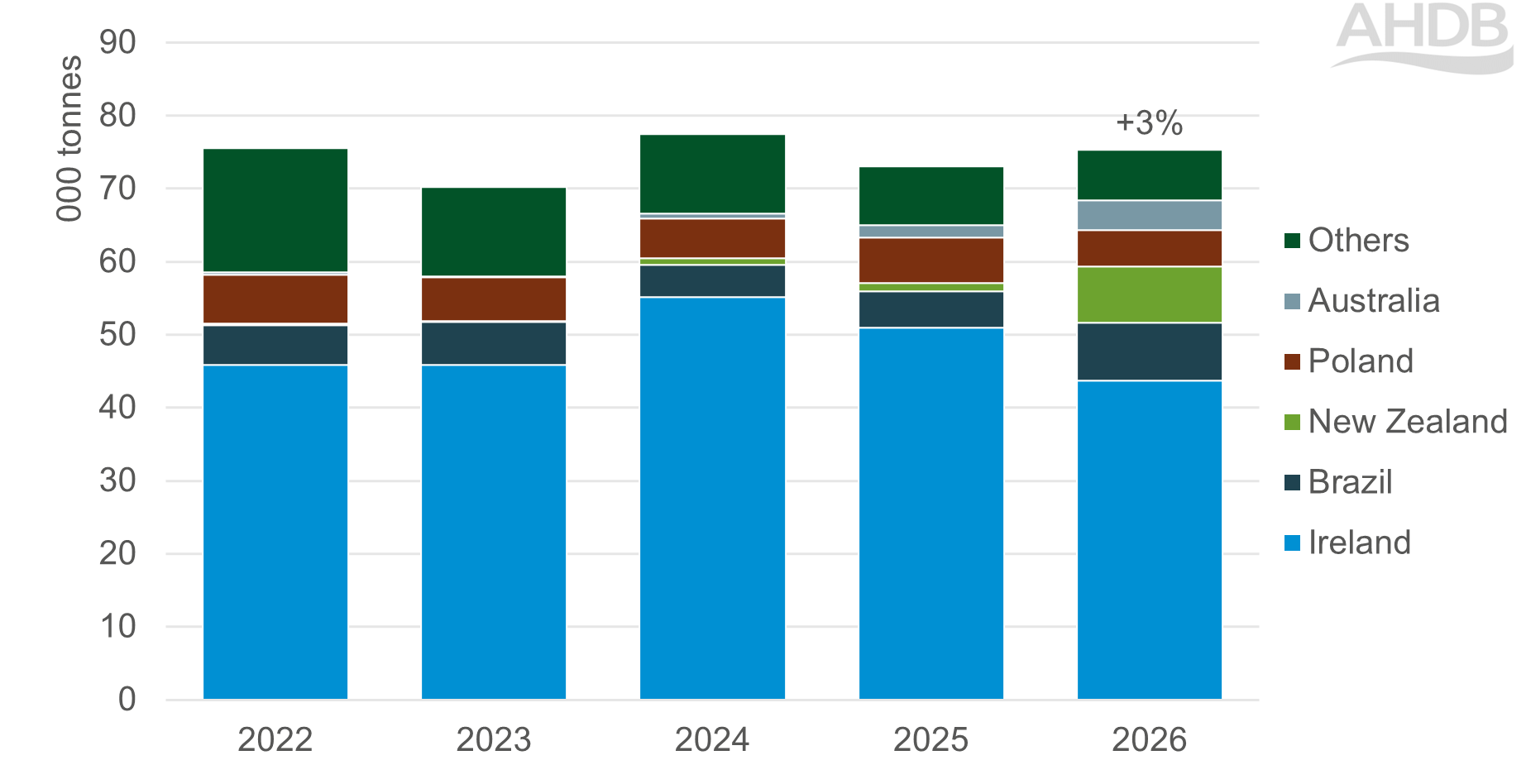
The total amount of beef imported so far this year (Q1) has grown slightly (+3% vs 2025), but the supplier base is shifting considerably5.

Most imported beef continues to come from Ireland and the EU, but the proportion of imports from non-EU suppliers is growing. Non-EU suppliers made up 28% of tonnage imported in Q1, compared with 10-12% for the same period over the previous three years. Currently leading the growth is New Zealand, followed by Brazil and Australia. Ireland’s beef production is down notably, limiting availability.

Figure 4: UK beef import volumes (tonnes) between 2022 and 2026 for the year-to-date (Q1 Jan-Mar) by supplier country

 Chart showing UK beef import volumes for the year-to-date Jan-Mar between 2022 and 2026

Source: HMRC via TDM LLC. Data includes fresh, frozen, processed and offal.

The stacked bar chart in Figure 4 shows trends in UK beef imports (tonnes) between 2022 and 2026 for Q1 each year, by supplier country. Ireland is in light blue, Brazil in dark blue, New Zealand in light green, Poland in brown, Australia in grey and a sum of other countries in dark green.

These imports are price-competitive into the UK market, primarily destined for foodservice. Most of the imported volume from these countries is fresh and frozen boneless product, with market reports suggesting higher-value steaking items. Indeed, much Brazilian product is corned beef sold via retail, while Australian steaks have a modest retail presence.

Meanwhile, UK beef export volumes have had a strong start to the year, growing 15% year-on-year for the first quarter. Growth has been particularly strong for product into Ireland and the wider EU.

While the UK remains a net importer of beef (import greater than export), exports remain crucial to balancing the value of cuts from each carcase.

What’s the outlook?

Consumer demand remains a central driver. Beef sales look to be steadying and moving more closely with typical trends but volumes remain lower than a year ago. If present trends continue, volumes may begin to line up with 2025 levels later in the year. However, consumer spending remains sensitive to wider economic pressures, and present cost-of-living drivers remain a key risk to consumer behaviour. The pace at which cattle price falls feed through the chain will also impact demand.

Cattle supply remains structurally lower, but weights are slow to adjust. Cattle population figures underpin our expectation for a 1% reduction in prime cattle slaughter in 2026 versus 2025, following reductions in the national breeding herd. However, weights have been above expectations, meaning slightly more beef on the market for the short-term. How this develops will depend on producer marketing decisions and feed availability through the rest of the year.

1 Based on data from Livestock Auctioneer’s Association Ltd.

2 Worldpanel by Numerator UK

3 Worldpanel by Numerator (AHDB OOH estimates)

4 ONS CPI beef inflation figures, April 2026

5 Trade figures shown include fresh and frozen beef, processed beef and offal


Sign up for regular updates

You can subscribe to receive Beef and Lamb market news straight to your inbox. Simply fill in your contact details on our online form.

Visit the Keep in touch page

While AHDB seeks to ensure that the information contained on this webpage is accurate at the time of publication, no warranty is given in respect of the information and data provided. You are responsible for how you use the information. To the maximum extent permitted by law, AHDB accepts no liability for loss, damage or injury howsoever caused or suffered (including that caused by negligence) directly or indirectly in relation to the information or data provided in this publication.

All intellectual property rights in the information and data on this webpage belong to or are licensed by AHDB. You are authorised to use such information for your internal business purposes only and you must not provide this information to any other third parties, including further publication of the information, or for commercial gain in any way whatsoever without the prior written permission of AHDB for each third party disclosure, publication or commercial arrangement. For more information, please see our Terms of Use and Privacy Notice or contact the Director of Corporate Affairs at info@ahdb.org.uk  © Agriculture and Horticulture Development Board. All rights reserved. 

×