UK pork outlook 2026: June production update

Monday, 22 June 2026

Key Points

  • UK pig meat production in Q1 2026 exceeded expectations, increasing 5.3% year on year, driven by higher clean pig slaughter numbers and heavier carcase weights
  • Full year 2026 production is now forecast at 1.03 million tonnes, up 5% on 2025
  • Full year 2026 clean pig slaughter is now forecast at approximately 10.77 million head, up 3.3% year on year
  • Producer margins remain under pressure due to weaker pig prices
Image of staff member Adam Chowdry

Adam Chowdry

Analyst (Livestock)

See full bio

Overview

When we published our original 2026 outlook in February, we were forecasting a marginal decline in pig meat production across the year. The expectation was for clean pig slaughter to ease back, partly offset by a continued rise in carcase weights, all set against a gradually shrinking breeding herd.

The first quarter has told a different story. Rather than the backlog of pigs unwinding early in the year as anticipated, supply has stayed elevated. A weaker market has kept more pigs moving through the system, and they have come forward at heavier weights. As a result, both slaughter throughput and average carcase weights have remained stronger than anticipated. This has prompted us to revise our forecast.

The UK pig industry has also faced a challenging market environment. GB pig prices have remained under pressure, continuing the downward trend seen towards the end of 2025. The EU-spec SPP stood at 177.98p/kg in the week ending 13 June, reflecting the impact of ample supplies and subdued demand. While the SPP provides a useful benchmark, it is an average measure and masks the currently wide spread of prices being paid for standard pigs across the UK.

At the same time, estimated cost of production figures fell during the first quarter of 2026, resulting in negative net margins for producers. Producer profitability therefore continues to face considerable pressure.

Looking ahead, consumer demand, feed costs and developments in global trade will remain important influences on producer confidence and production decisions. Equally, the pace and scale of any adjustment in pig supplies will be critical in determining market performance through the remainder of the year.

Supply

According to the latest Defra slaughter statistics, UK pig meat production reached 257,000 tonnes during the first quarter of 2026 (January to March), an increase of 5.3% year on year. This is some way ahead of our original forecast of 239,000 tonnes, which had implied a 2% decline.

Two factors lie behind the increase. Clean pig slaughter rose 2.3% YoY to 2.64 million head, while average clean carcase weights climbed to 94.2 kg, around 2.8 kg heavier than the same period of 2025. The combination of higher throughput and heavier carcases suggests that the expected backlog of pigs has taken longer to clear than anticipated, with weaker demand limiting the pull through of pigs across the supply chain.

Incorporating these actuals, alongside monthly data through to May, we have revised our forecast for the full year. We now expect 2026 pig meat production to reach approximately 1.03 million tonnes, an increase of 5% on the 978,000 tonnes produced in 2025.

Figure 1. Actual and forecast UK pig meat production

Source: Defra actuals, AHDB forecasts

Figure 1 shows pig production. Actual data for full-year 2025 and Q1 2026 is shown in light blue; forecast figures from Q2 2026 to Q4 2027 are shown in dark blue.

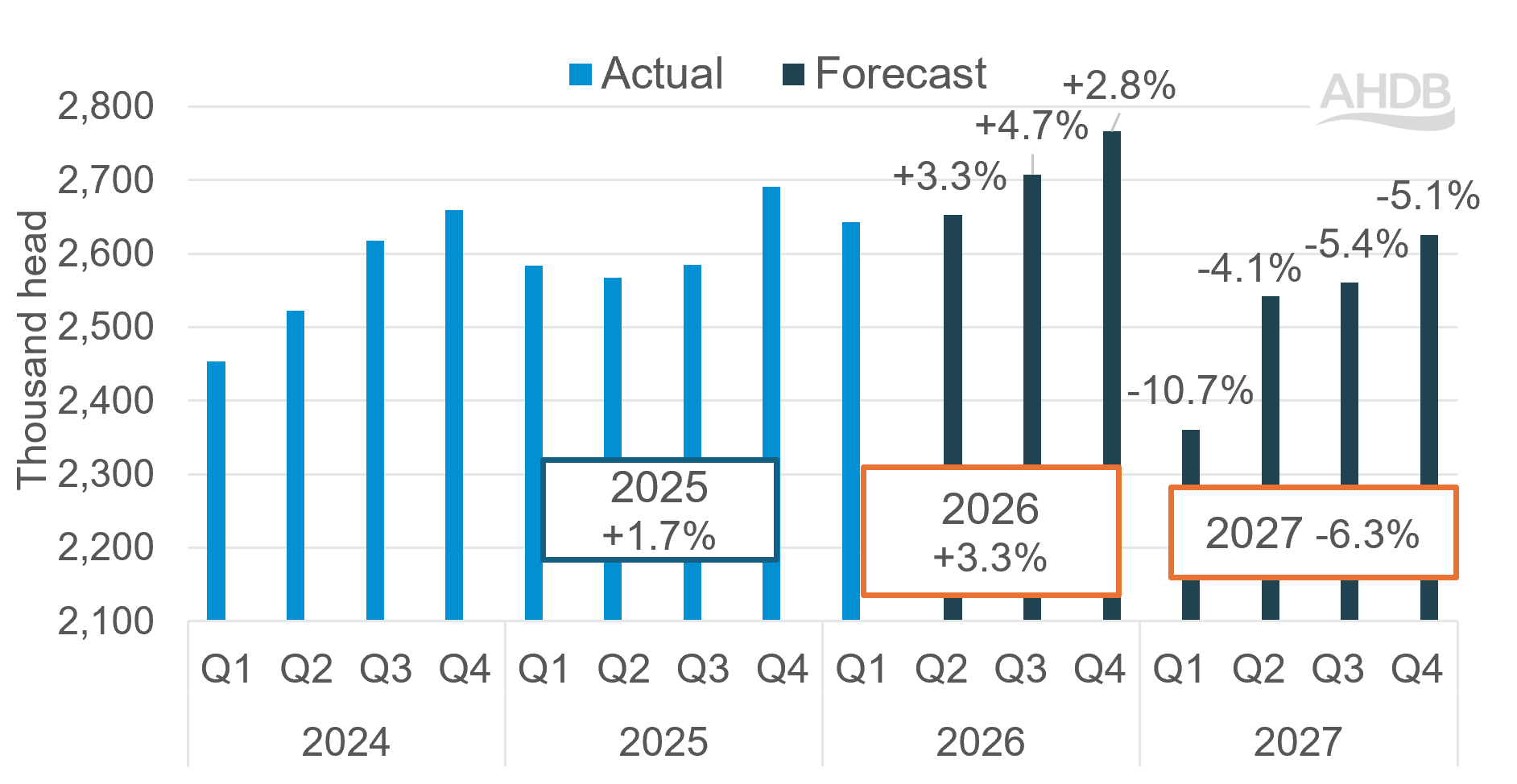
For the full year, clean pig slaughter is now forecast at approximately 10.77 million head, up 3.3% YoY. Carcase weights are expected to average around 92.3kg, approximately 1.5kg higher than the 2025 average.

Figure 2. Actual and forecast UK clean pig throughputs

Source: Defra actuals, AHDB forecasts

Figure 2 shows UK clean pig throughputs. Actual data for full-year 2025 and Q1 2026 is shown in light blue; forecast figures from Q2 2026 to Q4 2027 are shown in dark blue.

Looking beyond the current year, the elevated production seen in 2026 is not expected to be sustained. As the remaining backlog clears and the underlying contraction in the breeding herd reasserts itself, both throughput and carcase weights are expected to ease through 2027. On current assumptions, full-year 2027 pig meat production is forecast to fall to 952,400 tonnes, a decline of 7.2% on 2026 that would return output to broadly 2024 levels, with clean pig slaughter easing to around 10.1 million head down 6.3% year on year. The pace of this adjustment remains uncertain, and will depend on how the breeding herd, producer margins and wider demand evolve over the coming months.

The extent of the current production overshoot also raises questions about the underlying supply base. Our previous forecast assumed that the breeding herd would continue its gradual decline, with productivity improvements partly offsetting lower sow numbers. However, the strength of slaughter throughput observed so far in 2026 suggests either that there are more breeding sows in the system than current census data indicate, or that productivity per sow has improved beyond expectations.

At present, slaughter data alone cannot distinguish between these explanations. The implications for future supply differ significantly. A larger breeding herd would support elevated production levels for a longer period, whereas stronger productivity growth would imply that output gains are being generated from a herd that continues to contract.

We will continue to monitor incoming data closely and refine our forecasts as the underlying supply picture becomes clearer.

Sign up for regular updates

Subscribe to receive pork market news straight to your inbox. Simply complete our online form.

Visit the Keep in touch page

While AHDB seeks to ensure that the information contained on this webpage is accurate at the time of publication, no warranty is given in respect of the information and data provided. You are responsible for how you use the information. To the maximum extent permitted by law, AHDB accepts no liability for loss, damage or injury howsoever caused or suffered (including that caused by negligence) directly or indirectly in relation to the information or data provided in this publication.

All intellectual property rights in the information and data on this webpage belong to or are licensed by AHDB. You are authorised to use such information for your internal business purposes only and you must not provide this information to any other third parties, including further publication of the information, or for commercial gain in any way whatsoever without the prior written permission of AHDB for each third party disclosure, publication or commercial arrangement. For more information, please see our Terms of Use and Privacy Notice or contact the Director of Corporate Affairs at info@ahdb.org.uk  © Agriculture and Horticulture Development Board. All rights reserved. 

×