Middle East escalation and potential implications for nitrogen and farm costs

Wednesday, 4 March 2026

Since publishing our latest nitrogen fertiliser market outlook, geopolitical tensions in the Middle East have intensified. While there has been no confirmed physical disruption to fertiliser supply into the UK, risk premiums have increased across gas, oil and freight markets which could impact input costs for farmers.

Key points

  • The UK is dependent on the Middle East for key input imports, especially fertiliser and oil, and is a key shipping route for certain goods
  • There are risks that input costs could increase, ultimately impacting business margins
  • Outward opportunities may arise through export competitiveness if sterling weakens or global protein markets tighten, but these are uncertain and exposed to freight risks
  • The longer the disruptions continue the more likely it is that the impact will intensify, with potential of tightened supply due to reduced production, disrupted supply chains and increasing raw material costs impacting prices

What has changed

  • As of 3 March 2026, brent crude oil is hovering around the $85 a barrel mark, the highest price in over a year and up around 16% since Friday
  • Gas prices are up 46% and European gas markets remain sensitive to escalation risk. QatarEnergy, which has the world biggest liquified natural gas (LNG) plant, has halted production of LNG
  • Freight and shipping risks have increased. Around 20% of the world's gas and oil is shipped south of Iran and is also a key route for urea trade. While no sustained closure of key routes has occurred, insurance and freight costs remain exposed to escalation in the region
  • Volatility in supply of oil, gas and urea across the Middle East region will tighten global supply and impact prices. Production of urea and gas has slowed or stopped in several regions due to increasing risks
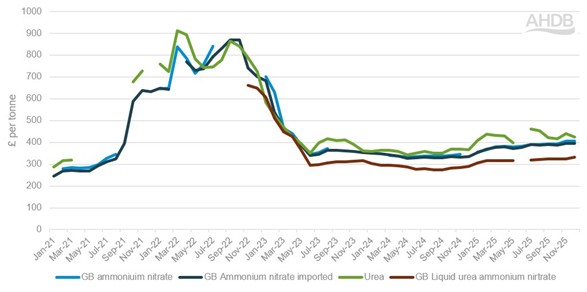
  • Market sentiment has shifted. There is understandable nervousness in the farming community given the experience of 2022, particularly where margins are currently tight. Figure 1 shows that although fertiliser prices were already increasing during 2021, there was a sudden rise in prices at the time of the Russian invasion in Ukraine. Depending on how long the disruptions continue will determine the impact on input costs.

Figure 1. GB fertiliser prices

Source: AHDB

In figure 1 the blue line indicates GB ammonium nitrate prices, the dark blue line GB ammonium nitrate imported, the green line urea, and the the brown line GB liquid urea ammonium nitrate.

Main points that could impact UK agriculture

  • Gas prices are linked to fertiliser prices and impact energy costs
  • Oil prices impacts diesel, plastics (e.g. bale wrap), agrochemicals and transport
  • Freight disruption will impact supply chains for fertiliser, oil, feed and export competitiveness
  • Currency impacts imported inputs vs export returns

Impacts

A likely scenario is continued geopolitical tensions without sustained physical disruption to energy or fertiliser supply.

In this scenario oil and gas prices will be volatile but available, fertiliser prices will fluctuate within an elevated range, freight costs will be higher than pre-crisis norms and sterling will remain sensitive to global risk sentiment.

For the British farming industry this will mean uncertainty around input costs such as fertiliser, feed and energy which will impact margins if farmgate prices are not adjusted.

A high-impact scenario would involve direct regional escalation leading to sustained disruption of gas flows or closure of key shipping routes such as the Strait of Hormuz or Red Sea corridor.

A sharp gas price spike would feed directly into nitrogen fertiliser production costs, potentially recreating rapid price escalation similar to 2022 caused by the fallout from Russia’s invasion of Ukraine.

Simultaneously, oil price surges could lift diesel, plastics and logistics costs, while freight bottlenecks constrain feed and input availability.

In this environment, UK agriculture would face simultaneous cost inflation, cash pressure and limited ability to pass costs through to consumers, creating acute margin stress across fertiliser-dependent cropping systems and feed-intensive livestock sectors in particular.

As of 3 March 2026 there have not been any confirmed supply shocks that are impacting UK availability of fertiliser.

However, fertiliser prices are linked to gas prices so there will be a probable impact on prices if volatility continues. At this stage, the issue is primarily one of volatility and forward risk, rather than immediate disruption.

Sector-specific impacts

Cereals & Oilseeds

  • Fertiliser is the largest variable costs for crop production. Nitrogen fertiliser prices are closely linked to gas prices, a likely uplift in price could inflate costs. If fertiliser prices were to rise sharply, it is likely application rates could decrease as a result, potentially impacting yields
  • Crude oil prices and vegetable oils/oilseeds are linked mainly through biofuels and production costs: when crude rises, biodiesel made from vegetable oils becomes more competitive, boosting demand for oils such as palm, soy and rapeseed and pulling up their prices; higher energy prices also raise farming, processing and freight costs, which can further support oilseed and veg oil values, while the reverse tends to happen when crude falls
  • Diesel, drying and agrochemicals are also oil-linked, meaning volatility in crude markets can feed directly into operating costs
  • Where uncertainty persists, some businesses may consider forward purchasing, increasing short-term working capital requirements
  • On the revenue side, geopolitical risk can support global grain prices, potentially offsetting some input inflation

Dairy

  • Grass-based dairy systems remain exposed to nitrogen volatility, while electricity, refrigeration and fuel costs are sensitive to energy markets
  • Purchased feed exposure adds further risk where forage substitution is limited. With milk prices currently providing a narrower margin buffer, cost shocks would transmit more quickly to profitability
  • Indirectly, volatility in global dairy trade, particularly powder markets serving the Middle East and North Africa (MENA), could influence export demand
  • Currency movements may improve competitiveness but raise imported feed costs
  • Strengthening margin over purchased feed, improving slurry utilisation and maximising forage performance remain key resilience levers

Beef & Lamb

  • Grass-based beef and lamb systems have moderate fertiliser exposure, although finishing systems are sensitive to cereal price movements
  • Direct energy exposure is generally lower than in dairy or pork, but feed-linked costs remain relevant
  • Export markets in parts of MENA are important for sheep meat flows, and geopolitical instability can affect demand patterns
  • Domestic consumer income pressure may also weigh on premium cut demand
  • Improving grass utilisation and scenario-testing finishing margins under varying feed costs can help manage risk.

Pork

  • Pork production is highly feed-intensive, making it the most sensitive of the sectors to grain and soya volatility
  • Indoor systems are also exposed to energy costs across housing and processing
  • Any feed cost escalation would quickly affect margins if pig prices do not adjust in parallel
  • Export competitiveness is influenced by currency movements and freight rates, particularly for trade beyond the EU
  • Close management of feed procurement, contract positions and working capital remains critical under volatile conditions

What can farmers do about these changes?

Further information

See our 2026 Agri Market Outlooks for sector and farm inputs

Image of staff member Jess Corsair

Jess Corsair

Senior Economist

See full bio

×