Outdoor-bred pig meat: Well positioned for future growth

Tuesday, 1 September 2026

Outdoor-bred (ODB) pig meat is an important part of the pig meat category.

In 2025, AHDB analysis of the ODB market focused on primary pork, sausages, bacon, gammon, ham and added value products. A comparison to this analysis shows that ODB products are growing in appeal for consumers, with the share of volumes purchased in retail increasing by 4% year on year. ¹

In this time, we have seen retailers expanding their ODB offerings to respond to increased consumer demand. Therefore, this year we expanded the definition used to represent the market better.

For this analysis, ODB includes outdoor-bred, outdoor-reared, free-range and organic pig meat products. These systems all involve pigs being born outdoors.

The updated definition also extends the standard Worldpanel by Numerator ODB definition through a review of retailer sourcing statements and on-pack information, enabling a robust identification of products that meet the ODB criteria across wider pig meat categories.²

Key points

  • Nearly two-thirds of households buy outdoor-bred pig meat (ODB), showing it has become a popular choice for many shoppers
  • Many consumers see outdoor-bred and outdoor-reared production as signs of quality, alongside British farming and good animal welfare
  • ODB products sell for a higher average price than pig meat overall, showing that many shoppers are willing to pay more for these products
  • Sausages are the biggest ODB product, but there is still plenty of opportunity to grow sales across other pork products

Quality credentials drive consumer appeal

Although ODB remains a smaller part of the pig meat market, it has become a mainstream choice for shoppers. In the last year, it attracted 18.3 million shoppers and accounted for almost 12% of total pig meat volumes.³

Nearly two-thirds of households buy ODB products, giving the category a reach similar to lamb.³

Consumers also see outdoor production as a sign of quality. Around three in ten shoppers say outdoor-bred and outdoor-reared production are important when buying premium pig meat.4 These factors sit alongside British provenance, animal welfare and meat appearance as key purchase drivers.

Table 1: Factors considered when purchasing premium pig meat4

Factors considered when purchasing premium pig meat

Consumers who claim importance

British

36%

Animal welfare assured

32%

Amount of fat

30%

Free range

30%

Colour of the meat

29%

Farm assured (e.g. Red Tractor, RSPCA assured)

28%

Outdoor bred

27%

Outdoor reared

27%

The results show that shoppers recognise and value outdoor production methods, giving the category a strong base for future growth.

ODB achieves a higher price

Consumers see ODB pig meat as a higher-quality choice, which helps the category command a higher price. On average, ODB products sell for £11.18/kg,³ compared with £7.43/kg³ for pig meat overall.

Table 2: Average price per kg for red meat, fish and chicken³

Protein

Average £/kg

Total fish

£12.73

Total lamb

£11.74

ODB pig meat

£11.18

Total beef

£10.53

Total pig meat excluding ready meals

£7.43

Total chicken

£6.46

Even so, a quarter of consumers say they always buy, or try to buy, ODB products, while only 13% think they are too expensive.4

Price remains important for many shoppers, but ODB's success shows that many people are willing to pay more when they believe a product offers better quality, animal welfare or production standards.

Everyday favourites lead the way for ODB

Much of ODB's success comes from processed pork products, which make up most of the category's sales volume.

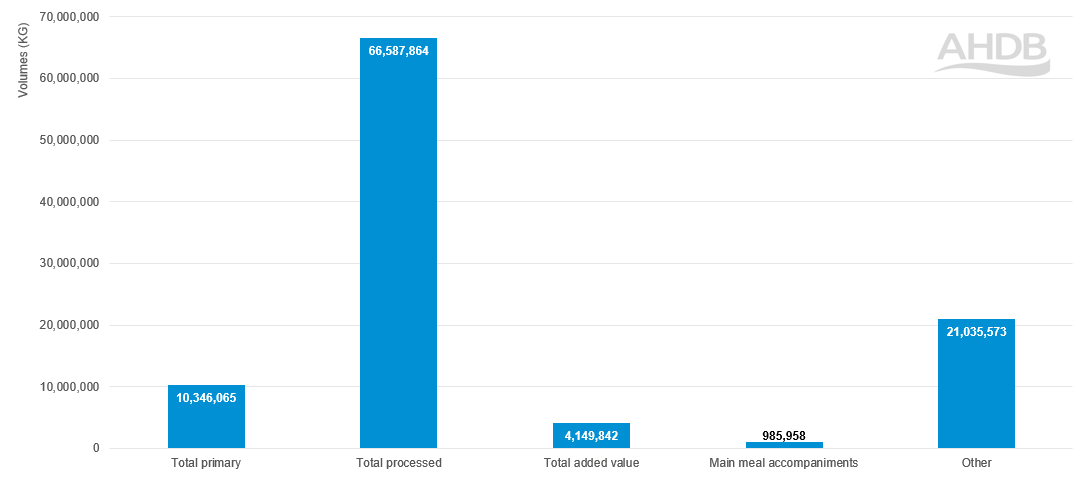
Figure 1: Volumes of ODB by category³

Processed is the largest category of ODB, followed by other, primary, then added value

Figure 1 shows processed products account for the largest share of ODB sales at 66.6 million kg, considerably higher than any other category. The Other category is the second largest at 21.0 million kg, followed by Primary products at 10.3 million kg. Added value products account for 4.1 million kg, while Main meal accompaniments represent the smallest volume at 1.0 million kg.

Within this, sausages have the most success, accounting for 35% of total ODB sales volume.³ They are a familiar product that many shoppers already buy, making them an important gateway into the category.

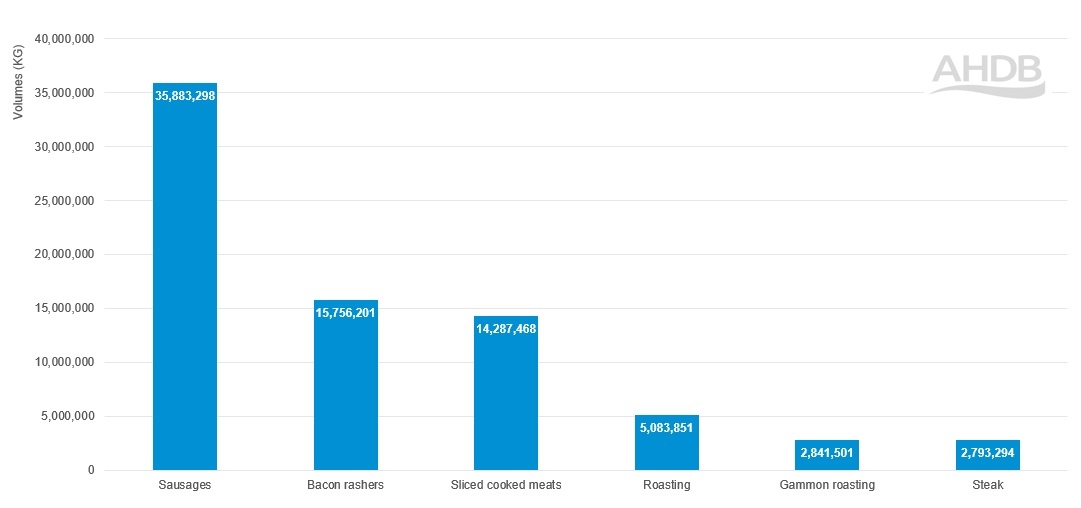
Figure 2: Top ODB cuts by volume³

Sausages are the biggest ODB cut, followed by bacon, sliced cooked meats, roasting, gammon and steak

Figure 2 shows sausages account for the largest volume at 35.9 million kg, more than double any other category. Bacon rashers (15.8 million kg) and sliced cooked meats (14.3 million kg) are the next largest categories. Roasting products account for 5.1 million kg, while gammon roasting (2.8 million kg) and steak (2.8 million kg) have the lowest volumes.

Bacon and sliced cooked meats also make up a large share of ODB sales.³ This shows that shoppers are choosing ODB products across a range of everyday meals, not just for special occasions.

The strong sales of sausages, bacon and sliced cooked meats suggest that ODB is becoming a regular part of many households' shopping baskets.

However, sausages also highlight a major opportunity for growth. Although they are the largest ODB product, only around one in five pork sausages sold are currently outdoor bred.³ This means there is still plenty of room to encourage more shoppers to switch from standard sausages to outdoor-bred options.

Beyond sausages: Unlocking future growth

There are also opportunities beyond processed products, which for the total pig meat category are finding it harder to attract shoppers.

More people are becoming concerned about ultra-processed foods (UPFs), with 71% saying they are trying to avoid them.5 When deciding if a food is ultra-processed, shoppers often check if they recognise the ingredients list, the number of ingredients, how much processing the food has gone through, and the traffic-light nutrition labels.6

This can be a challenge for processed pork products, as they use ingredients to help with curing, texture, flavour and moisture. As a result, their ingredient lists can look longer and more complicated.

As a result, at a total level, processed pig meat products are declining in volume, while demand for primary pork cuts is growing.7

This could create challenges for some ODB products, but it also brings new opportunities. As interest in primary pork increases, there is scope to grow demand for ODB pork cuts alongside the category's strong performance in processed products.

Seasonal celebrations drive demand

Seasonal events play an important role in ODB sales.

Christmas is the most important trading period for the category, with strong sales of outdoor-bred sausages.³ Easter also boosts demand, particularly for roasting joints,³ as consumers prepare special meals at home.

These peaks show that ODB products work well for both everyday meals and special occasions, where shoppers are often willing to invest a little more for perceived quality and indulgence.

Attracting younger shoppers

While ODB is bought by many households, its shoppers tend to be older and more affluent than average.³

Younger households and families currently make up a smaller share of ODB buyers.³ However, these consumers are showing growing interest in food quality, British produce and products that help create better meals at home.

If the category can clearly explain why ODB products are worth the extra cost, it could attract more younger shoppers and families and support future growth.

Looking ahead

The wider food landscape provides further reasons for optimism for ODB. As consumers continue to recreate restaurant-style experiences at home and trade up into premium food and drink for special occasions, the category is well placed to benefit.

ODB has already demonstrated that shoppers are willing to pay a premium when they perceive a meaningful difference in quality. Maintaining these credentials, while broadening appeal beyond its traditional shopper base, will be key to sustaining momentum.

With strong household penetration and opportunities to attract new shoppers and grow across more product types, ODB is well placed to continue growing within the wider pig meat category.

Key opportunities

  • Grow sales of outdoor-bred pork cuts by taking advantage of increasing demand for primary pork products
  • Make the most of key occasions such as Christmas and Easter, when shoppers are more likely to spend extra on quality food
  • Continue to highlight quality, animal welfare and British farming to show shoppers what makes ODB special
  • Tap into the trend for better meals at home by promoting ODB as a way to make everyday meals and special occasions feel more special

Sources

¹Worldpanel by Numerator, Outdoor bred pig meat, 52 w/e 15 June 2025 versus 52 w/e 14 June 2026. Comparison is based on a cut-down definition including primary pork, sausages, bacon, gammon, ham and added value products.

²Outdoor-bred definition includes primary pork, processed pig meat (sausage, bacon, gammon, burgers and sliced cooked meats), added value (Sous vide, ready to cook and marinades), other (party food pastry and mixed meat products e.g. pigs in blankets), and main meal accompaniments (e.g. pork meatballs in a sauce but without an accompanying carbohydrate such as spaghetti) products. The definition covers outdoor-bred, outdoor-reared, free range and organic products, as all of these are pigs that are born outside. This bespoke definition extends the standard Worldpanel by Numerator definition through a review of retailer sourcing statements and on-pack information, enabling the identification and inclusion of products that meet the ODB criteria

3Worldpanel by Numerator, Outdoor bred pig meat, 52 w/e 14 June 2026

4AHDB/YouGov, May 2026

5Mintel, Attitudes towards healthy eating – UK – March 2025

6IGD Research, Shopper Vista Research, June 2025

7Worldpanel by Numerator, 52 w/e 14 June 2026

Image of staff member Charlotte Forkes-Rees

Charlotte Forkes-Rees

Retail and Consumer Insight Analyst

See full bio


Sign up to receive the latest information from AHDB.


While AHDB seeks to ensure that the information contained on this webpage is accurate at the time of publication, no warranty is given in respect of the information and data provided. You are responsible for how you use the information. To the maximum extent permitted by law, AHDB accepts no liability for loss, damage or injury howsoever caused or suffered (including that caused by negligence) directly or indirectly in relation to the information or data provided in this publication.

All intellectual property rights in the information and data on this webpage belong to or are licensed by AHDB. You are authorised to use such information for your internal business purposes only and you must not provide this information to any other third parties, including further publication of the information, or for commercial gain in any way whatsoever without the prior written permission of AHDB for each third party disclosure, publication or commercial arrangement. For more information, please see our Terms of Use and Privacy Notice or contact the Director of Corporate Affairs at info@ahdb.org.uk  © Agriculture and Horticulture Development Board. All rights reserved. 

×