Using potentially mineralisable nitrogen to measure soil health

Potentially mineralisable nitrogen (PMN) is a measure of organic nitrogen in soil. Find out how measuring PMN can be used as an early indicator of change in soil health.

Potentially mineralisable nitrogen (PMN) is one of the optional biological indicators on the AHDB Soil Health scorecard. Soil monitoring using this scorecard is typically undertaken once a rotation (every 3 to 5 years). However, PMN can be tested more frequently.

What is potentially mineralisable nitrogen?

Plants need to take up nitrogen to grow successfully.

Nitrogen exists in several forms in soil. The easiest forms for plants to use are mineral (inorganic) forms, including ammonium and nitrate.

Most nitrogen enters the soil system as organic nitrogen – nitrogen in dead and decaying plant and animal material. This material must be degraded by soil microbes to be transferred into the plant available, mineral nitrogen pool.

PMN is the proportion of the organic nitrogen in soil that can be converted into plant available (or mineral) nitrogen by soil microbes.

PMN and soil health

The process of transferring nitrogen stored in the soil’s organic pool to its inorganic pool is essential to both plant and microbial growth and is a key aspect of soil health. This is particularly important in low input systems.

PMN is also an indicator of biological soil health as it relies on soil microbes to convert the nitrogen from organic matter into nitrogen that is available to plants. Higher levels of PMN can suggest higher levels of soil microbial activity.

Measuring potentially mineralisable nitrogen

The PMN measure shows how well the soil microbial community works to convert nitrogen from organic matter and make it available to plants.

This is done by comparing the soil mineral nitrogen concentration when first received in the lab and after 7 days.

Taking a sample

Take a representative soil sample from the field using the standard soil sampling method described for measuring soil nutrients, pH and organic matter.

Once collected, keep the sample cold (below 4°C if possible) and send to the laboratory as soon as is possible.

See a list of soil testing companies that may carry out PMN testing

Sampling PMN for nutrient management planning

To get a good picture of PMN supply ready for nutrient management planning, testing should be carried out:

  • In late winter for spring sown crops
  • In late summer for autumn sown crops

Analysis

Typically, in the laboratory, the sample is separated into two portions and weighed.

In the first portion, the ammonium and nitrate concentrations are immediately extracted and measured.

The second portion will be incubated for a week in a tube filled with water to keep out oxygen. This will allow the microbes in the sample to continue to degrade organic matter nitrogen into mineral nitrogen but prevent further use of the resulting ammonium and nitrate. This means that the mineral nitrogen accumulates in the second sample.

The difference in mineral nitrogen concentration between the second and first portion of the sample is the potentially mineralisable nitrogen, reported as milligrams of nitrogen per kilogram (N mg/kg).

Interpreting results

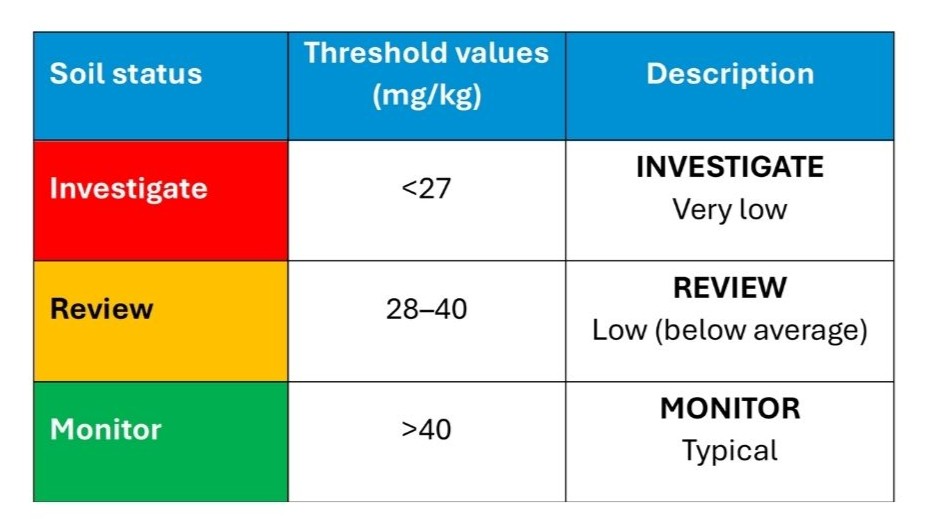
Most testing labs will give an interpretation of whether the concentration is high, moderate or low. The AHDB soil health scorecard has guideline bands for the interpretation of PMN results (Figure 1):

PMN <27 mg/kg

  • Very low
  • Investigate

PMN 28 to 40 mg/kg

  • Low, below average
  • Review

PMN above 40 mg/kg

  • Typical
  • Monitor

Results using our scorecard may differ from results reported by the testing lab as some take into account aspects of the soil such as soil texture and organic matter content which are known to impact PMN.

Figure 1. PMN benchmarks for all rotational land uses taken from the AHDB soil health scorecard benchmarking document version 1.0

PMN results represent the amount of mineral nitrogen released from organic matter in the soil under ideal laboratory conditions. In the field the amount will vary based on factors such as soil texture, climate and organic matter.

PMN and climate

Humid areas tend to have higher rates of PMN than dry areas.

PMN and soil texture

Very heavy soils with lots of clay have lower PMN; this may be because the clay protects organic nitrogen from conversion to plant available forms by microbes.

PMN and organic matter

Soil organic matter can affect PMN results for the following reasons:

  • Systems with high levels of organic matter returned to the soil will likely have higher PMN, although this will be further impacted by soil texture (as evidenced by Spargo et al., 2011*)
  • Organic matter with higher nitrogen concentrations will likely result in higher PMN (as shown by Osterholz et al., 2017*)

It is important to consider any additional organic matter that has been added to the soil after testing e.g. late terminated cover crops, farmyard manure or slurry addition, or weeds incorporated into soil prior to sowing.

These will change the stock of organic material available for mineralisation and hence the amount of PMN.

How to increase soil PMN

Before taking measures to increase potentially mineralisable nitrogen first ensure that the soil is in good health.

A healthy soil has optimal interactions between:

  • chemistry (pH, nutrients and contaminants)
  • physics (soil structure and water balance)
  • and biology (earthworms, microbes and plant roots).

Assess soil health using the AHDB soil health scorecard

Increase organic matter inputs, where organic matter inputs are low, using materials with high N concentrations – make sure that crop/soil nutrient requirements are not exceeded and relevant environmental regulations are met.

Read about adding organic matter to soil

Reduce frequency of cultivations – repeated cultivation, particularly without organic matter input, can lead to reduced long-term PMN because of reduced organic matter concentrations (as evidenced by Mahal et al., 2018*).

Find out about reduced tillage options

Maintain a good soil structure through remedying and preventing compaction.

Soils with a higher proportion of small aggregates (e.g. crumbs less than 2 mm across) tend to have higher PMN (as shown by Bimüller et al., 2016*). This is likely because the organic matter is less physically protected from degradation by soil microbes.

Learn how to easily assess soil structure and identify compaction

Read more about the features and impacts of good and poor soil structure

Find out how to identify, resolve and prevent soil compaction by livestock

Find out how to identify, resolve and prevent soil compaction from machinery

* Note: Full references can be found in the appendix of the original research report which can be downloaded from the project webpage: Early indicators to monitor changes in soil health.

×