Measure aggregate stability to detect changes in soil health early

Measuring aggregate stability can detect changes in soil health earlier than other indicators. Below we describe two kinds of tests that can be done via an app.

What is aggregate stability?

Aggregate stability describes the strength of aggregates (clumps) in soil and how resistant they are to breakdown from mechanical factors, including tillage, and water or wind erosion.

Soil aggregates are clusters of soil particles and organic matter that form the building blocks of soil.

The shape, size and arrangement of soil aggregates – with pores within and between them – is the basis of soil structure.

How does aggregate stability support a healthy soil?

Good aggregate stability is widely recognised as a positive indicator of the physical health of soil. It indicates:

  • Healthy levels of porosity and aeration, infiltration and drainage, and water holding capacity
  • Crops have sufficient water, roots grow well, and soils are less prone to erosion and compaction
  • Good chemical status and an active soil biology, as soil microorganisms produce substances that hold soil particles together even in water

Tests to measure aggregate stability

Aggregate stability can be measured by testing how well soil structure holds together in water.

It can be measured in non-commercial (research) laboratories using a method known as wet sieving.

It can also be measured on farm using a slake test.

Recent research has shown that slake testing results using a mobile phone app compare well with wet sieving (as evidenced by Flynn et al., 2020; Trybek et al., 2026).

Note: the full reference is in the appendix of the original research report which can be downloaded from the project webpage: Early indicators to monitor changes in soil health.

Wet sieving

Wet sieving involves placing dried soil aggregates on top of a set of stacked sieves of reducing mesh sizes and agitating in a column of water. After a period of time the weight of aggregates remaining on each sieve is measured and the percentage “water stable aggregates” is reported.

A similar, simplified wet sieving method involves placing sieved aggregates between 1 and 2 mm in diameter on a sieve and agitating in water for a period of time, then recording the percentage of aggregates remaining.

These methods are time-consuming and laborious, and not commercially available at any UK laboratory. Growing interest in this indicator, however, may result in laboratory techniques being available in future.

Slake testing

The slake test is a simple, quick method to assess aggregate stability on farm.

In soil, slaking is the rapid disintegration of dry soil aggregates when suddenly wetted, caused by the build-up of internal air pressure as water enters soil pores.

Slake testing protocols can vary, but the basic principle involves immersing small (pea sized or smaller) air-dried pieces of soil in water for a short time and recording how fast they disintegrate.

Two options for conducting slake tests on farm are provided below.

Since each test is done slightly differently, it is recommended that the same method is followed each time to ensure consistent scoring.

Sample collection

Aggregate samples can be collected at the same time as other in-field assessments on the soil health scorecard.

Collect samples with a spade from the topsoil at the same time of year (autumn is preferable), when the soil is moist but not too wet or waterlogged.

As the test assesses the strength of soil aggregates, the samples need to be handled with care so that they don’t break up before the test starts.

Once back at base, gently crumble the soil in your hands until you have the right sized aggregates for the chosen method. Air-dry the aggregates overnight or longer if the sample is very wet.

The Slakes app

The app Slakes: Soil Health Test is available for free on Android or iOS phone.

The app uses image analysis to document the disintegration of air-dried aggregates in tap water during a 10-minute period and returns an index of aggregate stability.

This removes the subjectivity associated with some other methods of assessing slake testing that require the operator to assign a score.

Items needed

This method requires:

  • Three pea-sized aggregates of soil that have been air-dried
  • Two clear or white plastic dishes
  • Mobile phone
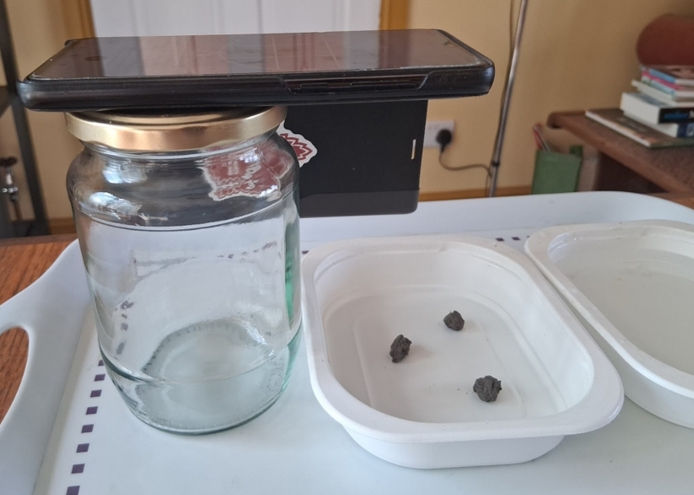
  • Something to mount the phone over the dishes (e.g. tripod, can, jar; see Figure 1)
  • Tap water
Method
  1. Set up the phone so that the camera sits 4–6 inches above an empty dish, e.g. using a tripod. Place the aggregates into the dish.
  2. On the Slakes app, tap ‘Start aggregate stability test’ and follow the on-screen instructions.
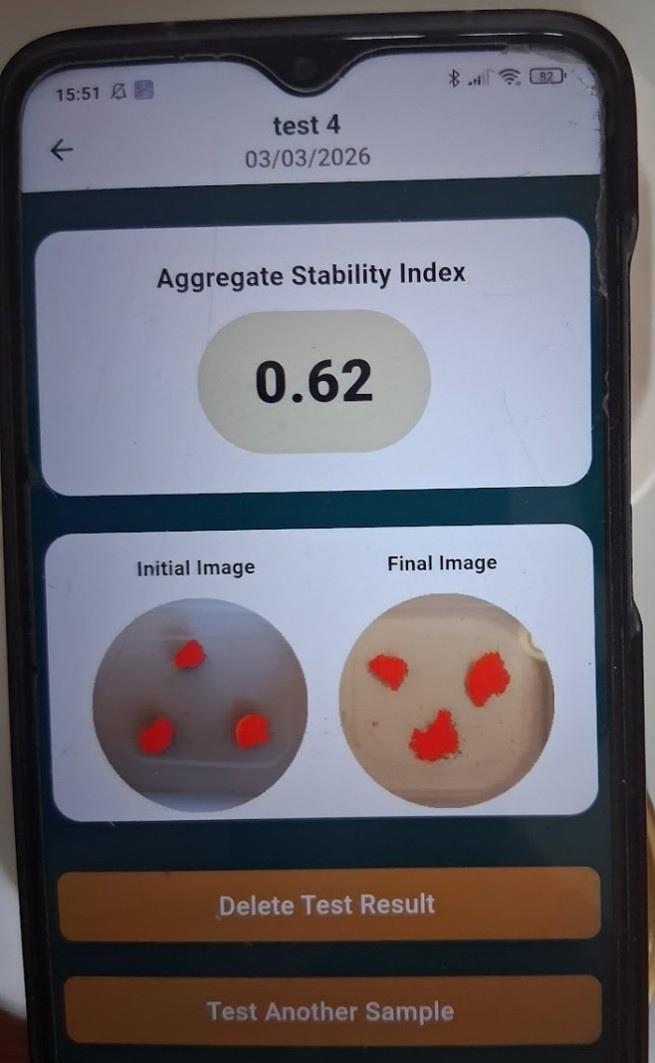
  3. At the end of the test, the app will report an index of aggregate stability and show an initial and final image of the aggregates (Figure 2).

Figure 1. A simple setup for at-home slake testing for aggregate stability using the Slakes app

Figure 2. Example outcome from an at-home slake test using the Slakes app

Interpretation

The aggregate stability index reported in the app (Figure 2) ranges from 0.1 to 1. A high score (closer to 1) indicates high (good) aggregate stability.

You can export the test results from the app to upload to a computer, add management and location data, and track changes in aggregate stability index values when sites are resampled.

Read more about the Slakes app (Soil Health Institute)

The Soilmentor app

The Soilmentor app is available on Android and iOS phone. It has an annual subscription cost.

The app can record the score and any observations as well as save images taken.

Unlike the Slakes app, the user scores aggregate stability using the guidance and a scoring scale provided. Where possible, the same person should score the aggregates to ensure consistent scoring.

User confidence and skill in interpreting results can be built by undertaking routine slake testing on the farm.

Looking at areas known to be “healthy” compared to areas with degraded soil structure will help develop understanding of what “good” looks like for slake scores within a farm’s environment.

Items needed

This method requires:

  • Small (1 to 3 mm sized) aggregates of air-dried soil
  • Mobile phone
  • A typical kitchen sieve
  • A light-coloured bowl of cold water
  • A stopwatch/timer
Method
  1. Arrange the soil aggregates on the sieve and take a photo using a light background.
  2. Fully immerse the sieve into the bowl of water.
  3. Start the timer and observe the aggregates.
  4. After 5 minutes, take a photo.
  5. Score the aggregates based on the amount of disintegration using the Soilmentor scoring scale presented below.
Soilmentor scoring scale

Scores range from 0 to 2 with a higher score indicating good aggregate stability. The scoring system below has been adapted from the soil mentor protocol.

Score 0 (Dissolves into single grains):

  • Soil lump collapses completely; soil aggregates too unstable
  • Indicates poor soil stability, lacking in soil organic matter and microbial activity

Score 0.5 (Soil slumps to pyramid shape):

  • Soil collapses into a cone shape of less than 2 mm grains, water cloudy
  • Indicates a lack of cohesion and stability

Score 1 (Breaks into angular pieces):

  • Soil lumps break into large angular pieces
  • Indicates a loose surface and needs more microbial activity

Score 1.5 (Stays mainly intact):

  • Soil lump edges crumble slightly but remain largely intact
  • Indicates good soil stability but could still be improved

Score 2 (Soil lump intact):

  • Soil lump remains intact and water is clear
  • Indicates good aggregate stability, continue to monitor

Read the full Soilmentor slake test instructions (Vidacycle)

How to improve soil aggregate stability

Before taking measures to increase aggregate stability first ensure that the soil is in good health.

A healthy soil has optimal interactions between:

  • Chemistry (pH, nutrients and contaminants)
  • Physics (soil structure and water balance)
  • Biology (earthworms, microbes and plant roots)

Assess soil health using the AHDB soil health scorecard

Aggregates can be broken up by tillage. Therefore, only loosen soils where necessary and when soil conditions allow.

Find out about reduced tillage options

Aggregates are enhanced in soils by regular inputs of organic matter, which feeds the microbial activity that helps hold soil particles together.

Read about adding organic matter to soil

Further information

Read more about the features and impacts of good and poor soil structure

Find out how to identify, remedy and prevent soil compaction from machinery

Learn how to identify, remedy and prevent soil compaction from livestock

×