Pressure in Q2 for beef and lamb export, imports steadier: Beef & lamb market update

Friday, 28 August 2026

The second quarter brought a change of pace for UK beef and lamb trade, with exports retreating from a robust first quarter. However, resilient imports and rising values underline the continued strength of global red meat markets.

Key points

  • Export momentum cooled in Q2 after a strong start to the year, with both sheep meat and beef volumes falling quarter-on-quarter
  • Import volumes remained resilient despite shifting trade patterns, with sheep meat reaching its highest levels for Q2 since 2019. Southern hemisphere suppliers, particularly Australia, continue to gain prominence
  • Values continued to outpace volume across both species, reflecting the strength of global meat prices

Sheep meat exports: pressure in the second quarter

After a record first quarter, the volume of sheep meat (excl. offal) exported by the UK faced resistance towards the middle of the year, particularly in June.

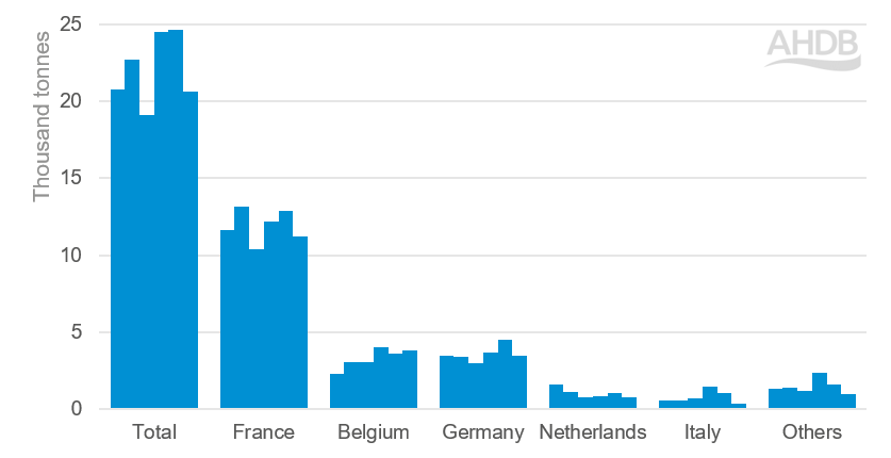
In the second quarter (Q2) of 2026, the UK exported 20,600 tonnes of sheep meat (fresh, frozen and processed), down 16% compared to Q1 and down 9% on Q2 2025.

Most of the quarterly drop came from volumes shipped to France, Germany and Italy. However, German shipments in Q2 remained above year-ago levels.

Meanwhile, volumes to Belgium continued their steady long-term growth trend, overtaking Germany in Q2 2026 to be the UK’s second-largest sheep meat export market. Reports point to firm demand from both the Belgian domestic market and for re-export elsewhere in Europe.

Figure 1: Quarterly UK sheep meat exports by destination, Q1 2025 – Q2 2026

Source: HMRC via Trade Data Monitor LLC

The bar chart in Figure 1 shows fluctuation in quarterly sheep meat exports. France still dominates volumes, but Belgium has gained share.

While EU sheep meat demand appears to be broadly resilient, likely spurring trade in Q1 ahead of Ramadan, market reports tell that generally the extreme heat has weakened consumption of late. This will be conflated by the summer holiday period. While volumes picked up in May ahead of Eid al-Adha festivities, the slump in June was enough to pull Q2 down.

Despite Q2 performance, UK sheep meat exports for the first six months of the year reached 45,300 tonnes, valued at £388.2 million. This represented a 4% year-on-year growth in volume but a 16% increase in value, equivalent to an extra £52.6 million.

Sheep meat imports: volumes move upwards

Meanwhile, the volume of sheep meat imported into the UK grew seasonally in Q2 and remained slightly above year-ago levels.

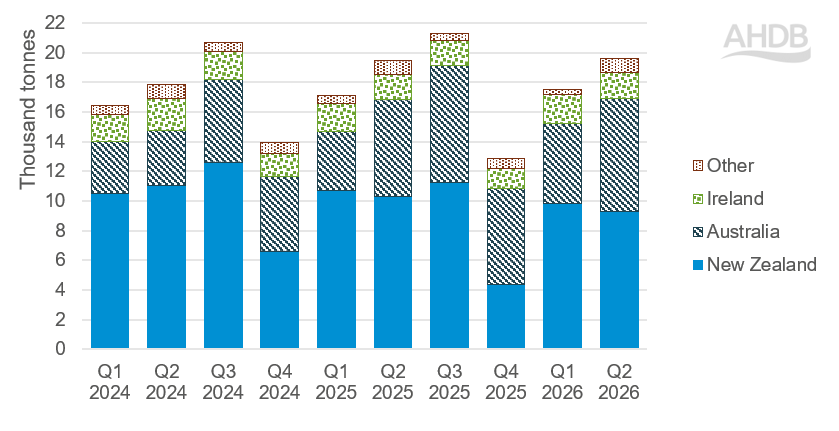
The UK imported 19,600 tonnes of sheep meat during the quarter, up 12% from Q1 and up 1% from Q2 2025. This was the highest volume for the quarter since 2019.

Australian volumes continued their long-term upwards trajectory, drawing closer to quantities received from New Zealand.

For the year-to-date, the UK imported 37,100 tonnes of sheep meat, valued at £251.8 million. This represented a 1.5% year-on-year growth in volume, but a 19% increase in value.

Figure 2: Quarterly UK sheep meat imports by supplier, Q1 2024 – Q2 2026

Source: HMRC via Trade Data Monitor LLC

The bar chart in Figure 2 shows how Australian volumes outweighed losses from New Zealand to drive a slight uptick in UK sheep meat import volumes in Q2 2026. Imports typically peak in the third quarter of the year ahead of Christmas.

Beef exports: a quieter quarter

Similar to the lamb trade, UK beef export volumes ebbed in the second quarter of 2026, following a strong Q1.

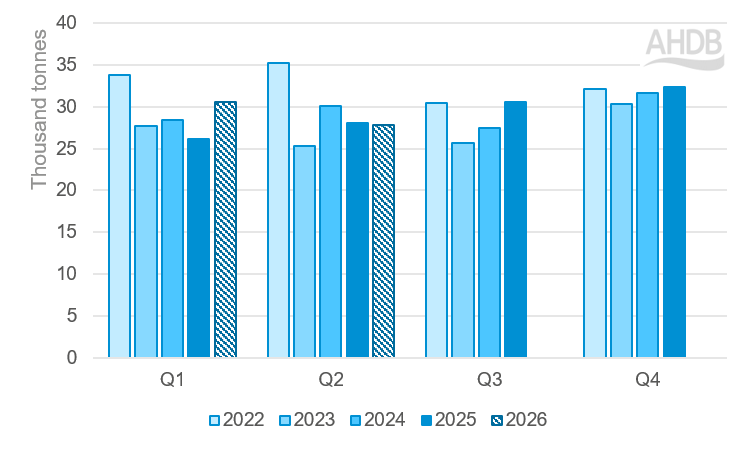
During Q2, the UK exported 27,800 tonnes of beef (excl. offal), down 9% from the previous quarter and down 1% from the previous year.

Shipments to Ireland and France continued to slip notably, while volumes to the Netherlands recovered a little from the previous quarter. Volumes to most other European markets declined apart from Poland and Italy.

Figure 3: Quarterly total UK beef import volumes, Q1 2022 – Q2 2026

Source: HMRC via Trade Data Monitor LLC

The bar chart in Figure 3 shows the decline in UK beef export volume in Q2 2026, following the elevated Q1, with the previous four years for comparison.

Despite a weaker second quarter, UK beef exports for the first half of 2026 reached 58,400 tonnes, valued at £409.8 million. This represented an 8% increase in volume but a 22% increase in value year-on-year, equivalent to an extra £73.4 million.

Beef imports: Mixed moves in Q2

UK beef import volumes ticked up slightly in Q2 from the previous quarter but moved below last year’s levels.

The UK imported 71,800 tonnes of beef (excl. offal) in Q2, up 2% from Q1 but 1% below the volume imported in Q2 a year ago.

Quarterly gains in Irish and Australian volume met losses from Brazil and New Zealand. However, volumes from the latter three (particularly Australia and New Zealand) remained higher than a year ago.

Focussing on Brazilian imports, the quarterly dip was driven largely by corned beef, as the quantity of boneless product slipped by a smaller margin. Boneless beef now makes up a much larger proportion of Brazilian volume, having grown sharply in Q2 2025. In Q1 2026, 31% of UK beef imports from Brazil were frozen boneless, up from 9% in Q2 2024.

Figure 4: Quarterly UK beef import volume by supplier, Q1 2025 – Q2 2026

Source: HMRC via Trade Data Monitor LLC

The bar chart in Figure 4 demonstrates year-on-year growth in UK beef import volumes from Australia and New Zealand between 2026 and 2025.

For the year-to-date, the UK imported 142,300 tonnes of beef (excl. offal), valued at £1.1 billion. This represented a 1% increase in volume but an 11% increase in value year-on-year.

Image of staff member Hannah Clarke

Hannah Clarke

Lead Analyst (Red Meat)

See full bio


Sign up for regular updates

You can subscribe to receive Beef and Lamb market news straight to your inbox. Simply fill in your contact details on our online form.

Visit the Keep in touch page

While AHDB seeks to ensure that the information contained on this webpage is accurate at the time of publication, no warranty is given in respect of the information and data provided. You are responsible for how you use the information. To the maximum extent permitted by law, AHDB accepts no liability for loss, damage or injury howsoever caused or suffered (including that caused by negligence) directly or indirectly in relation to the information or data provided in this publication.

All intellectual property rights in the information and data on this webpage belong to or are licensed by AHDB. You are authorised to use such information for your internal business purposes only and you must not provide this information to any other third parties, including further publication of the information, or for commercial gain in any way whatsoever without the prior written permission of AHDB for each third party disclosure, publication or commercial arrangement. For more information, please see our Terms of Use and Privacy Notice or contact the Director of Corporate Affairs at info@ahdb.org.uk  © Agriculture and Horticulture Development Board. All rights reserved. 

×