EU red meat short term outlook – Spring 2026

Friday, 15 May 2026

The European Commission has released their summer 2026 short-term outlook. This article dissects the key statistics and forecasts for the beef, lamb and pork sectors.

Key points

  • EU domestic red meat production is falling across all three red meat sectors, continuing long-term trends.
  • EU red meat import growth is increasing to fill widening supply gaps, driven primarily by Mercosur product in beef and southern hemisphere suppliers in lamb.
  • EU red meat export competitiveness is reducing across the board. High domestic prices and disease-related trade disruptions price European product out of key third markets.

Beef

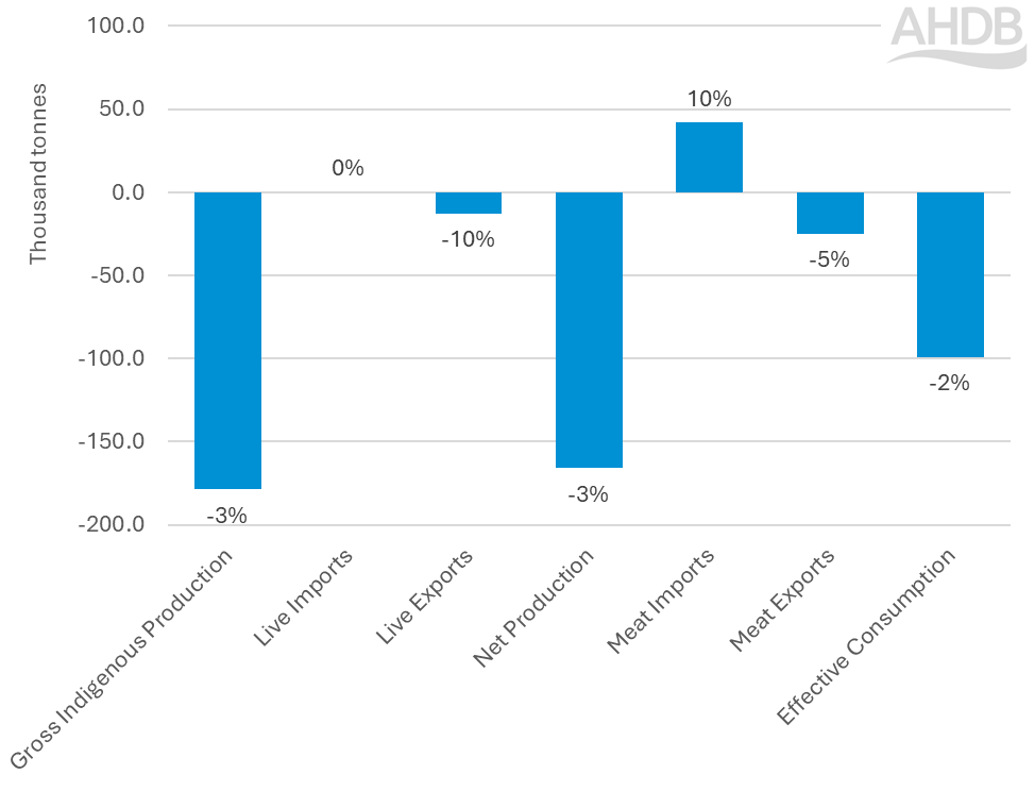
EU effective beef consumption has been in a long-run structural decline since 2007. This is forecast to continue, falling a further 2% in 2026. This is duplicated by per capita consumption, forecasted a 2% reduction in 2026.

A shrinking domestic herd and falling gross indigenous production (total domestic production plus the balance of international trade) have widened the gap between EU output and consumption, driving the forecast for a 10% increase in beef meat imports in 2026. This supply shortfall is being filled predominantly by Brazilian and Argentine beef, product benefiting from structurally lower production costs compared to European counterparts.

Sustained high EU prices and limited production have eroded export volume and competitiveness, with total EU beef meat exports forecast to decline 5% in 2026.

This dynamic is also reshaping the UK-EU trade relationship, as UK imports of EU beef have declined steadily through 2025, a trend likely to persist into 2026. While the UK remains a meaningful beef exporter to the EU, its market share has diminished relative to Mercosur suppliers, reflecting the same competitive pressures operating across the broader market.

Figure 1: EU 2026 beef outlook -- year-on-year market change

shows the forecasted year-on-year changes in key market metrics, production, trade and consumption

Source: European Commission, AHDB calculations

Figure 1 shows the forecasted year-on-year changes in key market metrics, production, trade and consumption for EU beef.

Pig meat

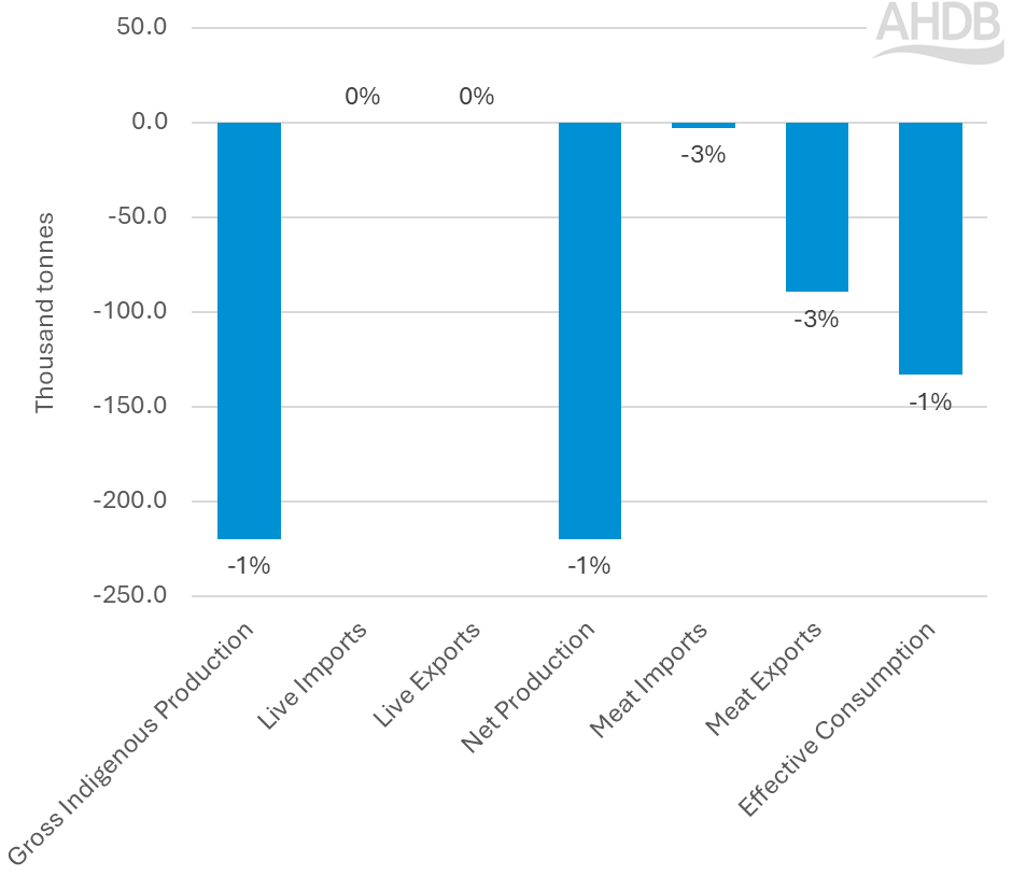
EU pig meat gross indigenous production is forecast to decline by 1% in 2026, continuing a broader structural contraction driven by a shrinking breeding sow herd. Despite this, pig numbers are forecast to increase by 3.2% in the fourth quarter of 2026, concentrated in Spain, which is projected to account for over a quarter of EU output.

Effective consumption is forecast to fall 1% in 2026, though pig meat is expected to benefit from shoppers switching out of more expensive proteins.

ASF remains a significant structural risk. From 1 January 2026 to 13 May 2026, the EU Commission have reported 4,756 cases of ASF in the EU for wild boar and domestic pigs, adding sanitary uncertainty to an already pressured production outlook.

EU exports came under pressure at the start of 2026 after China imposed import tariffs of up to 19.8% for the next five years, compounding the displacement of Spanish product from Japan following ASF-related import suspensions. With EU product losing ground in Asian markets, export volumes are forecast to decline by 3%, and over the coming decade the UK could become the largest single export destination for EU pigmeat.

In 2025, the UK was already the second-largest buyer of EU pork at 856,000 tonnes and import forecasts for 2026 point to a flat to marginal increase. Meanwhile, UK shipments to China increased in 2025, giving the UK a 7% share of Chinese pig meat imports.

Figure 2: EU 2026 pig meat outlook -- year-on-year market change

shows the forecasted year-on-year changes in key market metrics, production, trade and consumption

Source: European Commission, AHDB calculations


Figure 2 shows the forecasted year-on-year changes in key market metrics, production, trade and consumption for EU pigmeat.

Sheep meat

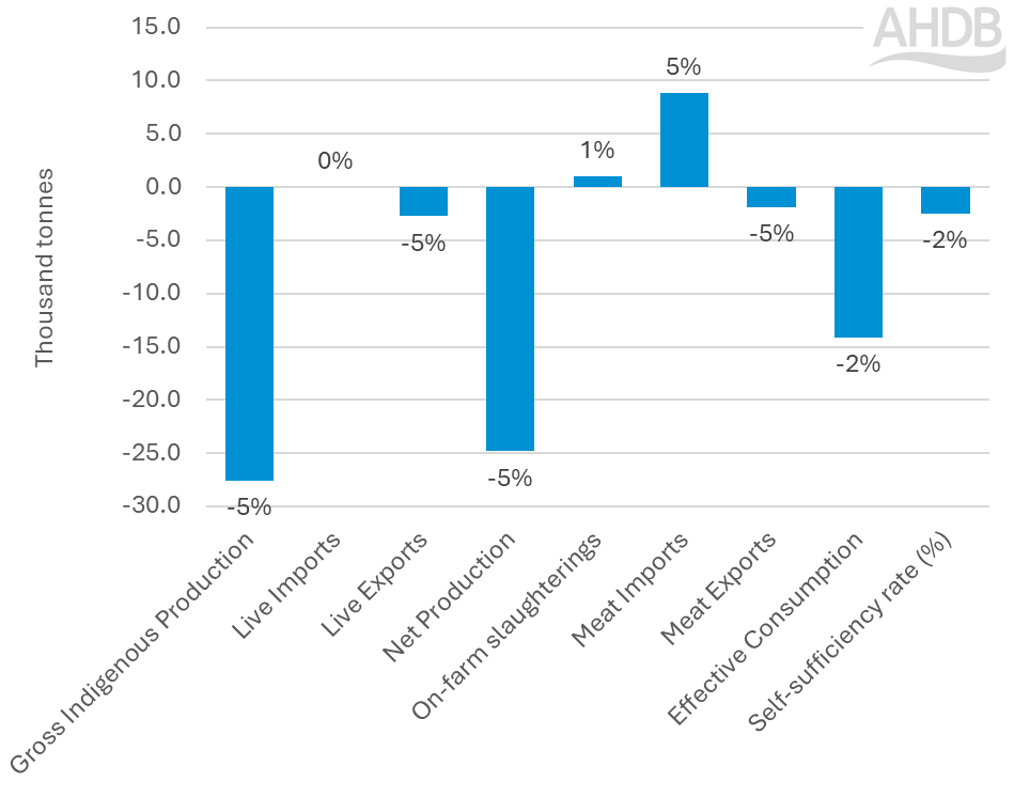
EU sheep meat production is forecast to fall 5% in 2026, extending a long-run structural decline as flocks continue to shrink across the bloc. The drop is sharpest in Spain, where output is forecast to slump 40.4% in the second half of the year due to disease pressure and movement restrictions.

Tight supply has kept prices elevated though this has done little to dent consumption, which is forecast to fall only 2%. Lamb demand has proven resilient, underpinned by its cultural significance at religious festivals and a growing Muslim population. Halal consumption requirements could be demanding higher levels of specific imports.

The supply gap is being filled by imports, which are forecast to grow a further 5% in 2026 on top of a 13% rise in 2025. Both New Zealand and Australian shipment volumes were up 13% and 27% respectively. The UK is well-placed to benefit from continued EU import demand, though southern hemisphere competition is intensifying and SPS alignment will be critical to access.

High prices continue to price EU product out of most third markets, with volumes forecast to fall 5% in 2026. The 13% export increase recorded in 2025 was largely a one-off, driven by a surge in shipments to Algeria. Exports to the UK fell 26% over the same period, and that trend shows little sign of reversing.

Figure 3: EU 2026 sheep meat outlook – year-on-year market change

shows the forecasted year-on-year changes in key market metrics, production, trade and consumption

Source: European Commission, AHDB calculations

Figure 3 shows the forecasted year-on-year changes in key market metrics, production, trade and consumption for EU sheep meat.

Image of staff member Sebastian Abbott

Sebastian Abbott

Trainee Analyst

See full bio


Sign up for regular updates

You can subscribe to receive Beef and Lamb market news straight to your inbox. Simply fill in your contact details on our online form.

Visit the Keep in touch page

While AHDB seeks to ensure that the information contained on this webpage is accurate at the time of publication, no warranty is given in respect of the information and data provided. You are responsible for how you use the information. To the maximum extent permitted by law, AHDB accepts no liability for loss, damage or injury howsoever caused or suffered (including that caused by negligence) directly or indirectly in relation to the information or data provided in this publication.

All intellectual property rights in the information and data on this webpage belong to or are licensed by AHDB. You are authorised to use such information for your internal business purposes only and you must not provide this information to any other third parties, including further publication of the information, or for commercial gain in any way whatsoever without the prior written permission of AHDB for each third party disclosure, publication or commercial arrangement. For more information, please see our Terms of Use and Privacy Notice or contact the Director of Corporate Affairs at info@ahdb.org.uk  © Agriculture and Horticulture Development Board. All rights reserved. 

×