- Home
- News
- Robust start for EU sheep prices in 2026 amid supply constraints and steady demand: Lamb market update
Robust start for EU sheep prices in 2026 amid supply constraints and steady demand: Lamb market update
Friday, 20 March 2026
Tighter supply and firm import demand continue to shape the European sheep market, while disease risk and movement restrictions add complexity. We explore the latest trends in the market and what they mean for the UK.
Key points
- EU sheep prices have opened 2026 in a robust position, with the reference price at €9.38/kg (+€0.03 YoY), though trends varied sharply by country
- EU sheep meat production declined in 2025, driven by disease pressure, adverse weather and policy changes
- Consumer demand stayed stable despite higher retail prices, helping maintain firm EU market conditions into 2026
- EU sheep meat imports rose 12% to 157,600 tonnes in 2025, led by New Zealand (+13%) and Australia (+27%), with further import growth expected as domestic supply tightens
- EU exports increased 27% to 30,700 tonnes, driven by a 164% surge in shipments to Algeria, while exports to the UK fell 26%
Prices
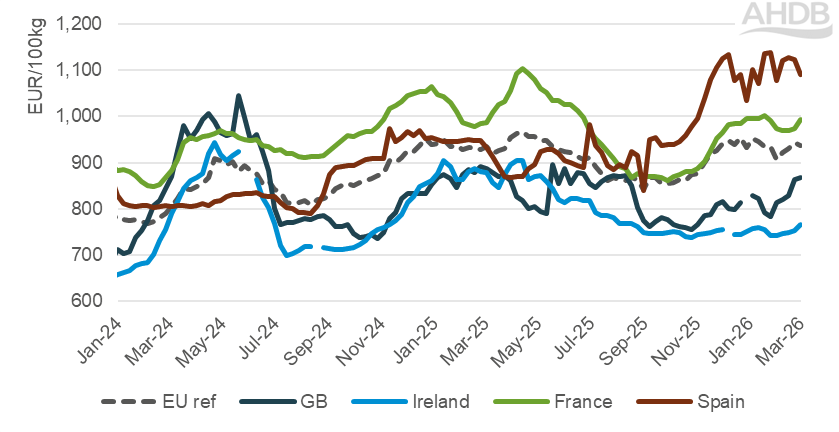
As shown in fugure 1, European sheep prices have begun 2026 in broadly robust position following a strong year, although regional differences are evident. In the week ending 2 March, the European reference price stood at €9.38/kg, up 3 eurocents year-on-year (YoY). In sterling, the price stood at 816.7p/kg, +38p YoY.
Digging within the average reveals stark divergence across key markets. Spanish prices are incredibly strong, up around €1.57/kg YoY in the week ending 2 March, driven by supply shortages, movement restrictions due to disease and strong consumer demand.
French prices are closer to 2025 levels currently, up 8 eurocents for week ending 2 March.
Meanwhile, Irish prices are notably lower than the historically strong levels of early 2025 (-€1.13/kg week ending 2 March). Irish sheep slaughter dropped substantially last year and kept the market firm. Kill was down a further 3% in January 2026, according to data from CSO Ireland.
Figure 1: Weekly EU and GB deadweight lamb prices (EUR/100kg) from Jan 2024 to Mar 2026
Source: European Commission
Figure 1 shows price trends for GB, Ireland, France, Spain and the EU reference. Prices for all regions fluctuate seasonally, with noticeable peaks around mid‑2024 and again in mid‑2025. France consistently recorded the highest prices but has been overtaken by Spain. Ireland tends to sit at the lower end.
Production lower in 2025, continuing in 2026
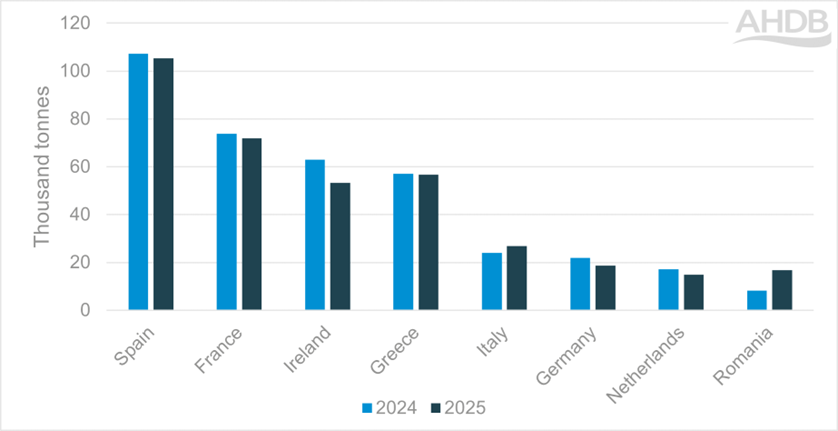
EU sheep production fell across the major producing countries in 2025, driven by a mix of disease challenges, adverse weather and shifting policy pressures (see figure 2).
Ireland saw the largest decrease of 15% compared to the previous year. Production in Greece remained relatively stable with a 1% decrease despite heightened disease pressure.
Figure 2: Sheep meat production of select EU27 countries in 2024 and 2025 (thousand tonnes)

Source: European Commission
Figure 2 shows Spain is the largest producer in both years, with production staying just above 100,000 tonnes. France and Ireland follow, each showing a slight decline from 2024 to 2025. Greece remains stable at around 60,000 tonnes across both years. Italy, Germany, and the Netherlands all produce much smaller volumes, with modest increases in 2025. Romania has the smallest output but a large rise in 2025.
Romania saw a 103% increase in production due to rebuilding of the flock after mandatory culling for PRR (peste des petits ruminants) in 2024.
Disease pressure remained high in 2025 with PRR, SPG (sheep and goat pox) and bluetongue virus all prevalent in the country. However, strict disease control measures prevented further mass outbreaks.
Italy also saw production growth due to strengthening domestic demand, industry modernisation and targeted regional support from the government.
Looking ahead, the European Commission forecast continued reductions in output through 2026 and beyond, notwithstanding more severe disease outbreaks.
Market reports suggest that European consumer demand for lamb has been stable despite retail price rises, supported by lamb’s sustained cultural importance at religious festivals and a growing Muslim population. These factors are expected to keep prices supported generally and increase import requirements.
Heavier import reliance for the bloc
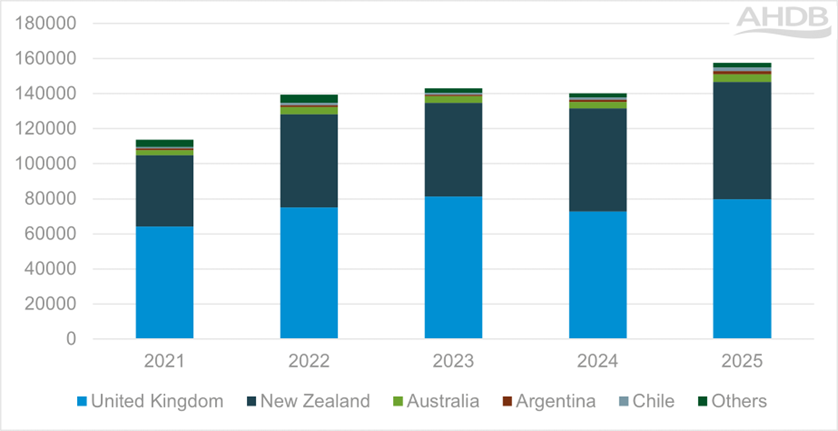
Total EU imports of fresh and frozen sheepmeat increased 12% to 157,700 tonnes in 2025. Imports from New Zealand and Australia increased 13% and 27% to 66,900 tonnes and 4,500 tonnes respectively due to ample supply and competitive prices.
Trade grew particularly in the first half of the year as strong returns pulled product into the market, but volumes returned closer to 2024 levels in the latter months.
Figure 3: Imports of sheep meat into the EU27 between 2021 and 2025 (thousand tonnes)
Source: Eurostat compiled by Trade Data Monitor LLC
Figure 3 shows the UK remains the largest supplier throughout the period, with volumes rising steadily each year. New Zealand is the second‑largest source, also showing gradual growth. Smaller contributors, including Australia, Argentina and Chile remain relatively stable with only modest year‑to‑year changes.
Continued growth in import volumes is expected as production tightens and market returns remain favourable.
The UK is well-positioned to capitalise on this demand, however potentially faces increasing competition from southern hemisphere suppliers with expanding access. The progression of UK-EU sanitary and phytosanitary (SPS) alignment is a key watchpoint for ease of trade into the bloc going forward.
Total EU exports of fresh and frozen sheep meat increased by 27% YoY to 30,700 tonnes. This was driven by exports to Algeria, which increased 164% to 14,100 tonnes. Exports to United Kingdom fell by 26% to 5,800 tonnes.
Sign up for regular updates
You can subscribe to receive Beef and Lamb market news straight to your inbox. Simply fill in your contact details on our online form.
While AHDB seeks to ensure that the information contained on this webpage is accurate at the time of publication, no warranty is given in respect of the information and data provided. You are responsible for how you use the information. To the maximum extent permitted by law, AHDB accepts no liability for loss, damage or injury howsoever caused or suffered (including that caused by negligence) directly or indirectly in relation to the information or data provided in this publication.
All intellectual property rights in the information and data on this webpage belong to or are licensed by AHDB. You are authorised to use such information for your internal business purposes only and you must not provide this information to any other third parties, including further publication of the information, or for commercial gain in any way whatsoever without the prior written permission of AHDB for each third party disclosure, publication or commercial arrangement. For more information, please see our Terms of Use and Privacy Notice or contact the Director of Corporate Affairs at info@ahdb.org.uk © Agriculture and Horticulture Development Board. All rights reserved.