Global trade flows shifting: Beef market update

Friday, 18 September 2026

Global beef trade is shifting as a result of changing import policies within the EU, China and the US. Could these policies indirectly impact the UK?

Key points

  • Chinese safeguard quotas have sharply reduced Australian and Brazilian beef shipments to China, forcing exporters to seek alternative markets.
  • The EU ban on Brazilian beef removes an important high-value outlet
  • The US has temporarily opened additional tariff-free access for manufacturing beef imports.

China’s safeguard quotas filled: beef pushed out

China, the world’s largest beef importer, have introduced new country-specific beef quotas. Volumes outside of the quota will now attract a tariff of 55%. Quota allowances will rise gradually each year.

Australia filled its 205,000-tonne tariff rate quota (TRQ) in mid-June, while Brazil is expected to fill its 1.1 million tonne quota this month.

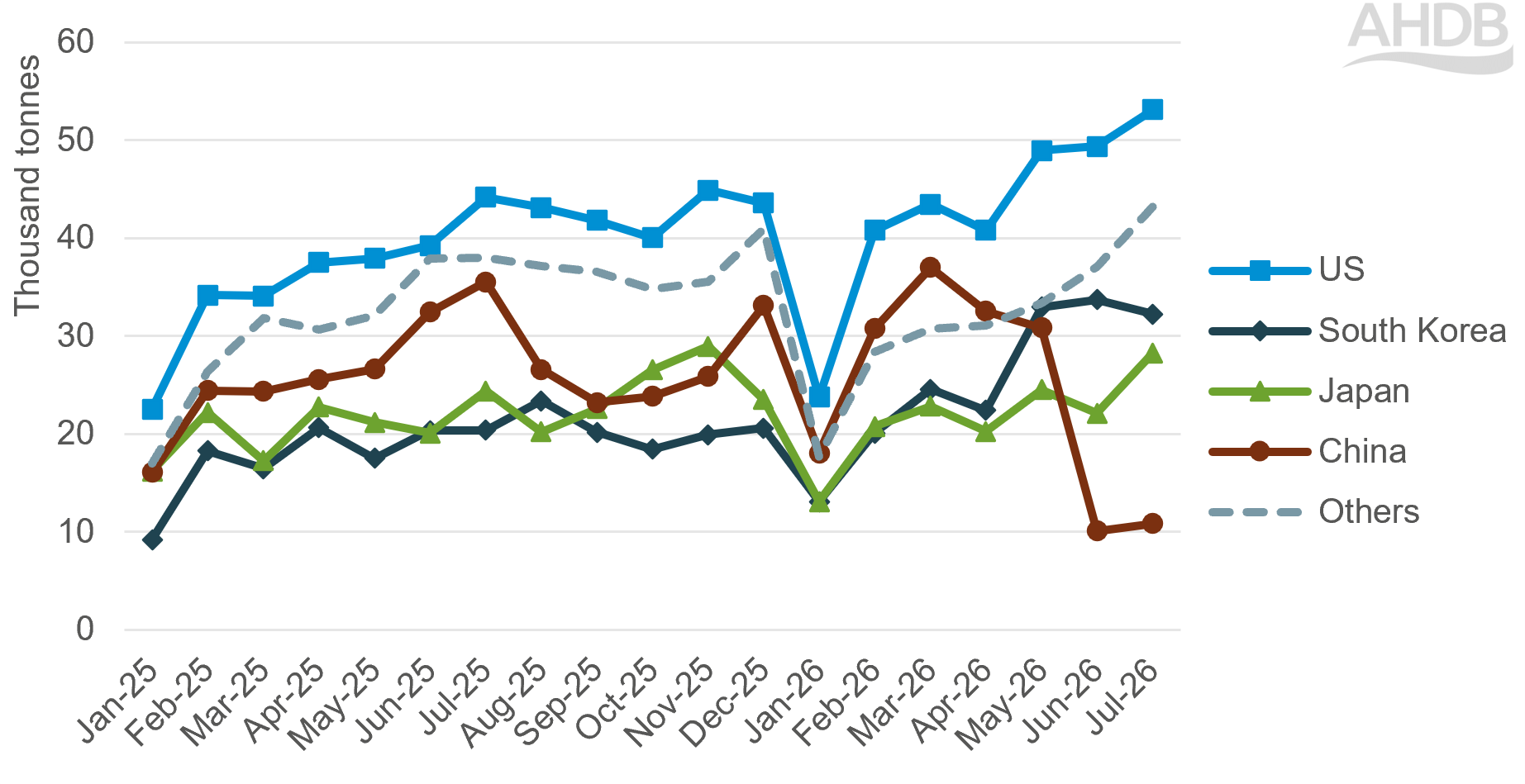
Australian beef exports to China dropped by 65% between May and July, equivalent to just under 20,000 tonnes.

Australia appears to have re-directed this volume, sending more to the US, Japan, South Korea, Indonesia and Canada among others. However, South Korea has reportedly triggered its own safeguard mechanism following the influx of Australian beef.

This re-direction meant that Australia’s overall beef export volumes, were still up 2% and 3% above year-ago levels in June and July, respectively.

Figure 1: Monthly Australian beef export volumes by trade partner, January 2025 to July 2026

Source: Australian Bureau of Statistics via Trade Data Monitor LLC

The line chart in Figure 1 shows trends in monthly Australian export volumes of fresh, frozen and processed beef over the past 18 months.

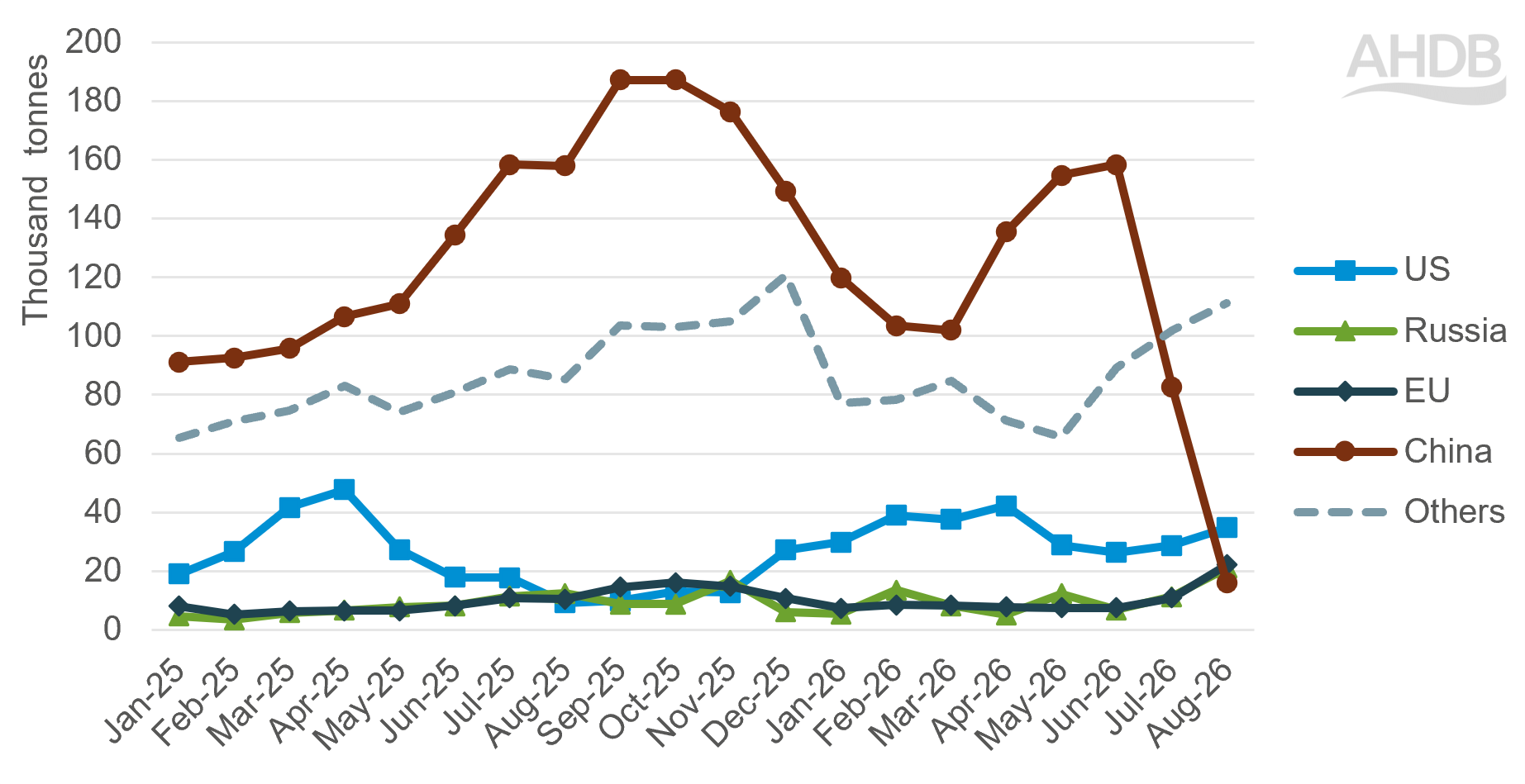
Brazilian beef exports to China followed suit, plummeting 90% between June and August, equivalent to a loss of just under 142,300 tonnes.

Some of the Chinese decline was offset by increased volume shipped to the US, Russia and the EU. However, much appears to have remained on the domestic market. Brazilian beef export volumes were down 26% year-on-year in August, having been up by 15% year-on-year in June.

Slowing export performance has weighed on Brazilian cattle prices but retention-led tightness in cattle supply is expected to add support to prices longer-term.

Figure 2: Monthly Brazilian beef export volumes by trade partner, January 2025 to August 2026

Source: Brazil Ministry of Development, Industry and Trade via Trade Data Monitor LLC

The line chart in Figure 2 shows trends in monthly Brazilian export volumes of fresh, frozen and processed beef over the past 18 months.

EU bans Brazilian beef: another market closes

Brazilian beef exports to the EU surged ahead of the 3 September ban, with traders eager to secure supply. In August, 20,000 tonnes was shipped by Brazil to the EU. Previous months' shipments totalled between 7,000 to 9,000 tonnes.

Brazil has historically accounted for around 30% of EU beef imports, equivalent to around 70,000 to 90,000 tonnes annually across fresh, frozen and processed products. The absence of that supply is therefore significant.

It remains too early to draw firm conclusions on the wider market impact. European cattle prices began to strengthen in the second half of August, but isolating the effect of the Brazilian ban from other market drivers is challenging at this stage.

For the UK, import volumes remain a key area to monitor. Although official UK trade data is reported with a two-month lag, Brazilian export statistics provide a timelier indication of market developments. The figures show that beef shipments from Brazil to the UK continued to grow in August, albeit from a relatively low base.

Brazil exported just over 3,200 tonnes of beef to the UK during August, up 9% on July and up 52% on the same month last year. This was 2% of Brazil’s total beef export volume during August.

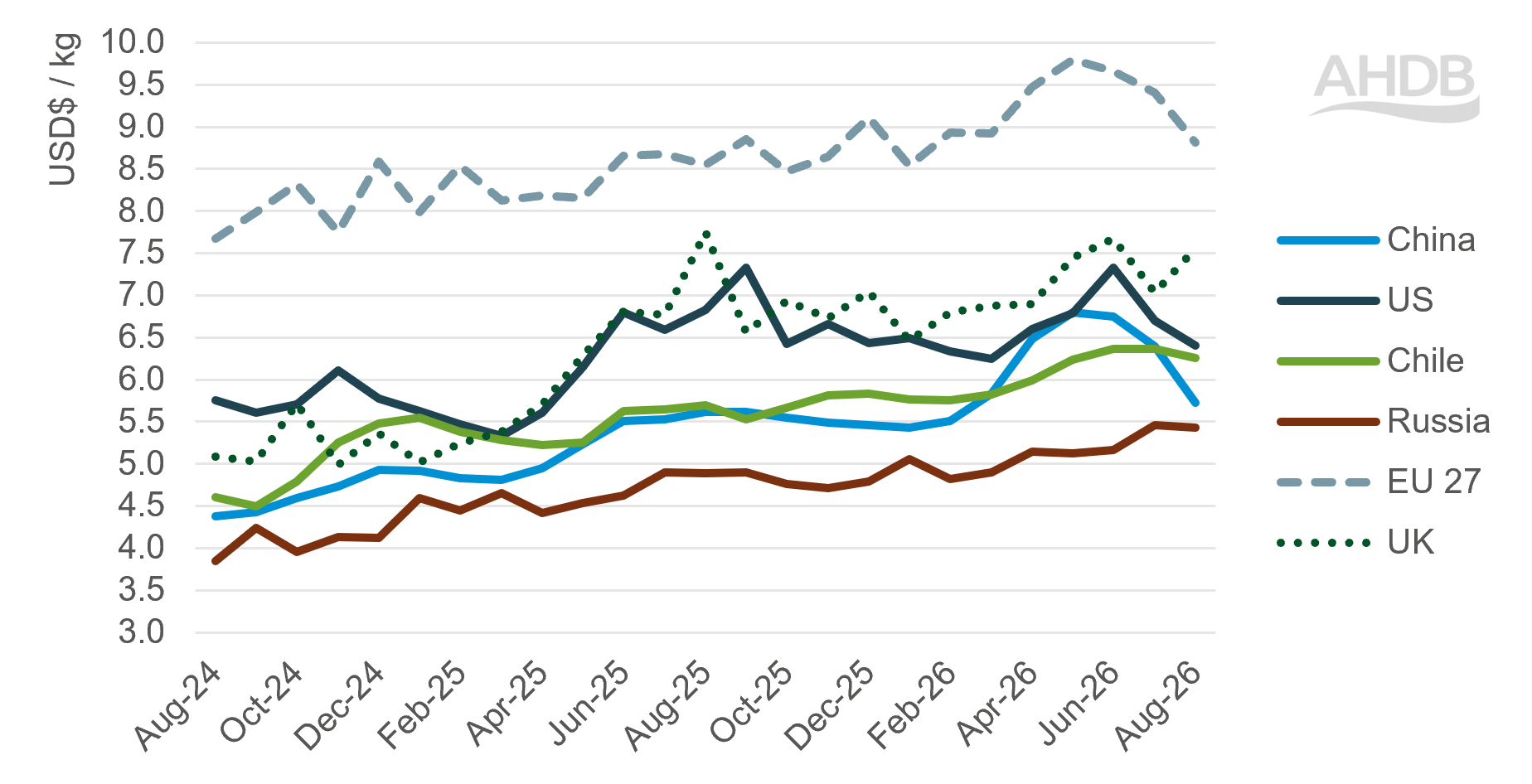
While the EU is a relatively small market for Brazilian beef in volume terms, it is an exceptionally high-value market. Consequently, the loss of access has the potential to have a disproportionately large impact returns within the Brazilian sector. Achieving access into other high-value markets such as Japan and South Korea, would be a timely development for Brazilian traders.

Figure 3. Monthly Brazilian beef export prices to selected partner countries, USD$ per kg from August 2024 to August 2026

Source: Brazil Ministry of Development, Industry and Trade via TDM LLC

The line chart in Figure 3 illustrates differences in monthly average Brazilian beef export prices over the past two years between selected end markets, including EU, China and UK. Prices are on a Free On Board (FOB) basis, meaning all costs associated with delivery from the manufacturer to the exporting ship / port are included, but freight, insurance and other fees are excluded.

Trump’s quota waiver: temporary outlet for some displaced beef?

The US has an opposing issue. Domestic cattle numbers are at historically low levels, and beef prices are historically high. In response, President Trump has temporarily waived out-of-quota tariffs on up to 300,000 tonnes of imported lean beef trimmings for a period of 90 days, beginning 1 September.

For context, the US imported 1.6 million tonnes of boneless chilled and frozen beef in 2025, meaning the measure represents a meaningful, but perhaps not transformational, increase in potential import volumes.

Importantly, the quota waiver excludes countries that have their own quota allocations, such as Australia. Australia already benefits from substantial preferential access to the US market, with tariff-free quota access of around 450,000 tonnes.

Brazil, however, stands to benefit. Brazilian exporters typically exhaust their standard US quota very early in the year and subsequently face a 26.4% out-of-quota tariff. The temporary waiver removes that tariff burden, improving the competitiveness for Brazilian lean beef into the US market and creating an additional outlet at a time when other trade restrictions are in place.

The waiver applies specifically to lean manufacturing beef used in ground beef production. While this provides some relief for Brazilian exporters, it does not fully compensate for restricted access to the higher-value EU market.

UK market consequences

Taken together, these developments illustrate how interconnected the global beef market has become. China's safeguard quotas and the EU's restrictions on Brazilian beef are removing demand from two major destinations, while the US is simultaneously opening additional access for manufacturing beef.

While alternative destinations have absorbed some of this volume, redirecting beef is not always straightforward. Different markets require different product specifications, certifications and cut preferences, meaning a tonne lost in one market cannot necessarily be replaced by a tonne sold elsewhere.

The result is a rapid reshaping of global trade flows, with exporters competing to redirect product into alternative markets.

While the impact on UK prices and trade flows looks modest at this early stage, there is concern that these changes could mean more Brazilian beef coming into the UK, and more competition for UK beef exports. Important indicators to monitor over the coming months will be UK import volumes and export performance.


Sign up for regular updates

You can subscribe to receive Beef and Lamb market news straight to your inbox. Simply fill in your contact details on our online form.

Visit the Keep in touch page

While AHDB seeks to ensure that the information contained on this webpage is accurate at the time of publication, no warranty is given in respect of the information and data provided. You are responsible for how you use the information. To the maximum extent permitted by law, AHDB accepts no liability for loss, damage or injury howsoever caused or suffered (including that caused by negligence) directly or indirectly in relation to the information or data provided in this publication.

All intellectual property rights in the information and data on this webpage belong to or are licensed by AHDB. You are authorised to use such information for your internal business purposes only and you must not provide this information to any other third parties, including further publication of the information, or for commercial gain in any way whatsoever without the prior written permission of AHDB for each third party disclosure, publication or commercial arrangement. For more information, please see our Terms of Use and Privacy Notice or contact the Director of Corporate Affairs at info@ahdb.org.uk  © Agriculture and Horticulture Development Board. All rights reserved. 

×