EU red meat short term outlook – mid-year update 2026

Wednesday, 5 August 2026

The European Commission has updated their short-term outlook for 2026. This article dissects the key statistics and forecasts for the beef, lamb and pork sectors.

Key points

  • EU beef and veal net production is forecast to drop 2% from 2025 in 2026f, with import volumes increasing and export volumes declining.
  • Pork net production is forecast to remail relatively stable, increasing by 0.3% year on year in 2026f. Imports are expected to drop 3% while exports fall 0.5%.
  • Lamb has the biggest forecasted change, with net production forecast to drop 4% in 2026. This is alongside a 7% increase in imported volume and 3% decline in exported product.

Beef and Veal

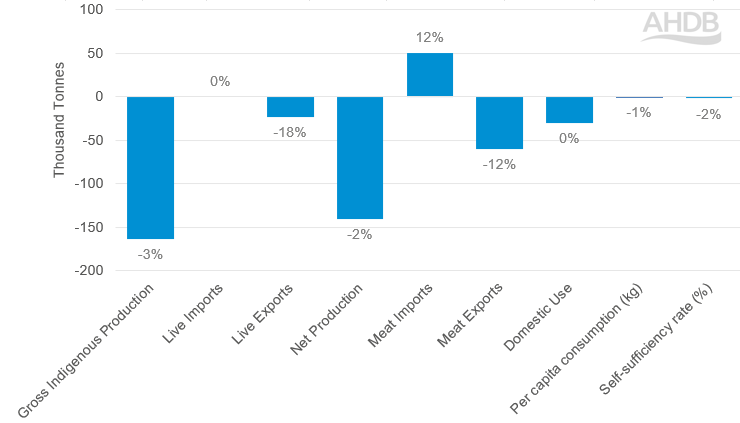
Net production of beef and veal for 2026 is forecast to drop 2% year on year, bringing the total volume to 6.25 million tonnes. This is a slightly bigger decrease than forecast at the beginning of the year, due to the ongoing structural decline of the herd.

Per capita consumption of beef is forecast to decline 1% on 2025 in the latest data. This continues a trend of long-term decline, with per capita consumption down from 12kg per person in 2006 to 9.7kg in the 2026 forecast.

Beef imports to the bloc are forecast to increase to 469,000 tonnes, up 12% year-on-year. In the first 5 months of the year (Jan-May), beef imports into the EU have been up 22% year-on-year, with Brazil being the largest supplier (30%), and the UK being the second largest (26%).

The EU is planning to bring in restrictions on Brazilian beef from September 2026 over antimicrobial concerns, which will influence trade volumes in the second half of the year. Reduced Brazilian access to the EU market may present opportunities for UK exports, but there is also a risk that some Brazilian product could be redirected to the UK, a key watchpoint.  

EU exports of beef are now expected to drop 12% in 2026 to 440,000 tonnes. This reduction in exports reflects tight domestic supply, and the steady consumption demand domestically.

This would bring the total volume of product produced in the EU, plus the net trade balance of beef and veal to 6.4 million tonnes over the year, down 3% on 2025 levels.

Figure 1: EU updated 2026 beef outlook - 2026f/2025 year-on-year change

  Forecasted 2025 volume changes for EU beef, with % changes.

Source: European Commission, AHDB calculations

Figure 1 shows the forecasted year-on-year changes in the volume of EU beef for key market metrics, production, trade and consumption. Data call outs show the % change in figures 2026f/2025.

Pig meat

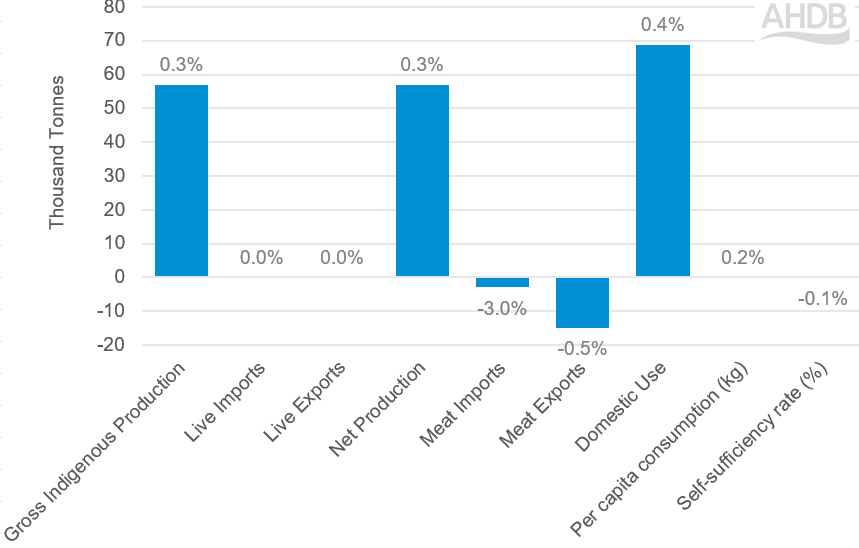
Net pig meat production for 2026 is forecast to remain relatively stable on 2025, rising just 0.3%, up to 22.1 million tonnes. This relatively stable production of pork come after 2 years of increased production and sits in line with a 0.6% increase in the size of the sow herd.

Per capita consumption is forecast to stay the same, with the 2025 and 2026 figures both at 33.1kg/capita.

Imported volumes of pigmeat are expected to drop 3% in 2026, reaching 94,900 tonnes, whilst export volumes are forecast to drop 0.5% to 2.97 million tonnes. This comes after exports decreased 1.9% out of the EU over the first 5 months of 2026 compared to 2025. Outbreaks of African Swine Fever in Spain, China’s anti-dumping tariffs and increased competition from Brazil in the Asian markets are driving this forecast.

EU pig prices have been lower in the year to date due to oversupply in the market. Additionally, ASF outbreaks, notably in Spain have meant that exported product has been rerouted back into the EU market, adding additional product to the mix. Despite this, overall pork production in the 2026f is set to remain relatively stable, with net production plus the trade balance resulting in a 0.3% increase in pork availability totalling 22.2 million tonnes.

Figure 2: EU updated 2026 pork outlook – 2026f/2025 year-on-year change

Forecasted 2025 volume changes for EU Pork, with % changes.

Source: European Commission, AHDB calculations

Figure 2 shows the forecasted year-on-year changes in key market metrics, production, trade and consumption for EU pigmeat. Data callouts show the % change in figures 2026f/2025.

Sheep meat

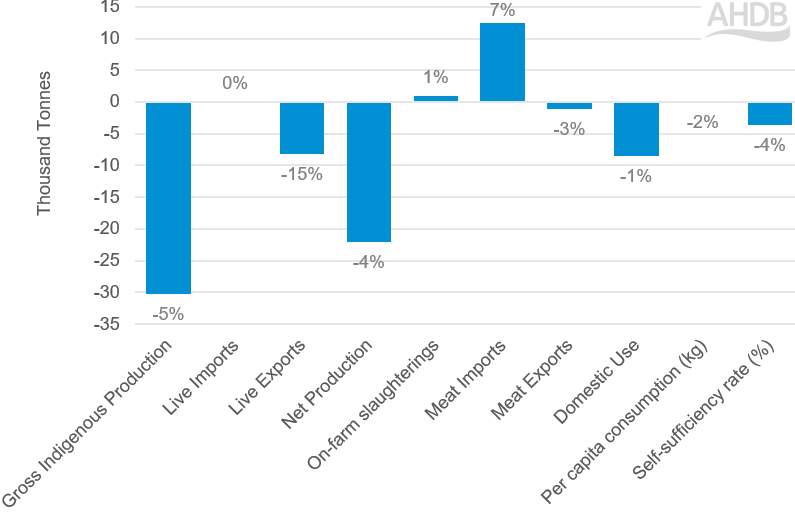
Net sheep meat production is forecast to drop 4% in 2026, totalling 478,800 tonnes.

Production of sheep meat across the EU has been steadily declining over time, now being just over half of the volume produced in 2000. This reflects a structural decline in the flock combined with disease and weather pressures in recent years.

Consumption of lamb is set to decrease by 2% in 2026, to total 1.2kg per capita.

Turning to trade, exports of lamb are set to decrease 3%, which brings the volumes exported for the 2026 forecast period to 35,800 tonnes. Meanwhile, imports for 2026 are forecast to rise 7%, bringing the total volume up to 189,400 tonnes.

As a result, net production plus the trade balance will result in a 5% drop in product available, totalling 522,000 tonnes.

Figure 3: EU updated 2026 lamb outlook - 2026f/2025 year-on-year change

Forecasted 2025 volume changes for EU Lamb, with % changes.

Source: European Commission, AHDB calculations

Figure 3 shows the forecasted year-on-year changes in key market metrics, production, trade and consumption for EU sheep meat. Data callouts show the % change in figures 2025/2026f.

Image of staff member Molly Corbett

Molly Corbett

Analyst (Livestock)

See full bio


Sign up for regular updates

You can subscribe to receive Beef and Lamb market news straight to your inbox. Simply fill in your contact details on our online form.

Visit the Keep in touch page

While AHDB seeks to ensure that the information contained on this webpage is accurate at the time of publication, no warranty is given in respect of the information and data provided. You are responsible for how you use the information. To the maximum extent permitted by law, AHDB accepts no liability for loss, damage or injury howsoever caused or suffered (including that caused by negligence) directly or indirectly in relation to the information or data provided in this publication.

All intellectual property rights in the information and data on this webpage belong to or are licensed by AHDB. You are authorised to use such information for your internal business purposes only and you must not provide this information to any other third parties, including further publication of the information, or for commercial gain in any way whatsoever without the prior written permission of AHDB for each third party disclosure, publication or commercial arrangement. For more information, please see our Terms of Use and Privacy Notice or contact the Director of Corporate Affairs at info@ahdb.org.uk  © Agriculture and Horticulture Development Board. All rights reserved. 

×