Q1 2026 dairy trade review: export volumes continued to grow

Thursday, 21 May 2026

Key trends

  • Total UK dairy export volume for Q1 2026 increased 2% year-on-year at 326,000 tonnes driven by powders, yogurt, butter and cheese
  • Total UK dairy export value stood at £478 million, down 7% year-on-year, due to falling commodity prices
  • Total import volumes and value were up, driven by powders, yogurt and cheese

UK dairy exports continued to grow

Total export volumes of dairy products from the UK for Q1 2026 increased 2% year-on-year driven by non-EU exports which increased by 9,000 tonnes. Exports of dairy products to the EU declined by 1,400 tonnes probably due to strong milk supplies and production in the EU region.

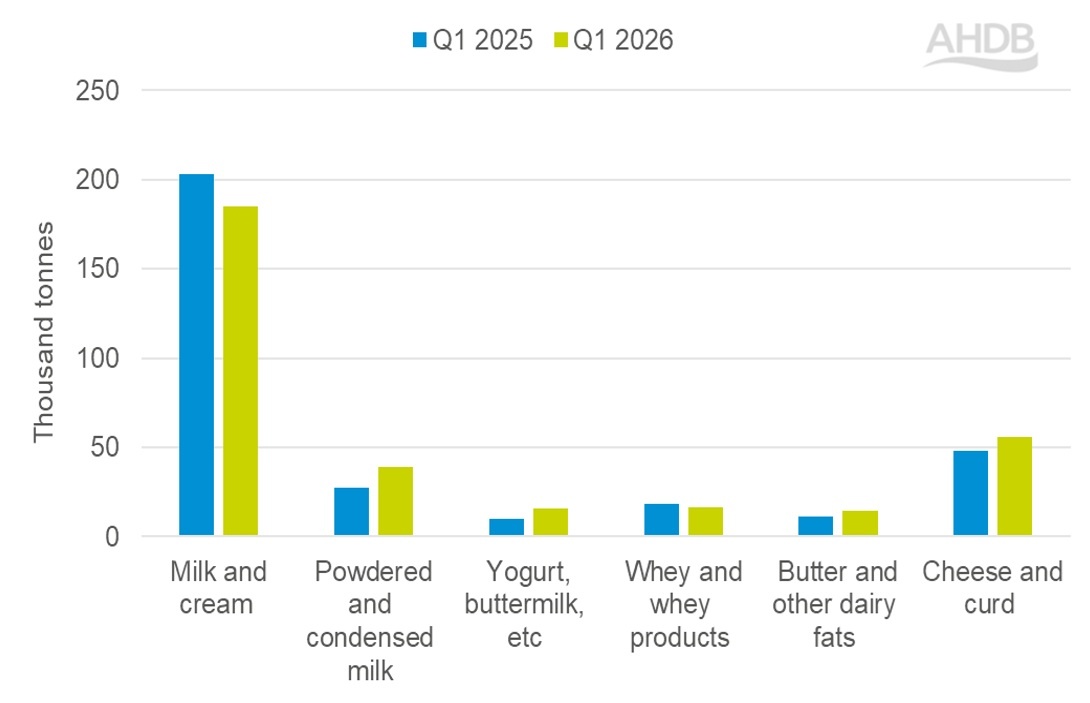
The overall increase was largely driven by an increase in the exports of powders, yogurt, butter and cheese. A decline in the exports of milk and cream by 17,800 tonnes (8.8%) and whey by 2,500 tonnes (13.5%) during the period limited overall upside movement. Though overall exports increased in terms of quantity, there was a fall in value terms for all commodities due to lower prices except for powders and yogurt. The data covers the period until March 2026, therefore does not fully capture the impact on export volumes resulting from the war in the Middle East. It is anticipated that there will be an impact on exports to the Middle East and Asia in Q2 and beyond.

Powders

Powders saw the biggest year-on-year volume increase, up by 11,600 tonnes (42.4%): bound for both EU nations such as Italy, Ireland, the Netherlands, Belgium and Spain, and non-EU nations including the United Arab Emirates, Egypt, Libya, Morocco, Bangladesh, the Philippines, Thailand and Singapore. We are globally competitive in SMP pricing compared to the USA, Oceania and the EU. Plentiful milk volumes during the last milk season have increased the availability of SMP at competitive rates.

Exports to China, one of the major dairy importers declined in Q1 2026 year-on-year. Continued weaker consumer buying interest and decreasing population are driving lower exports to China.

Cheese

Exports of cheese have been increasing since the second quarter of 2025 and are now at the highest quarterly level seen in the last six years. Export volumes of total cheese increased by 15.6% (+7500 tonnes) year-on-year.

Globally, the biggest increase in cheese volumes were reported to the EU including the Netherlands (+3500 tonnes), Belgium (+1700 tonnes) and France (+700 tonnes). This was followed by an increase to Asia and Oceania including China (+500 tonnes) and Indonesia (+200 tonnes).

Exports also picked up to the Middle East and North Africa (MENA): Bahrain (+600 tonnes), Israel (+200 tonnes), Saudi Arabia (+200 tonnes) and Lebanon (+200 tonnes). However, the current conflict in the Middle East could affect exports to the region in the second quarter due to logistical challenges. Increasing price competitiveness and availability from the USA due to expansion of cheese capacity may also pressurise British exports, particularly for industrial use.

Butter

Export volumes of butter increased by 26.7% (+3000 tonnes) in Q1 2026 year-on-year. However, in terms of value, it declined by 17% as the average price of butter remained far lower in the first quarter of 2026 compared with the same period previous year.

The biggest increases went to Europe (Belgium (+1100 tonnes), Germany (+600 tonnes), Poland (+600 tonnes) and Malta (+600 tonnes)) followed by the Middle East and North Africa (+1000 tonnes). A decline in exports to Asia and Oceania (-200 tonnes) limited the overall upside movement.

Yogurt

Exports of yogurt increased significantly by 58% (+5700 tonnes) in Q1 2026 after declining during the last few quarters.

Increase in exports to the EU: Ireland (+4900 tonnes) and France (+200 tonnes) and Asia and Oceania: Hong Kong (+700 tonnes), Middle East and North Africa: the United Arab Emirates (+300 tonnes) supported the upwards move. In value terms also, exports contributed to the basket in the first quarter.

Overall dairy exports to the EU constituted around 87% of total UK exports.

Figure 1. UK dairy products exports, Jan-Mar (Thousand tonnes)

Q1 2026 dairy exports

Source: HMRC compiled by Trade Data Monitor LLC

Figure 1 bar chart compares UK dairy export volumes (in thousand tonnes) across six product categories for Q1 2025 and Q1 2026. Each category shows two bars: blue for Q1 2025 and yellow‑green for Q1 2026.

UK dairy imports edged up

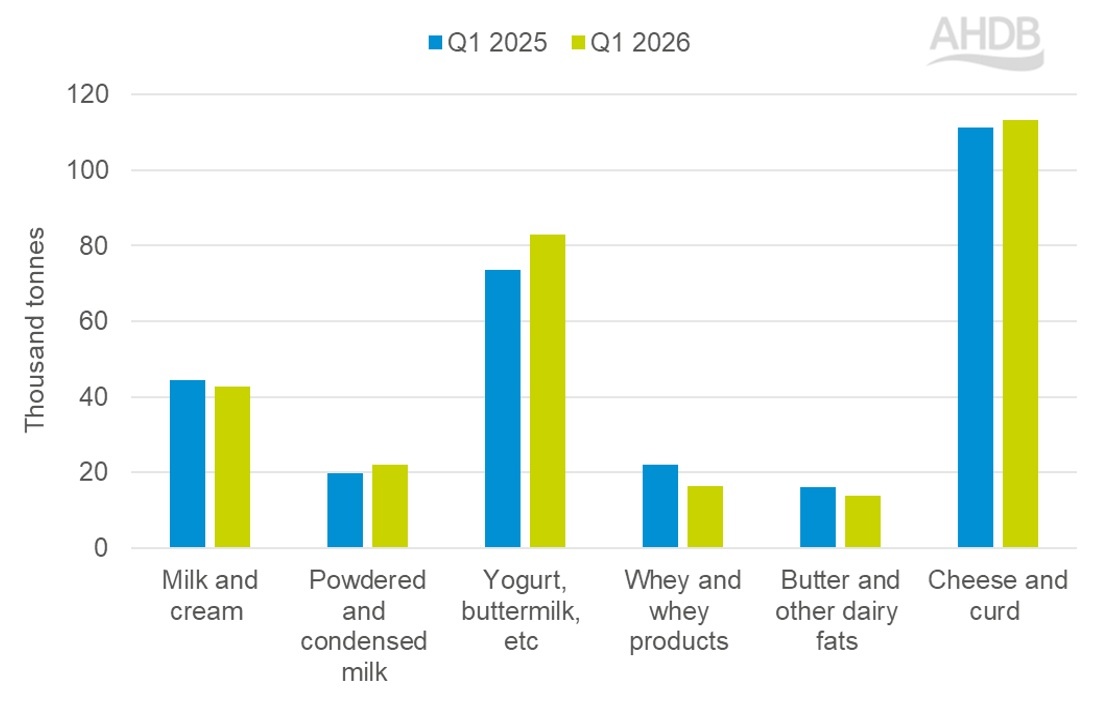
UK dairy imports increased by 1.5% (4,200 tonnes) to 291,400 tonnes in Q1 2026. Imports from EU nations increased by 1.2% (+3,200 tonnes) and imports from non-EU countries increased by 10.2% (+1,000 tonnes) mainly from Australia (+800 tonnes).

Total import changes by category included:

  • Yoghurt: up 9,400 tonnes (12.7%)
  • Milk powders: up 2,200 tonnes (11%)
  • Cheese and curd: up 2,200 tonnes (2%)
  • Whey and whey products: down 5600 tonnes (–25.5%)
  • Butter: down 2,100 tonnes (–13.3%)
  • Milk and cream: down 1,700 tonnes (–3.8%)

Imports from Greece saw the biggest increase (7,400 tonnes), followed by Spain (2600 tonnes), Switzerland (1800 tonnes), Denmark (1,500 tonnes) and France (1,000 tonnes). A growing appetite for proteins is fuelling imports.

Figure 2. UK dairy products imports (Jan–Mar, thousand tonnes)

Q1 2026 dairy imports

Figure 2 bar chart compares UK dairy import volumes (in thousand tonnes) across six product categories for Q1 2025 and Q1 2026. Each category shows two bars: blue for Q1 2025 and yellow‑green for Q1 2026.

Road Ahead

Record milk volumes this season have significantly increased the availability of dairy products. Exports play a crucial role in absorbing the excess stocks and at the same time enhancing value across the entire supply chain. The exports team have a mission to build on record year for British dairy exports.

Exporters can capitalise on the growing demand for proteins and focus on exports of powders, yogurt, whey and cheese. Value-added products like British speciality cheese, butter and ice cream alongside other functional proteins are gaining popularity worldwide. and other functional proteins are gaining popularity worldwide. The exports team have been organising events throughout the year and are aiming to diversifying into emerging markets like Asia and Middle East and North Africa (MENA countries).Most recently with the teams largest ever presence at the Food and Hotel Asia show in Singapore where they were joined by eight companies on stand including premium ice cream and butter exporters. 


Sign up to receive the latest information from AHDB.

While AHDB seeks to ensure that the information contained on this webpage is accurate at the time of publication, no warranty is given in respect of the information and data provided. You are responsible for how you use the information. To the maximum extent permitted by law, AHDB accepts no liability for loss, damage or injury howsoever caused or suffered (including that caused by negligence) directly or indirectly in relation to the information or data provided in this publication.

All intellectual property rights in the information and data on this webpage belong to or are licensed by AHDB. You are authorised to use such information for your internal business purposes only and you must not provide this information to any other third parties, including further publication of the information, or for commercial gain in any way whatsoever without the prior written permission of AHDB for each third party disclosure, publication or commercial arrangement. For more information, please see our Terms of Use and Privacy Notice or contact the Director of Corporate Affairs at info@ahdb.org.uk  © Agriculture and Horticulture Development Board. All rights reserved. 

×