Flexitarian eating explained: It’s not all about going meat-free

Thursday, 21 May 2026

‘Flexitarianism’ is still a confusing term for many within the protein market. For years, it’s been treated as a vague middle ground between meat eaters and plant‑based consumers. But the data shows a far more polarised picture, one defined not by ideology but by economics.

Key takeaways

Are consumers choosing to reduce their meat consumption in 2026?

  • Most flexitarians (reducing their meat consumption) still eat meat regularly while meat-free meals are in decline
  • There are two distinct groups of flexitarians with different motivations driven by cost, health and quality
  • Red meat remains a key elevator of mealtimes even among those cutting back

How many consumers are flexitarians?

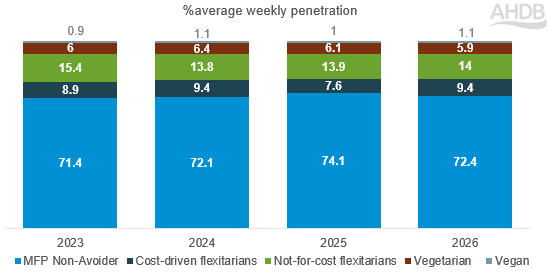
In 2026, 23.4% of the UK population identified as flexitarians (reducing their meat consumption). For comparison, 72.4% of consumers eat meat, fish and poultry (MFP), 5.9% are vegetarian and 1% are vegan[1].  

Figure 1: Average weekly penetration of consumers eating trends 2023–2026

% penetration of meat eaters, flexitarians, vegetarians & vegans 2023-26

Figure 1 shows the percentage of consumers eating MFP (72.4%), flexitarians driven by cost (9.4%), flexitarians not for cost (14%), vegetarians (5.9%) and vegans (1.1%). There has been an increase in flexitarians driven by cost from 7.6% to 9.4% in the last year, which is back to levels seen in 2024.

According to Worldpanel by Numerator, flexitarians fall into two clear camps: cost‑driven flexitarians and not‑for‑cost flexitarians. Their motivations, behaviours and protein choices diverge sharply, and the meat industry can no longer afford to treat them as one.

Cost‑driven flexitarians (9.4% share): The growing budget stretchers

The cost‑driven flexitarians have grown in importance, adding 1.2 million consumers year-on-year, as food inflation reshapes household priorities.

This segment is typically less affluent and often family focused. They navigate tight budgets while still wanting meals that feel satisfying and familiar.

Their behaviour is defined by:

  • Value‑led choices: more likely to eat primary pork rather beef, lamb or fish and cheaper cuts such as mince, burgers and sausages
  • Convenience: red meat forms a regular part of their meals, but these are usually quick and easy to prepare options. They are more open to treats for the family to enjoy
  • Meal‑stretching staples: due to cost constraints they are adding more dry pasta, baked beans and baked goods to bulk out their meals

Despite financial pressure, 67.1% of their evening meals still contain meat, fish or poultry, and the presence of MFP in those meals has grown by 1.7ppt year‑on‑year.

Cost-driven flexitarians have reduced their consumption of beef and lamb at main meals year-on-year – by -0.8ppt and -0.1ppt, respectively – due to high inflation and the average price of beef rising by 16% year-on-year [2], while total pork has increased by 0.3ppt points.

Pork provides an affordable option for these consumers and offers versatility, which is highlighted in AHDB’s This is British Pork campaign.

Not‑for‑cost flexitarians (14% share): The health‑led quality seekers

The not‑for‑cost flexitarians are more affluent, often post‑family, motivated by health and wellbeing and like adding good elements to their diets. They spend more per meal and are the most open to premium options.

Their behaviour is shaped by:

  • Health‑driven choices: more likely to eat primary chicken, fish, yogurt, fruit and vegetables
  • Perceptions of lighter proteins: looking for a more natural and less processed diet with added health benefits   
  • A willingness to pay for quality, provenance and nutrition: chicken and fish dominate their protein choices, driven by a blend of health perception and value‑for‑money logic

Even in this group, MFP remains central: 47.4% of their evening meals include meat, fish or poultry, and this share has remained stable despite rising prices.

But like their cost‑driven counterparts, they are also reducing how frequently they eat beef and lamb, though for different reasons. For them, it’s less about price and more about perceived health benefits.

Only 9% of main meals consumed by not-for-cost flexitarians include primary red meat, so campaigns like AHDB’s Let’s Eat Balanced are key for highlighting the natural health benefits of red meat as part of a balanced diet.

Flexitarians are not eating more meat‑free meals

The narrative that flexitarianism equals plant‑based eating simply doesn’t hold up. According to Worldpanel by Numerator, the number of vegetarian and vegan meals eaten in the home are down – by -2% and -1%, respectively, year-on-year.

As for meat substitutes, these feature in less than 3% of all main meals and again are in decline year-on-year.

Flexitarianism today is not about a shift to a meat‑free diet; it’s a rebalance within red meat, fish and poultry. As the total number of consumers claiming to be flexitarian has grown by 1.3 million consumers this year, many are turning to cheaper proteins like chicken in response to the rise in cost of living.

Health is rising but enjoyment rules

Across both flexitarian groups, health perceptions are growing, but they remain a minor factor influencing meal choices. Within health, food that is more natural and less processed is becoming more important to this cohort, as it provides an opportunity for the natural health benefits that red meat provides as part of a balanced diet.

While health is important, enjoyment and taste still win at mealtimes, and this is where red meat and dairy retain their edge.

Even though only 11% of MFP meals contain primary red meat, and just 8–9% among flexitarians, when red meat is chosen, it plays a distinctive emotional role: indulgence, comfort, celebration and elevation.

For example, a beef or pork mince dish, such as chilli-con-carne or spaghetti bolognese, can satisfy all emotional needs while delivering on taste and within a budget. This is the territory where meat‑free alternatives continue to struggle. 

Opportunities for red meat

  • Highlight affordable, family-friendly meal options containing red meat to appeal to the cost-driven flexitarians
  • Reposition red meat as a naturally, nutrient-dense, minimally processed, high-quality protein which fits into a healthy, balanced diet when eaten in moderation
  • Encourage consumers to treat themselves to a meal with red meat as the centrepiece, where friends and family can come together, for example, a roast dinner or a chilli

(1) Worldpanel by Numerator Usage, Total In-home and Carried Out occasions, 52 w/e 22 February 2026

(2) Worldpanel by Numerator UK, 52 w/e 19 April 2026

Image of staff member Vanessa Adamson

Vanessa Adamson

Retail and Consumer Insight Manager

See full bio


Sign up to receive the latest information from AHDB

Stay in contact


While AHDB seeks to ensure that the information contained on this webpage is accurate at the time of publication, no warranty is given in respect of the information and data provided. You are responsible for how you use the information. To the maximum extent permitted by law, AHDB accepts no liability for loss, damage or injury howsoever caused or suffered (including that caused by negligence) directly or indirectly in relation to the information or data provided in this publication.

All intellectual property rights in the information and data on this webpage belong to or are licensed by AHDB. You are authorised to use such information for your internal business purposes only and you must not provide this information to any other third parties, including further publication of the information, or for commercial gain in any way whatsoever without the prior written permission of AHDB for each third party disclosure, publication or commercial arrangement. For more information, please see our Terms of Use and Privacy Notice or contact the Director of Corporate Affairs at info@ahdb.org.uk  © Agriculture and Horticulture Development Board. All rights reserved. 

×