Strong Q1 exports driven by robust continental demand: Lamb market update

Monday, 1 June 2026

UK lamb export volumes rose in Q1, driven by demand from Germany and France. Meanwhile, New Zealand lamb imports to the UK slowed. Will Australia fill that gap?

Key points

  • The UK's sheep meat export volumes grew by 19% in Q1 2026 versus the same period of last year, driven by increased EU demand and tight supply on the continent.
  • Meanwhile, sheep meat import volumes remained consistent year-on-year in Q1, while the value increased 23% versus last year, portraying high global prices.
  • New Zealand remain the largest supplier, but their volumes fell 9% versus the same period last year, whilst Australia’s increased by 32%.

Imports

Imported volumes of sheep meat (fresh, frozen, processed and offal) into the UK remained consistent in Jan-March (Q1) 2026, up just 0.6% on the year to total 19,200 tonnes.

Global sheep prices remain strong, with imported values continuing to increase. Q1 imported sheep meat values were up 23% versus the same period last year, at £126.5 million.

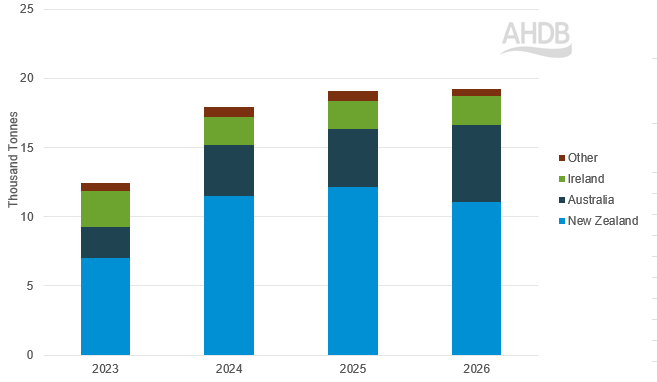
Figure 1. UK sheep meat imports by supplier

Chart showing UK lamb import volumes by origin Q1 2023-2026

Source: UK HMRC via Trade Data Monitor

The bar chart in Figure 1 shows the origin of imported sheep meat into the UK by country for Q1 of 2023-2026. The largest importer New Zealand is represented in light blue, Australia in dark blue, Ireland in green and other countries of origin in brown.

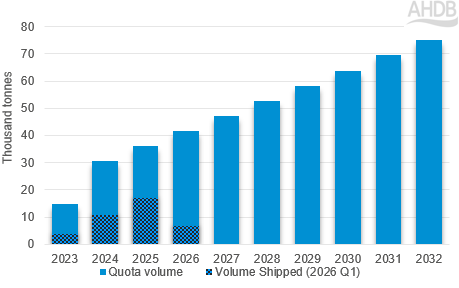
New Zealand remains the largest exporter to the UK with 11,000 tonnes of product shipped in Q1 2026. This was down by 9% on 2025, indicative of the NZ sheep flock shrinking, and diversifying export opportunities arising for New Zealand. Australian imports were up by 32% on the year previous in Q1, reaching 5,600 tonnes. Although the 2025 quota was not filled, the volumes shipped are increasing. With UK domestic supply tightening and the UK continuing to be a high value market globally, it reasons that volumes entering the UK from Australia under this FTA will likely continue to grow.

Figure 2. Australian sheep meat FTA quota usage

Chart showing Australia lamb export quota to UK 2023-2032

Source: Australian Government

The bar chat in Figure 2 shows the quota volume Australia have to export sheep meat into the UK (in blue), and the quantity the have shipped (represented by the darker shaded area). The shaded area represents the volume for the year, except in 2026 where it represents the volume shipped in Q1.

Volumes from EU27 to the UK in Q1 2026 were up by 2%, to a total of 2,400 tonnes. This is primarily made up of Irish product, which was up 4% to 2,100 tonnes.

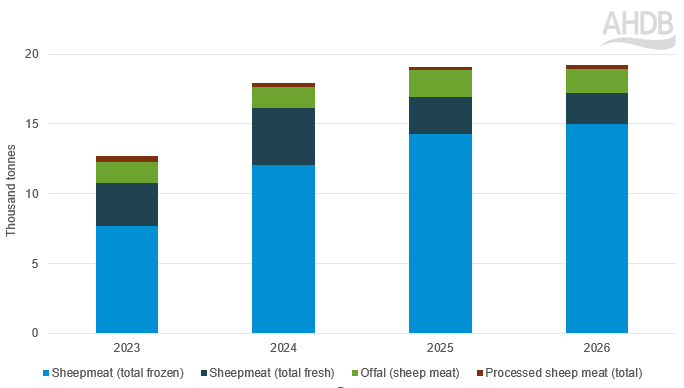
When broken down by product type, imports continue to be dominated by Australian and New Zealand frozen sheep meat. Frozen imports were up by 5% YoY in Q1 compared to 2025 to 15,000 tonnes. This was dominated by frozen leg meat (34% of total imports), frozen boneless meat (21% of total imports) and frozen bone-in cuts (10% of total imports).

Fresh sheep meat imports fell again in Q1, back 16% compared to 2025 totalling 2,200 tonnes. Much of this is boneless cuts from Australia and Ireland, and legs from New Zealand.

Offal fell by 12% to 1,700 tonnes while processed sheep meat was up 9% to 200 tonnes.

Figure 3. Sheep meat imports by product

Chart showing UK lamb import volumes Q1 2023-2026

Source: UK HMRC via Trade Data Monitor

The bar chart in Figure 3 shows the volume of sheep meat imported into the UK by product type for Q1 of 2023-2026. The largest light blue area represents frozen product, fresh is in dark blue, offal in green and processed sheep meat in brown.

Exports

Total UK sheep meat exports for Q1 of 2026 totalled 26,800 tonnes, up 19% year on year.

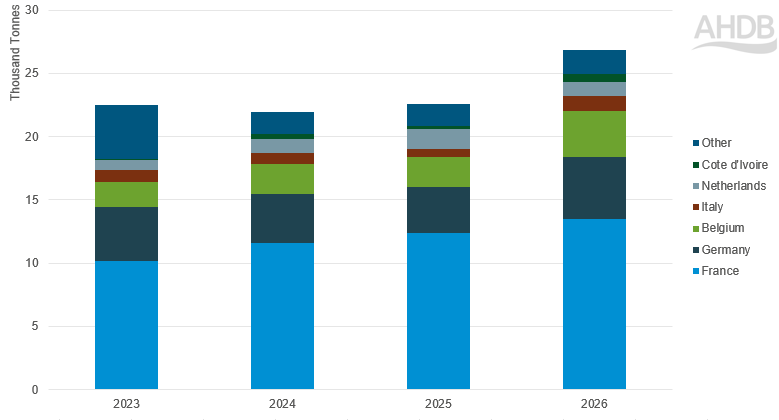
Exports to the EU grew 18% on the year. Continued supply tightness in key export partners such as France (+9%) and Germany (+35%) has driven this. This is likely not to change in the short term with a 5% fall in EU sheep meat production forecast for 2026.

Figure 4. UK sheep meat exports by destination

Chart showing UK lamb export volumes Q1 2023-2026

Source: TDM (HMRC data)

The bar chart in Figure 4 shows sheep meat export volumes by destination for Q1 of each year from 2023-2026. The biggest export destination if France represented in light blue, Germany in dark blue, followed by Belgium (green), Italy (brown), Netherlands (grey), Cote d’Ivoire (dark green) and others in navy blue.

The value of exports continues to rise, with sustained high lamb prices in the UK. The export value of sheep meat for Q1 was up by 24% YoY, to a total of £204 million.

£108 million of this was exports into France, up 15% in value compared to the 9% growth in volume into France. French demand remains firm, while deadweight lamb prices in France remain above 900p/kg.

Exports to Belgium increased by 53%, to 3,700 tonnes, while exports to Italy doubled to 1,100 tonnes.

Outside of the EU, Cote d’Ivorie was the most notable market, with Q1 exports increasing by 140%. 80% of this was offal, with the rest being frozen bone in product.

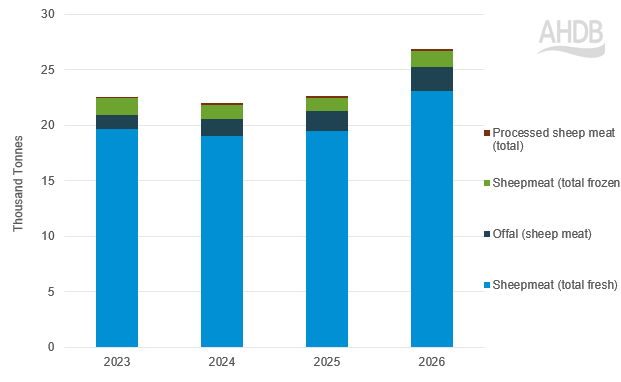
Figure 5. UK sheep meat exports by product

Chart showing UK lamb exports by cut Q1 2023-2026

Source: TDM (HMRC)

The bar chat in Figure 5 shows UK Q1 sheep meat export volumes by product from 2023-2026. The largest exported product by volume is fresh sheep meat (light blue), followed by offal (dark blue), then frozen sheep meat (green) with processed the least exported product in brown.

Fresh product continues to dominate, accounting for 86% of the total picture at 23,000 tonnes. Offal export volumes conti  nued to increase, but remains at 8% of total export volumes for the period.


Sign up for regular updates

You can subscribe to receive Beef and Lamb market news straight to your inbox. Simply fill in your contact details on our online form.

Visit the Keep in touch page

While AHDB seeks to ensure that the information contained on this webpage is accurate at the time of publication, no warranty is given in respect of the information and data provided. You are responsible for how you use the information. To the maximum extent permitted by law, AHDB accepts no liability for loss, damage or injury howsoever caused or suffered (including that caused by negligence) directly or indirectly in relation to the information or data provided in this publication.

All intellectual property rights in the information and data on this webpage belong to or are licensed by AHDB. You are authorised to use such information for your internal business purposes only and you must not provide this information to any other third parties, including further publication of the information, or for commercial gain in any way whatsoever without the prior written permission of AHDB for each third party disclosure, publication or commercial arrangement. For more information, please see our Terms of Use and Privacy Notice or contact the Director of Corporate Affairs at info@ahdb.org.uk  © Agriculture and Horticulture Development Board. All rights reserved. 

×