Steady demand amid limited production growth in the US: Pork market update

Wednesday, 1 April 2026

Key points

  • US pig prices have opened 2026 in a broadly steady position year-on-year (YoY), supported by good demand domestically and overseas
  • Pork production decreased by 1.2% between 2024 and 2025. The USDA expects production in 2026 to increase marginally, driven by productivity as herd expansion is limited
  • The March 2026 Quarterly Hogs and Pigs report indicates an inventory of all hogs and Pigs at 3 million head, a decline of 0.3% year on year.
  • US pork consumption in 2025 remained relatively stable, totalling 9.83 million tonnes, down 0.8% year-on-year
  • US pork exports totalled 3.05 million tonnes in 2025, a decline of 2% year-on-year. US export volumes are expected to grow modestly in 2026, but risks remain from geopolitical tensions, disease and the wider economic landscape

Prices

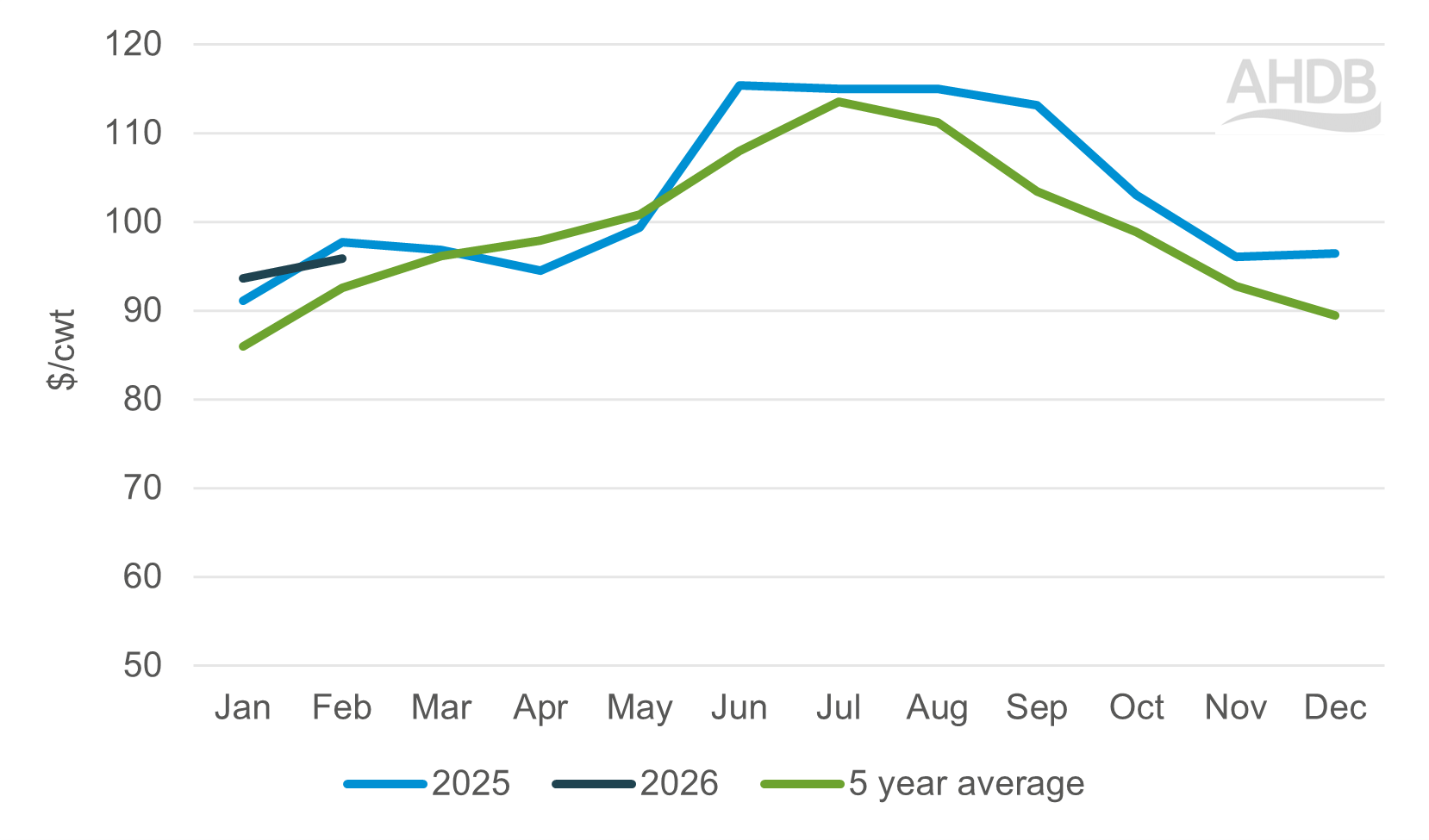
Following a stronger bout of pricing in mid-2025, US pig prices opened 2026 in a steadier position. Figure 1 shows the pork cutout composite price averaged $95.91 in February, up 2% ($2.28) on the previous month but down 2% ($1.82) year on year (YoY).

Markets are supported by steady domestic retail demand and robust export performance. Retail pork demand is benefiting from tight beef supply and strong beef prices.

According to Rabobank, these dynamics are expected to keep prices broadly stable through 2026, alongside limited supply growth. However, competition from lower priced poultry and may limit upward price movement.

Figure 1. US pork carcase cutout composite price, 2025–26 (monthly average, $/cwt)

Source: United States Department of Agriculture (USDA)

Figure 1 shows a line chart of the US pork carcase cutout composite price from January 2025 to February 2026. The price represents the USDA’s estimated wholesale value of a standardised pork carcase, in $/cwt, not the price paid to a farmer. 2025 prices are shown in light blue, 2026 prices in dark blue, and the five‑year average in light green.

Production

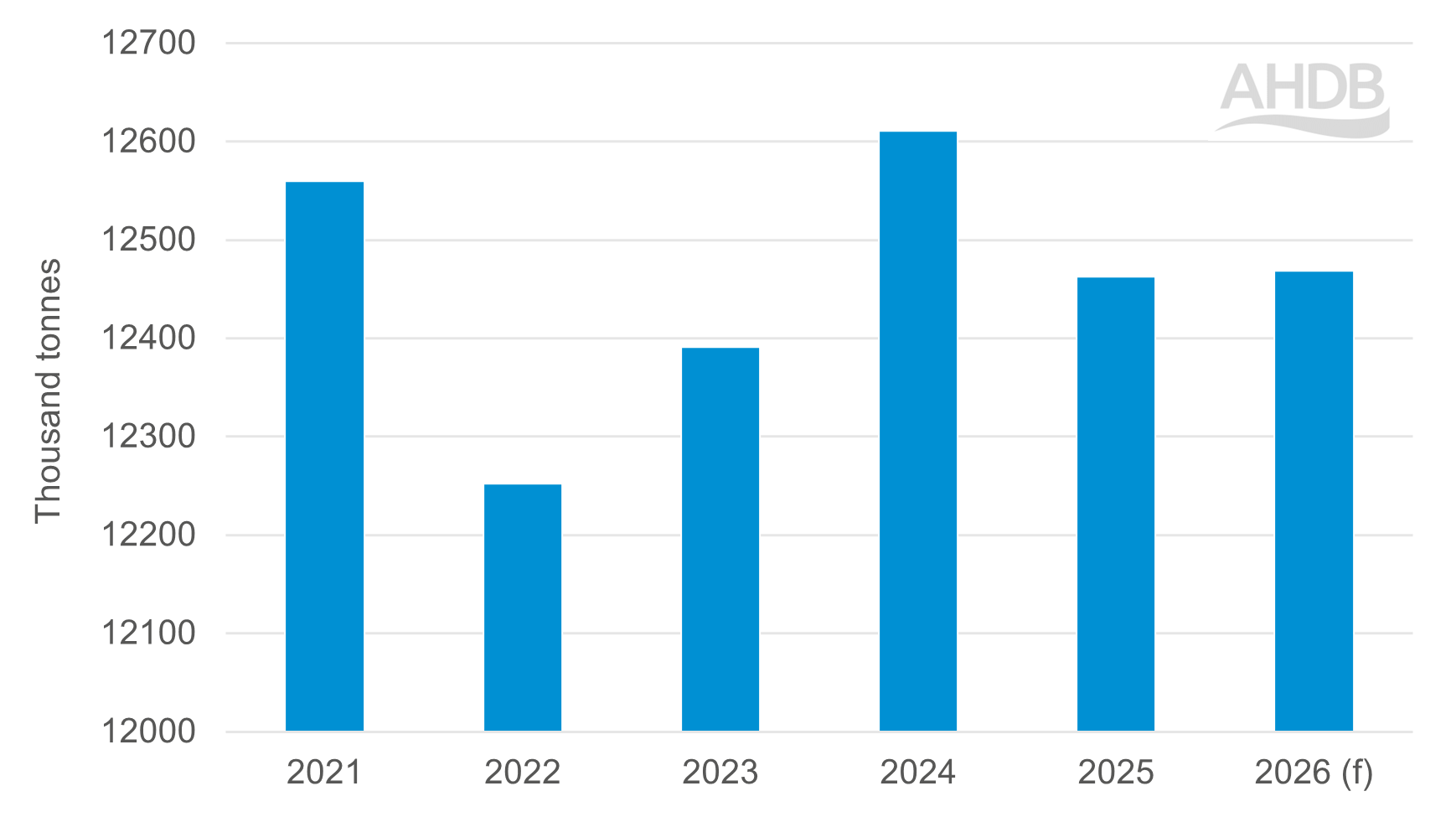
US pork production declined slightly in 2025. According to data from the USDA, production decreased by 1.2% YoY, totalling 12.46 million tonnes. This was 11% of the world’s production, putting the US in 3rd place behind China and the EU.

Looking ahead, the USDA forecasts production to grow marginally in 2026, to approximately 12.47 million tonnes.

Productivity gains are expected to offset limited herd expansion, as disease pressures, high construction costs and permitting challenges curtail any rapid growth in sow numbers.

The March 2026 Quarterly Hogs and Pigs report estimated the total US pig inventory at 74.3 million head, up 4% YoY but 1% lower than December 2025. The breeding herd declined 1% YoY to 5.89 million head.

Longer-term projections from USDA suggest production could increase by 11.2% between 2027 and 2035, indicating gradual expansion driven by efficiency gains.

Figure 2. US pork production

Source: USDA

Figure 2 shows US pork production measured in thousand tonnes from 2021 to 2026. 2026 is forecasted value.

Consumption

US pork consumption has remained relatively stable in recent years. In 2025, consumption totalled 9.83 million tonnes, a decline of 0.8% YoY.

According to the USDA, stability in pork consumption is forecast to continue, totalling around 9.81 million tonnes in 2026 (-0.2% YoY).

Pork continues to rank as the third most consumed protein in the US, behind poultry and beef. Poultry remains the most price competitive option, which continues to influence consumer demand, given inflation and cost-of-living pressures.

Exports

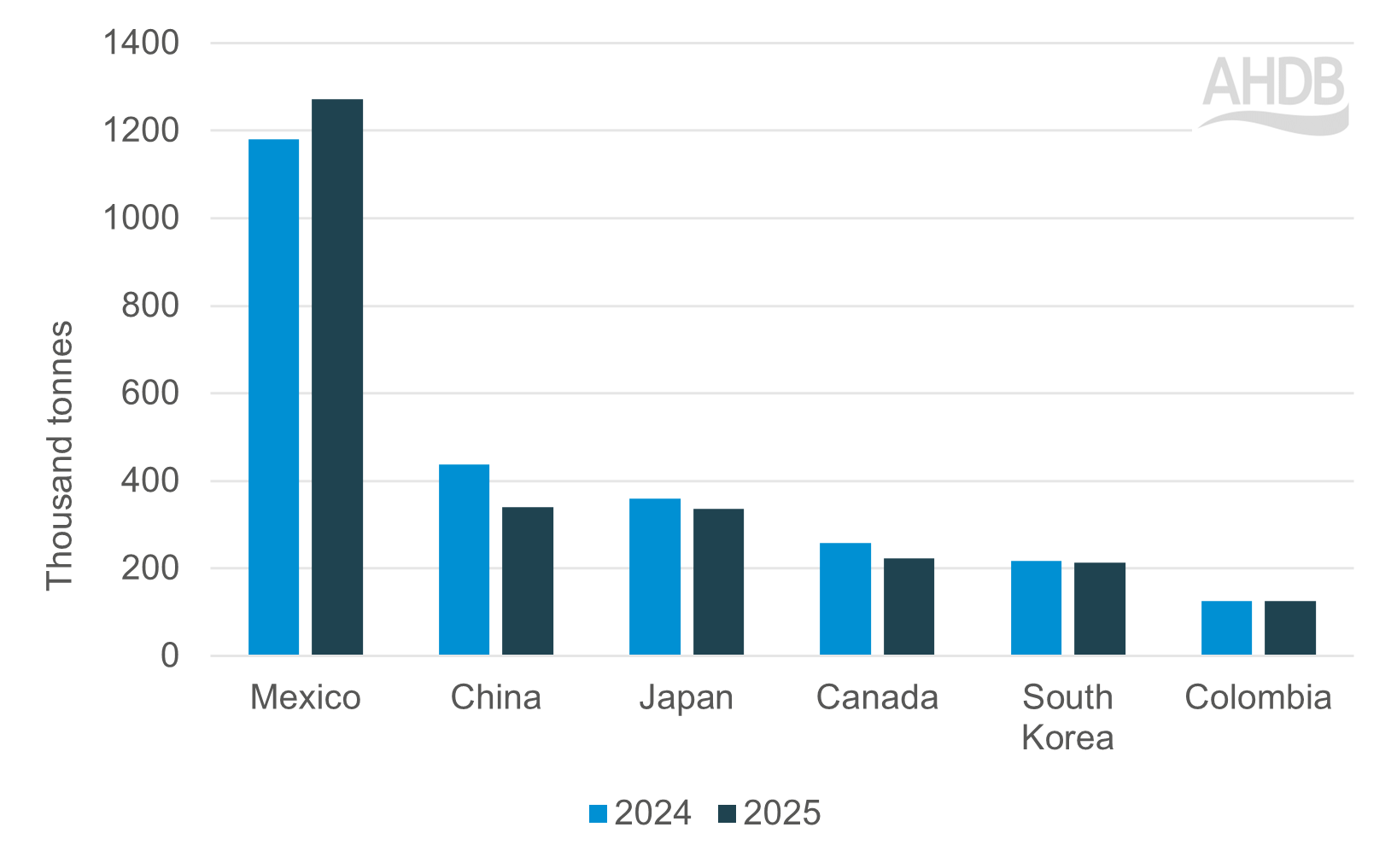
US pig meat exports totalled 3.05 million tonnes in 2025, a decline of 2% (72,000 tonnes) YoY (including fresh, frozen, processed and offal).

This was primarily driven by reduced shipments to key Asian markets. Exports to China fell by 22% (97,800 tonnes) YoY, reflecting weaker demand and geopolitical friction. Shipments to Japan also declined by 7% (24,400 tonnes) YoY, reflecting the weaker yen, high Japanese inventories and Brazilian competitiveness.

Exports to Canada also decreased, falling by 14% (35,700 tonnes) YoY.

In contrast, exports to Mexico increased by 8% (92,100 tonnes) YoY, making it a key growth market. This increase is likely linked to Mexican production challenges and favourable exchange rates, meaning key cuts such as bone-in-hams are more competitive.

Figure 3. Exports of pig meat (including offal) by destination between 2024 and 2025

Source: Trade Data Monitor LLC

Figure 3 shows US pig meat exports (including offal) between the years 2024 (light blue bars) and 2025 (dark blue bars), expressed in thousand tonnes.

Industry forecasts point to modest growth in US pork export volumes in 2026 (+2-2.5% YoY), supported by a weaker US dollar, production growth and good international demand.

Imports

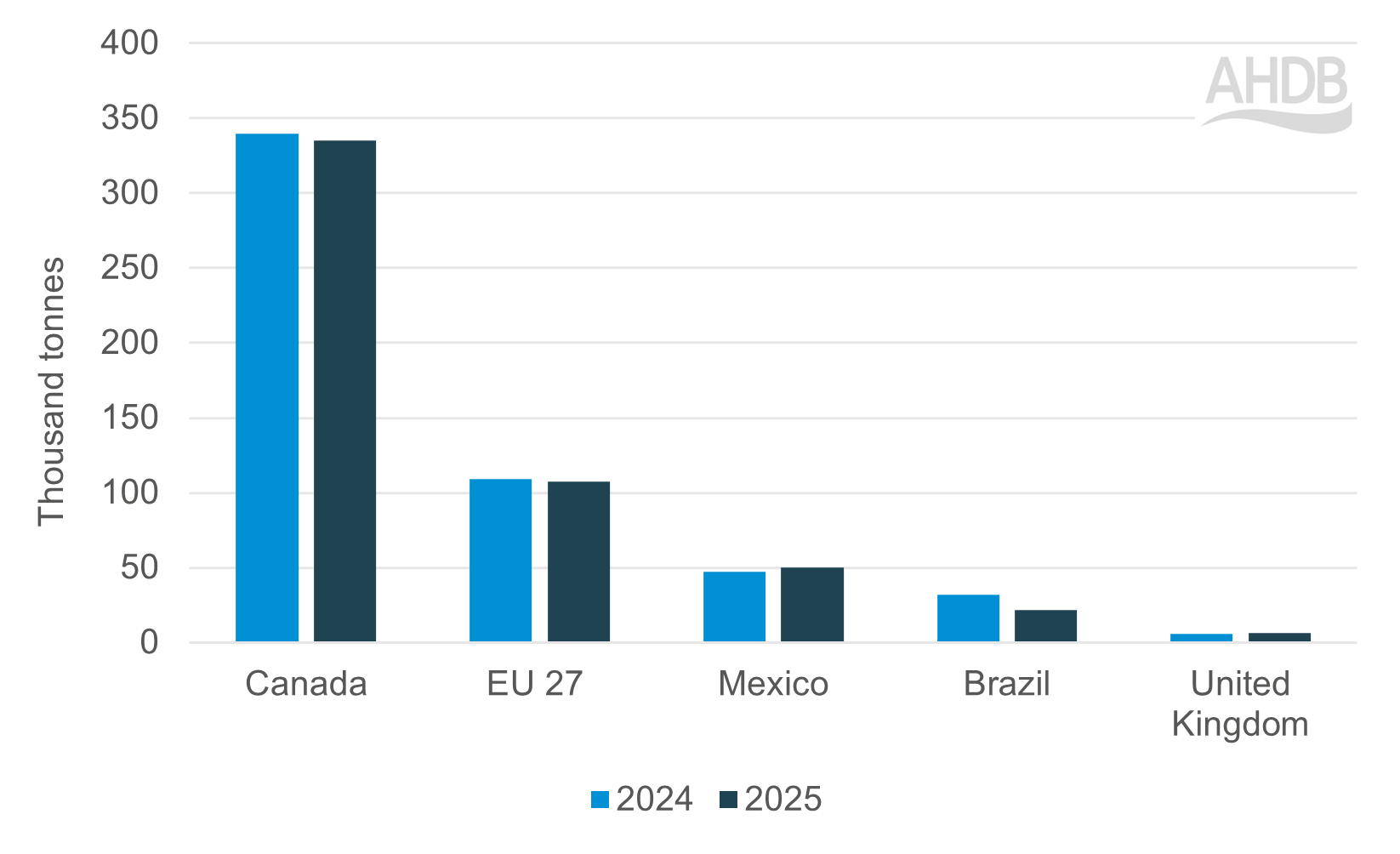
US imports stood at 523,000 tonnes in 2025, down 2% (12,900 tonnes) YoY.

The decline was primarily driven by a sharp reduction in imports from Brazil (-32%; 10,200 tonnes YoY) following tariff-related disruption. Imports from the EU declined slightly (2%) YoY, limited by lower production and ASF disruption.

Shipments from Canada (the US’s largest supplier) fell by 1% to 335,200 tonnes.

In contrast, imports from Mexico increased by 6%, while UK HMRC reported steadier trade (growth in fresh/frozen, reductions in offal).

Figure 4. Imports of pig meat (including offal) by destination between 2024 and 2025

Source: Trade Data Monitor LLC

Figure 4 shows US pig meat imports (including offal) between the years 2024 (light blue bars) and 2025 (dark blue bars), expressed in thousand tonnes.

Looking ahead

US pork production is unlikely to see significant expansion in the short term, despite recent strength in producer margins. Disease risks, high construction costs and permitting challenges are expected to continue limiting herd growth. As a result, production increases are likely to be driven by improvements in productivity and efficiency rather than expansion.

Ongoing geopolitical tensions, disease and China’s self-sufficiency focus are expected to continue to shift global pork trade flows.

US pork exports are forecast to grow modestly in 2026, with particular focus on Mexico as Chinese shipments face pressure. As Chinese import demand reduces, competition intensifies in other parts of the world, namely the wider Asian region.

Rabobank suggest there may be potential disruption tied to the renewal of the USMCA (United States-Mexico-Canada Agreement) and is a key risk for trade in 2026 given the importance of the agreement in facilitating pork and live pig trade.

In addition, Mexico’s recent anti-dumping investigation into previous years’ shipments of hams and shoulders from the US remains a watchpoint, with potential future duties on product. A final outcome is expected by late summer 2026.

While Mexico presents some opportunity for UK exporters, helped by improved market access, prospects remain niche.

Meanwhile, rising input costs, particularly for energy and fertiliser, are a further challenge linked to the Iran conflict. Impacts on oil markets and key shipping routes have driven up production costs, placing pressure on producer margins and potentially limiting investment, reinforcing the shift towards efficiency-driven production.

Sign up for regular updates

Subscribe to receive pork market news straight to your inbox. Simply complete our online form.

Visit the Keep in touch page

While AHDB seeks to ensure that the information contained on this webpage is accurate at the time of publication, no warranty is given in respect of the information and data provided. You are responsible for how you use the information. To the maximum extent permitted by law, AHDB accepts no liability for loss, damage or injury howsoever caused or suffered (including that caused by negligence) directly or indirectly in relation to the information or data provided in this publication.

All intellectual property rights in the information and data on this webpage belong to or are licensed by AHDB. You are authorised to use such information for your internal business purposes only and you must not provide this information to any other third parties, including further publication of the information, or for commercial gain in any way whatsoever without the prior written permission of AHDB for each third party disclosure, publication or commercial arrangement. For more information, please see our Terms of Use and Privacy Notice or contact the Director of Corporate Affairs at info@ahdb.org.uk  © Agriculture and Horticulture Development Board. All rights reserved. 

×