How have the recent heatwaves impacted GB milk production?

Monday, 13 July 2026

Western Europe has been hit by a series of intense heatwaves in recent months with temperature records being broken in both May and June in GB.  With climate change and more extreme fluctuations in weather becoming a fact of life we look at what the impact is on milk production and what this means for the future, both short and long-term.

Key takeaways

  • The UK and mainland Europe have been hit by a series of heatwaves seeing record-breaking temperatures – with the UK seeing temperatures over 35C in May, June and July for the first time ever
  • Milk production in the UK and has tipped from over to under supply in the short-term
  • GB milk production estimated to be down by 18.5 million litres so far and counting due to the heatwaves
  • Spot milk prices have recovered 10ppl with signs commodity prices may follow suit as milk utilisation shifts

Milk production in summer 2026

2025 and 2026 have been characterised by increased milk production, both here and abroad with excess milk in Europe coming out of places like Germany and the Netherlands of particular concern.  The 2025/26 milk year ended with a 5.0% increase for GB and 5.3% for the UK.  The EU also saw strong growth. 

Since the Autumn last year markets have been under pressure and farmgate milk prices have slumped from an average of 46.6ppl to 34.2ppl in May 2026 incentivising farmers to slow production.

At the same time we have seen a series of three heatwaves, two of which can now be seen in the production data – one in late May, one June (the third in July is not yet in the data). The data already shows significant loss of volume in both heat wave periods in GB.

However, we are also now past the Spring flush and milk production is seasonally declining. In addition production is impacted by falling milk prices and the impact of volume-management schemes.

Therefore, when we look at the production data we need to factor in how much decline is driven by factors other than high temperatures. 

What does heat stress do to dairy cows?

Dairy cows are particularly susceptible to heat stress because high milk production generates substantial metabolic heat. Researchers typically assess heat stress using the Temperature Humidity Index (THI), which combines air temperature and humidity, rather than temperature alone. Heat stress is generally considered to begin at a THI of around 68, equivalent to roughly 22°C under moderate humidity conditions, although high-yielding cows can show signs of stress at lower thresholds.

It is worse when night-time temperatures stay high, preventing cows from recovering and leading to a build-up of heat load over several days.

  • Cows spend more time panting and standing
  • Feed intake, rumination and lying time decline
  • This can lead to lower milk yields and depressed milk components, with studies reporting production losses of several kilograms of milk per cow per day under moderate to severe heat stress.
  • Reproductive performance is also affected, with reduced expression of oestrus, poorer conception rates and increased embryonic loss.
  • Emerging research suggests there may be longer-lasting impacts on animal health and productivity, particularly where dry cows experience heat stress during late pregnancy, potentially affecting calf growth, immunity and future performance.
  • Fertility and health impacts may persist for weeks or even months after temperatures have returned to normal.

With several parts of the UK exceeding 30°C during recent heatwaves and experiencing unusually warm overnight temperatures, conditions were sufficient to create a meaningful risk of heat stress in many dairy herds.

Not only heat stress but logistical challenges also play a role with it being more difficult to keep the milk adequately cooled after milking and during transit. 

How much of an impact have the heatwaves so far had?

Anecdotally we have heard of some severe impacts on individual farms but it is more difficult to isolate the effects in the data. 

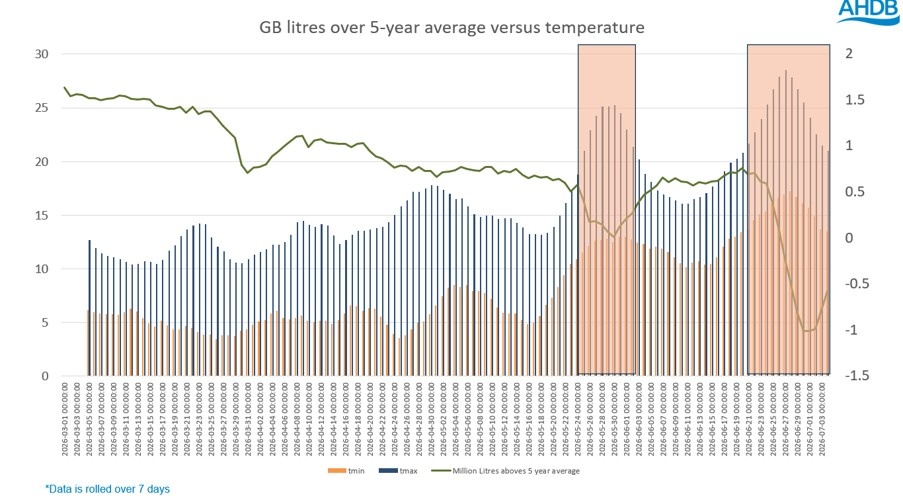
The first heatwave was in May and reached peaks of 35.1C on 26 May setting a record. A new record of 21.4C overnight was also set in Cornwall.

Prior to the heatwave production was running at 1.6 to 2.0% above the 5-year average. During the heatwave production was running only 0.4% ahead of the 5-year average.   However, the heatwave coincided with month end meaning volume management schemes were also in play and a number of factory breakdowns were reported. 

The first heatwave probably lost around 5.8million litres before the cows recovered back to pre-heatwave levels, which didn’t happen until mid-June despite much more moderate temperatures. 

The second heatwave was at the end of June, by this time some of the key volume management schemes had been adjusted to much more favourable terms so would have less of an impact. 

This time around temperatures were even more severe, with a record of 37.7C set on 26 June and England recorded its warmest ever June. 

In the short gap between the end of the effects of the first heatwave and the beginning of the second, production averaged 2.0% above the 5-year average.  By the peak, production on a 7-day rolling average basis was running 2.9% below the 5-year average.  Accounting for the post-event effects, we have seen a loss of an estimated 12.7 million litres so far (the data period ends 4 July where we are still seeing residual effects). 


Figure 1. GB litres over the 5-year average versus average temperature across dairy producing regions

Graph showing GB milk production versus tempeature

Figure 1 shows a line graph looking at litres compared to the 5-year average plotted against average maximum and minimum temperatures from March to July 2026. The line shows that milk supplies dropped in both heatwaves but that the June heatwave saw a bigger response. 

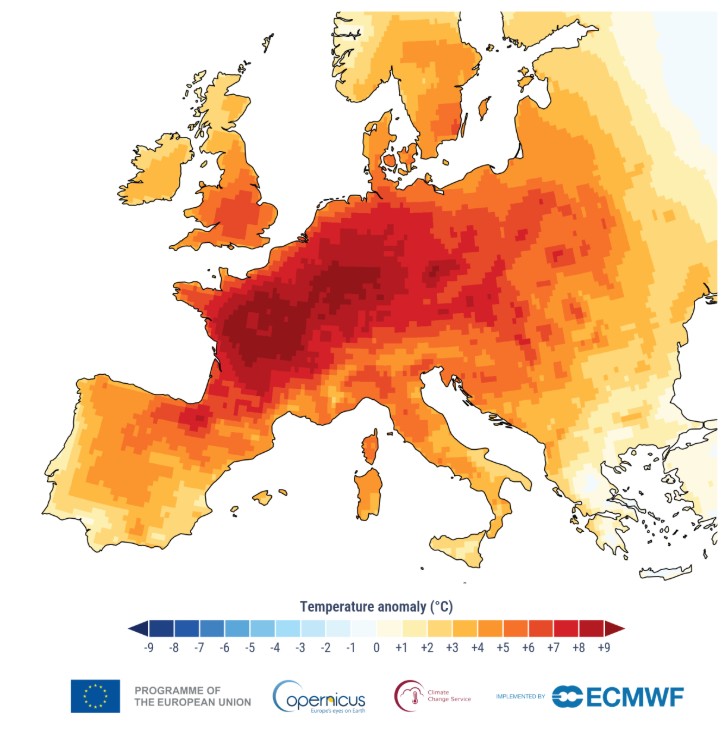
Figure 2. Average surface air temperature anomaly for 18-30 June 2026

Map showing temperature anomaly

Figure 2 shows the heatwave across Western Europe with the epicentre in France and Germany, extending out to the UK.

Early data seen from the continent indicates that France saw a drop off of 7.0% year on year in week 26 with some regions even worse affected. German volumes reduced by 3.6% year on year, according to ZMB.  As the heatwave was widespread across Europe (and even higher temperatures seen on the mainland) we would expect heat stress to be a common theme across the continent.

What does this mean for the markets? 

Effects have been quite pronounced, tipping Europe and the UK from an over-supply to an under-supply situation temporarily. 

According to milkprices.com spot milk has risen to 38-48ppl, firming by around 10-15ppl which is well above Defra’s average farmgate milk price of 34.2ppl. this suggests some anxiety amongst processors about milk availability, at least in the short-term. 

Bulk cream has also firmed towards as high as £1.60 ex-works (even reports up to £1.68) which is well above the £1.37 reported by AHDB at the end of June.

Dutch prices have also headed northwards, which is particularly startling given the pre-holiday doldrums that most commodities were in only a couple of weeks ago.  According to Trigona Dutch cream has risen by 250-300 euros, SMP 200 euros and even butter by 1-200 euros.

This is likely to be a temporary response in that market fundamentals remain the same – the US and NZ are still pumping out milk, the GDT fell by 4.9% in the last auction and butter stocks remain bursting at the seams. 

There may be some tightening in cheese markets as reportedly some cheese makers have been selling milk on the spot market rather than making cheese. 

The outlook

Climate change mean that severe heat events are likely to become a more common feature of British summers and will become an increasingly important dynamic facing the industry.

Farmers should consider taking steps to mitigate the effects of heat stress which may include providing extra shade, housing with fan and misting systems or minimising yard time. 

Longer-term we may need to consider heat-resistance as a genetic goal. 

Hotter temperatures as well mean more pressure on grazing so pasture management will require extra thought. 

Processors may need to consider supply disruptions as a more regular feature of summer. 

At the time of writing heatwave 3 is in progress with temperatures in the forecast remaining above the 25C threshold for the foreseeable which could indicate further supply challenges in July. As many of the heat stress effects are cumulative, we may expect to see even more pressure on milk supplies. 

High spot milk prices change the valorisation equations meaning markets could well become unpredictable in the coming months.  


Image of staff member Susie Stannard

Susie Stannard

Lead Analyst (Dairy)

See full bio


Sign up to receive the latest information from AHDB.

While AHDB seeks to ensure that the information contained on this webpage is accurate at the time of publication, no warranty is given in respect of the information and data provided. You are responsible for how you use the information. To the maximum extent permitted by law, AHDB accepts no liability for loss, damage or injury howsoever caused or suffered (including that caused by negligence) directly or indirectly in relation to the information or data provided in this publication.

All intellectual property rights in the information and data on this webpage belong to or are licensed by AHDB. You are authorised to use such information for your internal business purposes only and you must not provide this information to any other third parties, including further publication of the information, or for commercial gain in any way whatsoever without the prior written permission of AHDB for each third party disclosure, publication or commercial arrangement. For more information, please see our Terms of Use and Privacy Notice or contact the Director of Corporate Affairs at info@ahdb.org.uk  © Agriculture and Horticulture Development Board. All rights reserved. 

×