Imports stabilise as exports begin to dip in Q3: Pork market update

Tuesday, 2 December 2025

Key Points

  • UK pig meat import volumes for September remained relatively consistent with previous years, totalling 63,800 tonnes
  • In the year to September, import volumes are the lowest for the period since 2021. UK pig meat imports decreased 4% (22,600 t) year-on-year
  • Exports in September fell to 22,316 tonnes, the lowest monthly volume since January 2025
  • For the year-to-date, export volumes have increased by 3% (6,800 t) totalling 228,000 t

Exports

Quarterly analysis

UK pig meat exports (including offal) in September fell to 22,300 tonnes, the lowest monthly volume since January 2025.

Across the full Q3, exports decreased by -9% (7,000 t) compared to Q2. This was driven by substantial decreases in shipments to China (5,100 t) and Ireland (1,800 t). Reduced shipments to China likely reflect its short-term refocus on self-sufficiency and reports suggesting that Chinese consumer demand is below expectations currently.

Despite the quarterly decline, Q3 2025 exports were 1% lower year-on-year (YoY) indicating that the broader export position has remained stable compared to 2024.

On an annual basis, a notable fall in exports to Ireland (-2,600 t) was partially offset by growth in shipments to South Africa (+221%; +1,400 t). This may reflect strengthening demand in emerging markets and suggest growing opportunities for UK pork outside traditional EU destinations.

Year-to-date comparison 

Notwithstanding quarterly changes, UK pig meat export volumes for the year-to-date (Jan–Sep) were up by 3% (6,800 t) YoY at 228,100 t. This growth was largely driven by China (+16%; +13,600 t YoY). These gains more than offset declines elsewhere, including to the EU (-4%; -3,800 t) and the Philippines (-6%; -1,000 t).

Product trends

Looking across products, fresh and frozen pork exports grew by 4% YoY, supported by strong demand from China and Denmark.

Shipments to China increased by 12% (3,700 t), while exports o Denmark surged by 64% (1,100 t) YoY. These increases helped offset a decrease of -22% (3,300 t) YoY to Ireland.

Meanwhile, sausage exports recorded a modest rise (628 t), whereas bacon and processed pig meat fell by (900 ) and (600 t), respectively.

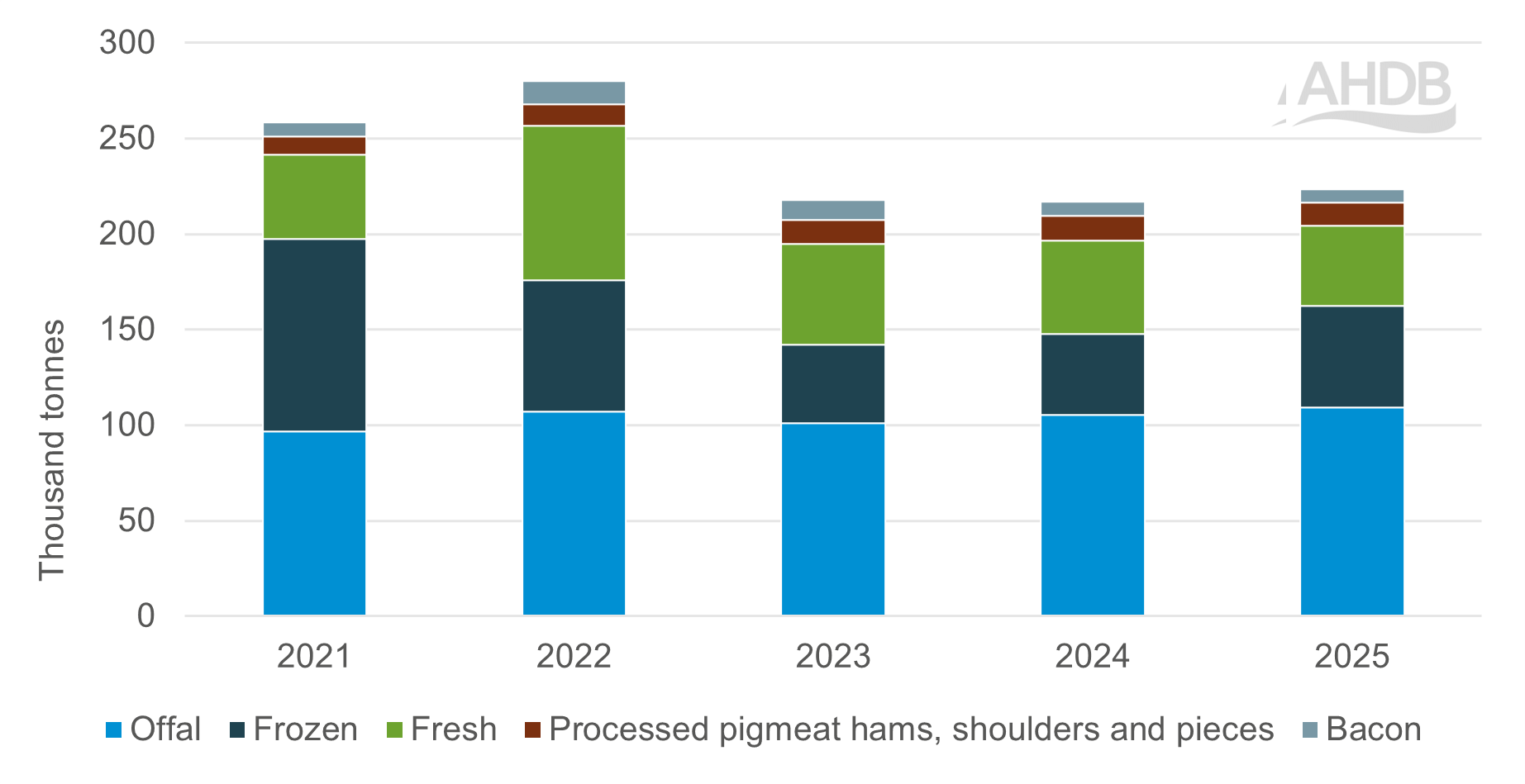
UK pig meat exports by product (Jan–Sep) (incl. offal)

UK pig meat exports by product (Jan-Sep) (incl. offal)

Source: HMRC, compiled by Trade Data Monitor LLC

UK offal exports stood at 109,400 t in the year to September.

China remained the leading destination, accounting for 61% of total shipments, up from 54% in 2024. Shipments to China grew by 18% (10,000 t) YoY, likely supported by ongoing trade tensions between China and other nations, notably the US and EU. EU exports of offal to China fell by 27% YoY to 35,200 t in September, coinciding with the introduction of anti-dumping duties.

UK offal exports to the Philippines decreased by -14% YoY, potentially linked to increased Brazilian competition over the same period.

Meanwhile, UK offal exports to the EU declined by 9% YoY (2,200 t) decreasing the EU’s market share of UK offal trade from 23% in 2024 to 20% in 2025. This decline likely reflects the widening price gap between EU and UK pig prices throughout Q3, weakening UK export competitiveness.

Imports

Quarterly analysis

Meanwhile, despite some monthly fluctuation, UK pig meat imports (including offal) remained lower year-on-year through Q3. Volumes totalled 187,500 t for the quarter, down 3% (-5,700 t) on the year.

Volumes remained lower from Germany and the Netherlands in particular, while Denmark saw growth.

Year-to-date comparison

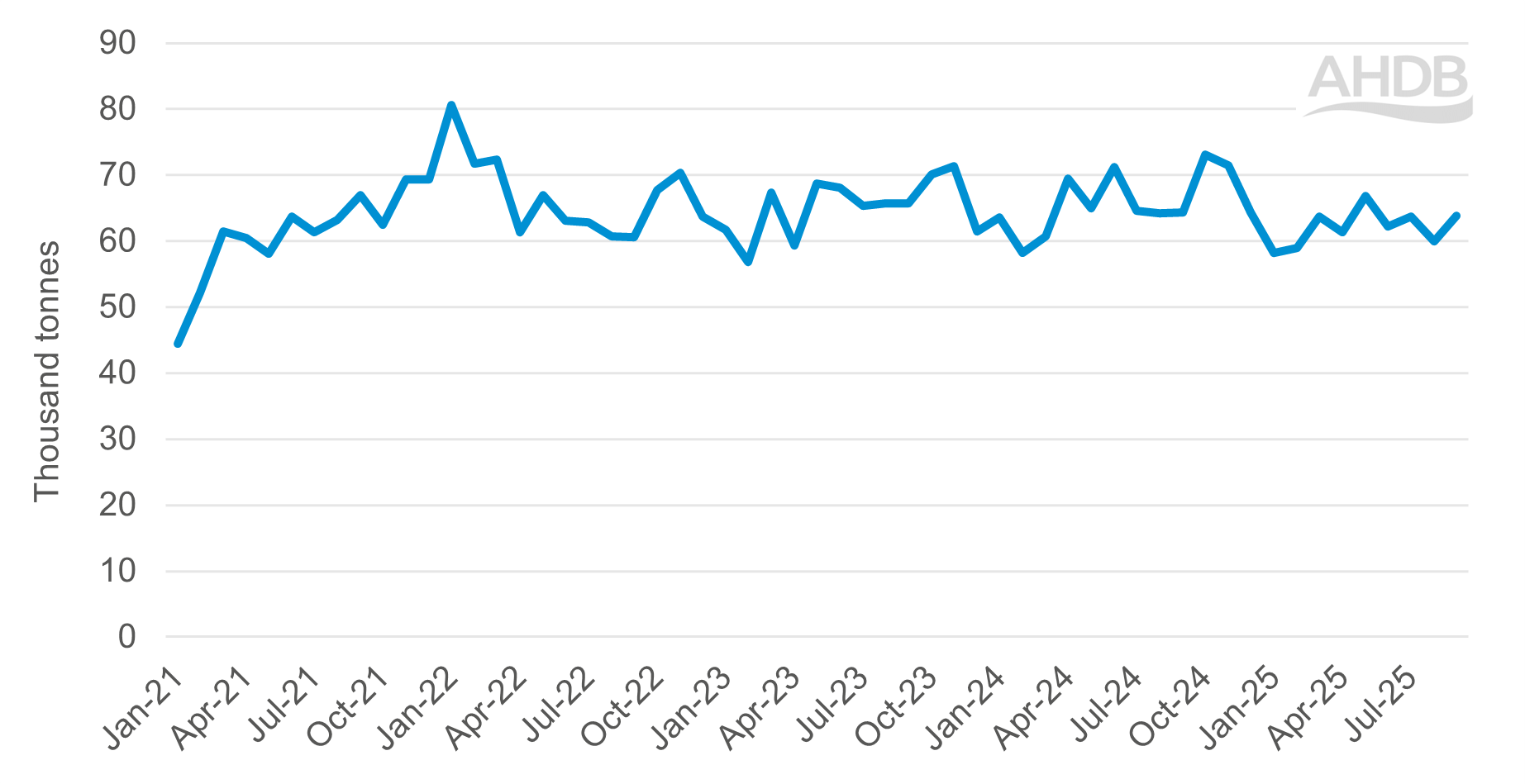
For the year-to-date, volumes decreased by 4% (22,600 t) YoY totalling 558,700 t. This import volume is the lowest for the nine-month period since 2021.

Product trends

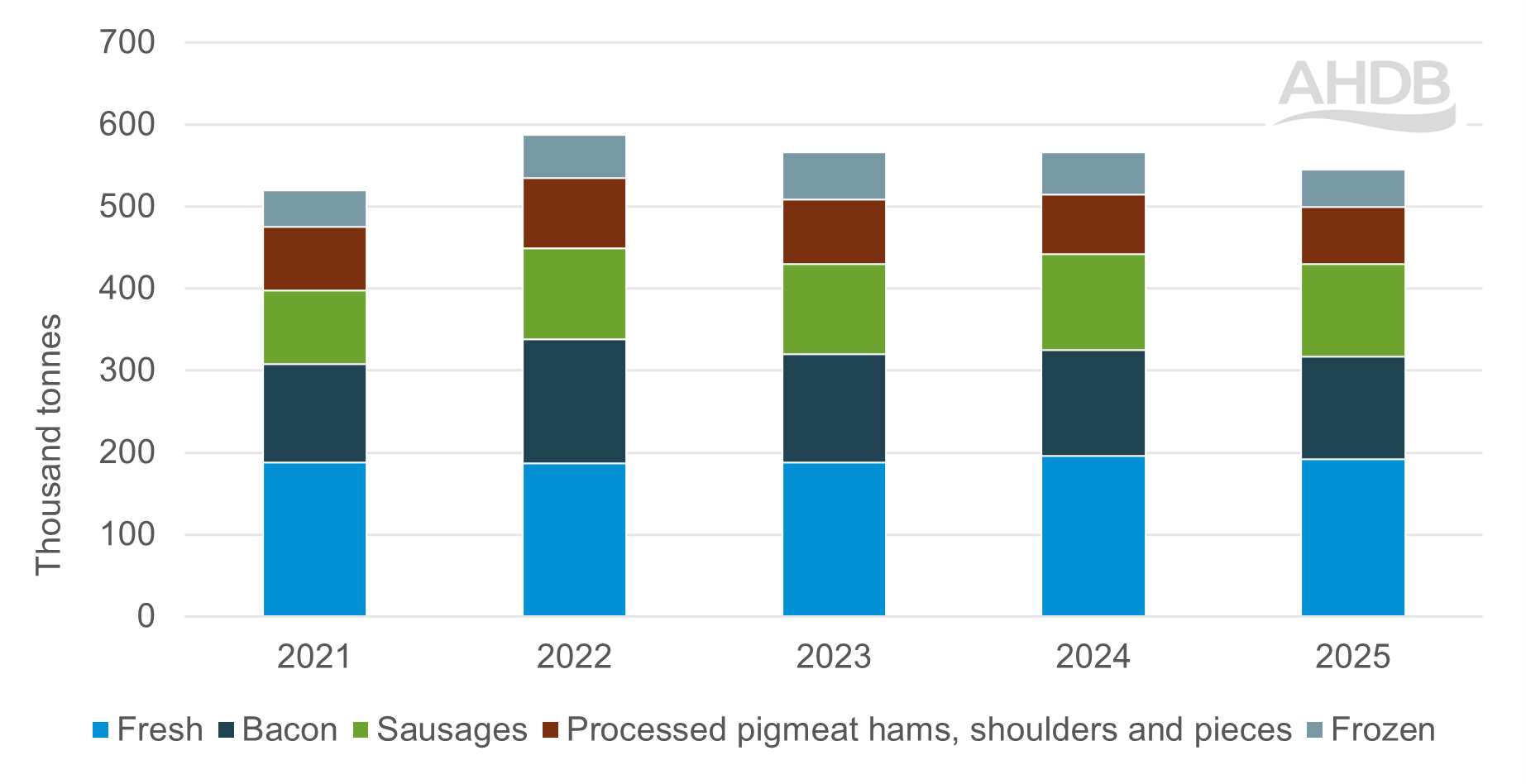
Looking at products, imports of all headline categories decreased year-on-year; the most significant changes came from fresh and frozen and sausages declining by -4% (9,900 t) and -3% (3,800 t) respectively.

The bacon category saw a fall of -3% (3,500 t) YoY. This was driven by Denmark which declined by -15% (5,800 t), although this was marginally offset by Ireland which increased by 77% (3,600 t).

Overall sausage imports fell by -3% (3,800 t) YoY.

Italy recorded the largest increase, up 12% (796 t), but this was not enough to offset the sharp decline from Germany earlier in the year. Shipments from Germany dropped by -12% (4,100 t) YoY.

UK monthly imports of pig meat (including offal)  (2021–2025)

UK monthly imports of pig meat (including offal)  (2021 – 2025)

Source: HMRC, compiled by Trade Data Monitor LLC

Country focus

Imports of fresh and frozen pork from Germany fell sharply, down -45% (24,600 t) YoY, while German sausage imports declined by -12% (4,200 t) YoY. In contrast, imports of fresh and frozen pork from Belgium and Spain rose by (6,900 t) and (5,600 t), respectively.

Germany has since regained market access to the UK following an outbreak of FMD, and import levels have begun to recover. However, for the year-to-date German imports were down 29% YoY (30,300 t), reducing its share of UK imports to 13% from 18% last year.

Both Belgium and Spain saw the biggest increases in imports to the UK, up 18% and 11% YoY, respectively. 

UK pig meat imports by meat type

UK pig meat imports by meat type

Source: HMRC, compiled by Trade Data Monitor LLC

Movement in EU-UK pricing

In July, the difference between EU and UK pig pricing reached its narrowest point since mid-August 2024. This potentially drove some decline in imports for August 2025, totalling 59,900 t, down from 63,700 t the previous month.

Additionally, data from our country-of-origin audit points to sustained retailer support for domestic product through this time.

However, since October EU pig prices have seen a sharp decline, driven by changes in demand and stronger-than-expected production levels, this has increased import competitiveness and remains a key watchpoint for import volumes for the rest of the year.

Image of staff member Adam Chowdry

Adam Chowdry

Analyst (Livestock)

See full bio

Sign up

You can subscribe to regular updates straight to your inbox. Create a free account on our Preference Centre and select the information you wish to receive.

Visit the AHDB preference centre

While AHDB seeks to ensure that the information contained on this webpage is accurate at the time of publication, no warranty is given in respect of the information and data provided. You are responsible for how you use the information. To the maximum extent permitted by law, AHDB accepts no liability for loss, damage or injury howsoever caused or suffered (including that caused by negligence) directly or indirectly in relation to the information or data provided in this publication.

All intellectual property rights in the information and data on this webpage belong to or are licensed by AHDB. You are authorised to use such information for your internal business purposes only and you must not provide this information to any other third parties, including further publication of the information, or for commercial gain in any way whatsoever without the prior written permission of AHDB for each third party disclosure, publication or commercial arrangement. For more information, please see our Terms of Use and Privacy Notice or contact the Director of Corporate Affairs at info@ahdb.org.uk  © Agriculture and Horticulture Development Board. All rights reserved. 

×