Dairy June forecast update: GB milk production to ease

Thursday, 18 June 2026

GB milk production for the 2026/27 season is forecast to decline to 12.91bn litres, 0.9% lower than the previous milk year according to our June forecast update

The past 2025/26 milk year reached record highs supported by favourable dairy economics. Now milk volumes have begun to ease and the current milk year (2026/27) has started with a year-on-year decline in milk deliveries to dairy processors. In the current year, deliveries to date (April to 13 June), were down by 0.9% compared to the same period in the previous year.

The declining GB milking herd, volume management control schemes, a decline in the number of GB producer numbers, rising input costs and declining milk-to-feed-price-ratio (MFPR) are the major factors behind the drop in milk deliveries.

Farmers could be facing winter pressures in cash flows considering low milk s ear and rising input costs. In addition to that, many will be hit with a bumper tax bill following the last year of high milk cheques. Though the war could see a ceasefire (although how lasting this will be is uncertain), the impacts on input costs will continue to be felt throughout the year.

Herd Size

Cow numbers continue the declining trend, with the size of the GB milking herd in April 2026 2.0% lower than a year earlier. The GB milking herd totalled 1.59 million head as of April 2026, another lowest number recorded, and a 2.0% decline compared to the same month the previous year. The GB total herd also stood at 2.46 million head, a year-on-year decline of 2.0%. A fall was seen across all age groups with the exception of the 4-6 years age group. Youngstock levels continue to decline, which remains a watchpoint for the sector.

Producer numbers

In our latest survey of major milk buyers, it is estimated that there were 6,850 dairy producers in GB as of April 2026. This is a substantial reduction of 160 producers (-2.3%) which was estimated since our last survey in October 2025. Looking at year-on-year changes since April 2025, there was an estimated decline of 190 producers (-2.7%) indicating that the majority of the industry exits took place last winter.

Favourable cull cow prices (above 5-year average despite recent pressure) and continued inflationary pressure on key input costs incentivised some producers to exit the industry as farm margins tighten.

Farmer sentiment is largely negative with squeezes on both milk prices and costs of production, with now a falling beef price putting dairy farm businesses under increasing pressure.  However, this factor is less influential as most cows will be picked up by other farms, minimising the impact on milk production.

Milk prices

In the latest milk price announcements for June and July, prices are mostly holding steady to firm but remain below the COP for many. Coming price announcements will depend on how demand is able to absorb the excessive stocks in the wholesale markets, both domestically and on a global level. Currently the outlook for fats is subdued, although demand for protein is strong and cheese more balanced.

Agricultural Price Index

API data for March shows total agricultural input price inflation rose by 3.7% year-on-year and was up 1.1% month-on-month, primarily driven by fertiliser, soil enhancers, fuels and lubricants. Much of this can be attributed to the war in the Middle East. Increasing input costs will squeeze farmers margin further, thereby encouraging to slow milk production.

The forecast

The milk year (2026/27) so far is running behind last year’s levels. Still there is lot of milk in the market as we are annualising against a year of record highs. Prices cuts since last autumn stipulated some of the declines and also resulted in some farmers exiting the sector. The milking herd continues to decline and under current uncertain market conditions, farmers will not be incentivised to rebuild herds.

This is in contrast to the previous milk year which saw strong yield growth and high feed use despite lower cow numbers. The drought also prompted more use of concentrate feeds. However, in the current milk year, production of concentrate feed has come down by 5% in April compared to the previous year and is now below the 5-year average. The milk-to-feed-price-ratio (MFPR) is declining denoting lower milk supplies in the coming months.

Commodity markets especially fats remain under pressure, with butter losing more than 50% of its value and is at the lowest price since August 2021. Proteins continue to recover amid tight stocks and good demand in the global market. Prices could witness some short-term recovery, however the overall picture remains bearish amid the fundamentals of global over-supply.

Weather and animal diseases will be influential in yield levels. Farmers will be hoping for a better growing season after last year’s drought to replenish depleted forage stocks. Bluetongue remains a risk. The number of active cases of Bluetongue in the country till June are higher compared to last year. This could increase further as midge activity increases during the warm days.

Favourable cull cow prices (well above the 5-year average despite recent pressure) will incentivise producers to streamline herds, but at the same time heifer replacement shortages could hold this dynamic back. Beef prices are currently at 484p/kg last week (6-June), which is lower compared to previous year but 27% higher compared to the 5-year average. Tighter margins and higher input costs have led to increase in dairy culls in the first part of the year but this slowed in April.

Our forecast is based on normal weather and market conditions. The war in the Middle East has the potential to rumble on despite ceasefire agreements. Regardless, the ripple effects will be felt later through the year, with input costs remaining inflated. Any pressure in milk and commodity prices, further increase in input costs and poor weather could accelerate the rate of declining milk volumes.

Dairy farmers should look at ways of remaining resilient wherever possible until market conditions improve.

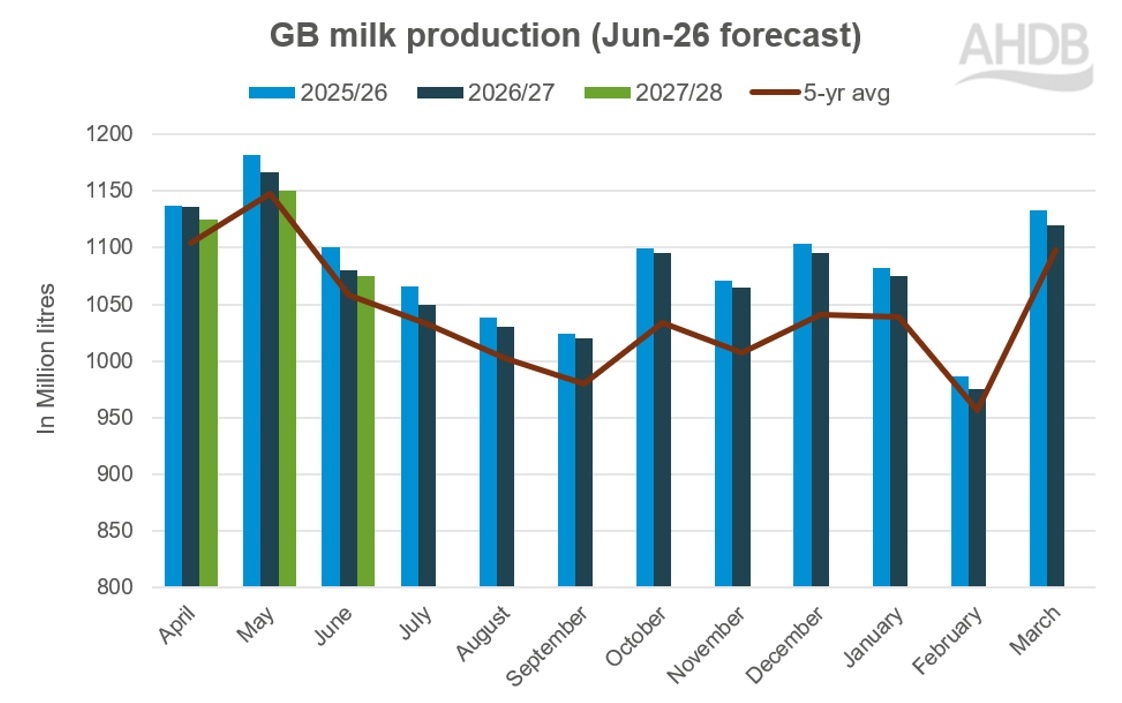
Figure 1. GB milk production (Jun-26 forecast)

(million litres)

GB milk production forecast graph_Jun26

Source: AHDB

Figure 1 shows GB milk production during the last two years and forecast for the milk year 2026/27. This is compared with the 5-year average milk production.

2025/26 milk production (light blue line)
2026/27 milk production (dark blue line)

2027/28 milk production (green line)

5-yr average milk production (dark red line)


Table: 1 GB milk production forecast - June 2026 (million litres)

m litres 2025/26 2026/27 2026/27 2025/26 2027/28 2026/27
Actuals Actuals Forecast Yr-on-yr Forecast Yr-on-yr
Apr 1,137 1,136   -0.1% 1,125 -1.0%
May 1,182 1,167   -1.3% 1,150 -1.5%
Jun 1,100   1,080 -1.8% 1,075 -0.5%
Jul 1,066   1,050 -1.5%    
Aug 1,038   1,030 -0.8%    
Sep 1,024   1,020 -0.4%    
Oct 1,099   1,095 -0.4%    
Nov 1,071   1,065 -0.6%    
Dec 1,104   1,095 -0.8%    
Jan 1,082   1,075 -0.7%    
Feb 986   975 -1.1%    
Mar 1,133   1,120 -1.2%    
Year 13,023   12,908 -0.9% 3,350 -1.0%

Source: AHDB

Note: 28-day equivalent used for leap year Februarys

Image of staff member Soumya Behera

Soumya Behera

Senior Analyst (Dairy)

See full bio


Sign up to receive the latest information from AHDB.

While AHDB seeks to ensure that the information contained on this webpage is accurate at the time of publication, no warranty is given in respect of the information and data provided. You are responsible for how you use the information. To the maximum extent permitted by law, AHDB accepts no liability for loss, damage or injury howsoever caused or suffered (including that caused by negligence) directly or indirectly in relation to the information or data provided in this publication.

All intellectual property rights in the information and data on this webpage belong to or are licensed by AHDB. You are authorised to use such information for your internal business purposes only and you must not provide this information to any other third parties, including further publication of the information, or for commercial gain in any way whatsoever without the prior written permission of AHDB for each third party disclosure, publication or commercial arrangement. For more information, please see our Terms of Use and Privacy Notice or contact the Director of Corporate Affairs at info@ahdb.org.uk  © Agriculture and Horticulture Development Board. All rights reserved. 

×