Growth in imports alongside increased UK exports of beef in Q1: Beef market update

Thursday, 4 June 2026

The latest global trade data has been released. This article summarises the key statistics for UK Q1 (January-March) beef trade.

Key points

  • UK beef imports rose 3.2% year-on-year in Q1 2026 to 75,000 tonnes, with value up 19.7% to £547 million as global prices stayed high.
  • Australian and New Zealand volumes surged, with widening FTA access and exports being diverted away from China.
  • UK beef exports rose 14.4% to 36,000 tonnes (value £231 million, +36.2%), led by stronger demand from Ireland and France, due to weaker domestic demand and closer EU and UK prices.

Imports

UK beef imports (fresh, frozen, offal and processed) rose by 3.2% for the first three months of 2026, totalling 75,000 tonnes. The increase in volume has led to a rise in value of 19.7% in 2026, compared to the January to March of 2025, to reach £547 million.

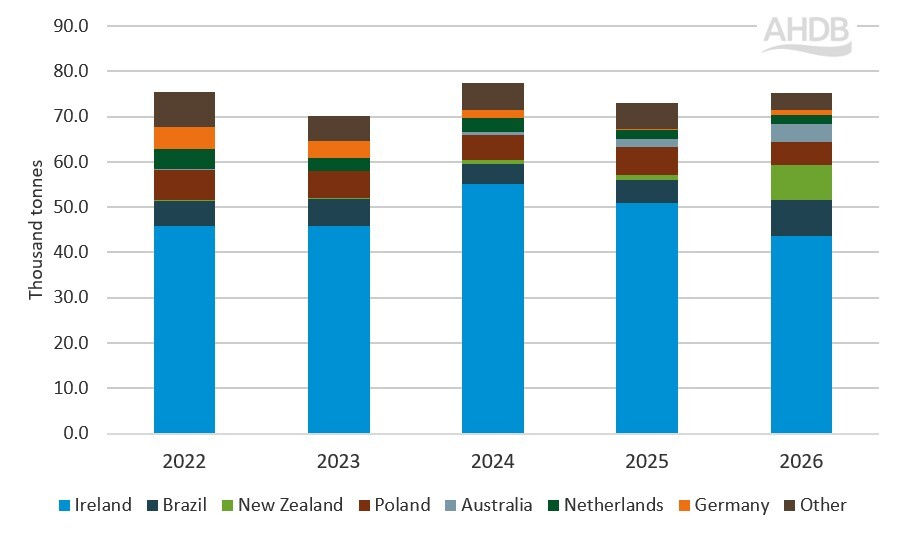
Ireland continues to dominate the UK beef supply, providing 44,000 tonnes, though this was 14.3% lower YoY (from 51,000 t). Among EU member states, imports from Poland declined to 5,000 tonnes (-19.3% YoY), reflecting its competitive price point in the EU market.

Volumes from Brazil rose to 8,000 tonnes, an increase of 58.7% on the year. This rose proportionally with value, suggesting similar beef products were sent over both years.

Figure 1: UK Q1 (January – March) beef imports by supplier, 2022-2026

   UK Q1 (January – March) beef imports by origin country, 2022-2026

Source: HMRC, compiled by TDM

Figure 1 shows the volume in thousand tonnes of imports of fresh, frozen, processed and offal beef in the first quarter of each year 2022-2026 by origin country.

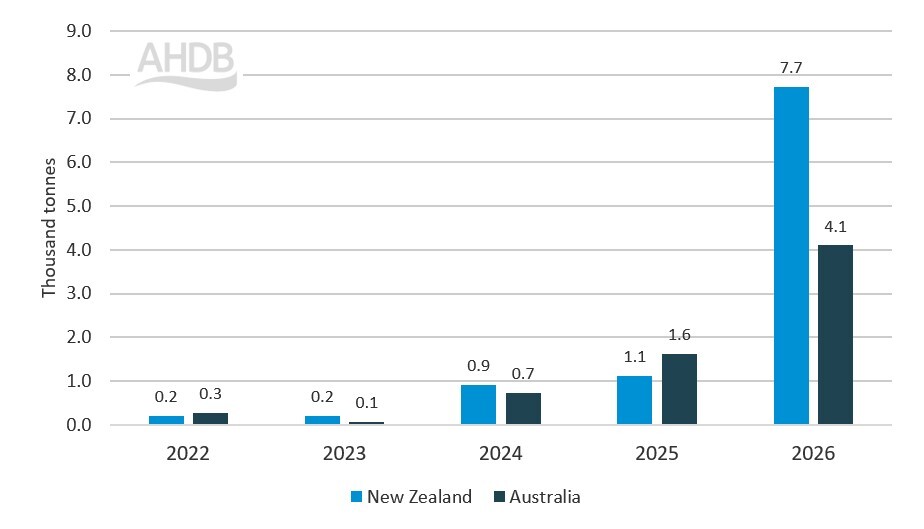
Imports from Australia expanded sharply from 2,000 to 4,000 tonnes in Q1 compared to 2025, a rise of 153%. New Zealand increased exports to the UK by a monumental 586% from 1,000 tonnes to 8,000 tonnes. The value of these imports has risen at a slightly slower pace, Australia at 140% and New Zealand at 473%, suggesting a possible change in the type of beef product being imported.

As of 18 May 2026, Australia have used 19% of their 60,000 tonnes TRQ, shipping over 11,000 tonnes. As of 26 May, New Zealand have used 55% of their TRQ, totalling 11,500 tonnes out of a year total 20,900 tonnes. If this rate of exports continues, the TRQ could act as a cap on New Zealand beef imports. 

Since 2023, these volumes have been increasing. However, the increases in 2026 are significant and large. This will be due to a multiple of factors: the Middle East conflict diverting exports to more stable regional importers, Chinese import safeguarding measures and strong UK pricing.

Although these remain much smaller quantities than Irish volumes, the pace of growth from non-EU suppliers highlights the increasing utilisation of tariff-free access under recent trade agreements and growing interest in the UK market. This pattern could continue under uncertain geopolitical tensions.

Figure 2: UK Q1 (January – March) beef imports from Australia and New Zealand, 2022-2026

UK Q1 (January – March) beef imports from Australia and New Zealand, 2022-2026

Source: HMRC, compiled by TDM

Figure 2 shows the volume of UK imports from Australia and New Zealand from 2022-2026 for the first three months of the year.

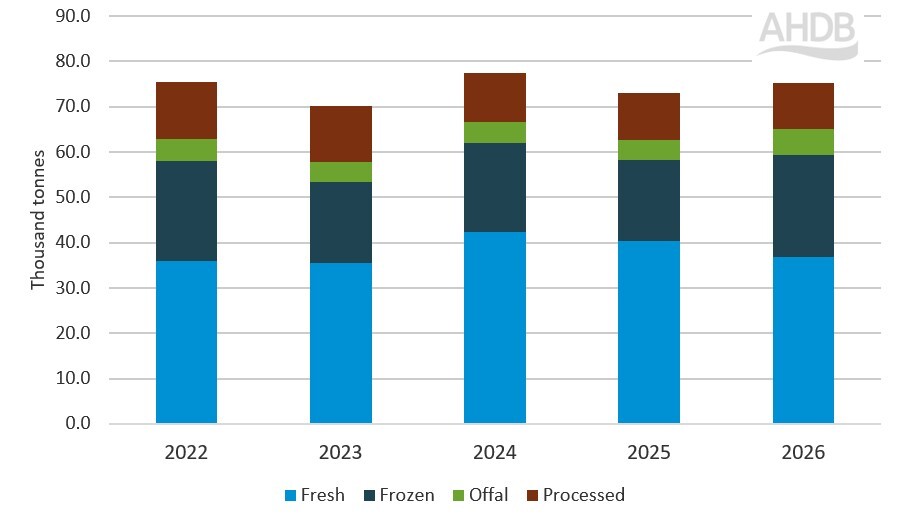
Q1 UK beef imports are still dominated by fresh beef; however, this share has been declining since 2024.

Fresh beef imports for the year to date were 37,000 tonnes, down 8.9% YoY. Meanwhile frozen beef imports have continued growing to 23,000 tonnes, an increase of 25.8%, led by increased imports from Brazil, Australia and New Zealand.

Processed beef (including corned beef) stayed at similar levels to last year at 10,000 tonnes (-0.2% YoY). Beef offal imports grew by a substantial amount, growing 30.5% to approximately 6,000 tonnes.

The increase in volume from frozen and offal beef have led to increases of 69.7% and 55.0% year-on-year for Q1, reaching £18 million and £143 million respectively.

Despite fresh and offal volumes reducing, both still grew in their value share. Both grew by 8.8% and 10.2%, totalling £324 million and £62 million respectively.

Figure 3: UK Q1 (January – March) beef imports by product, 2022-2026

UK Q1 (January – March) beef imports by commodity category, 2022-2026

Source: HMRC, compiled by TDM

Figure 3 shows the import volume in thousand tonnes of UK fresh, frozen, processed and offal beef in the first quarter of each year 2022-2026.

Exports

UK beef exports for Q1 2026 totalled 36,000 tonnes, up 14.4% from a year earlier. This increasing volume grew the value share of exports to £231 million, 36.2% up from Q1 last year. As Irish absolute volumes rose most significantly, this could reflect an increase in carousel trade over the Irish and Northern Irish boarder, as well as British beef now becoming more competitive relative to EU prices seen the year prior. This could be exacerbated by a shrinking domestic beef demand.

Within Europe, export performance was mixed.

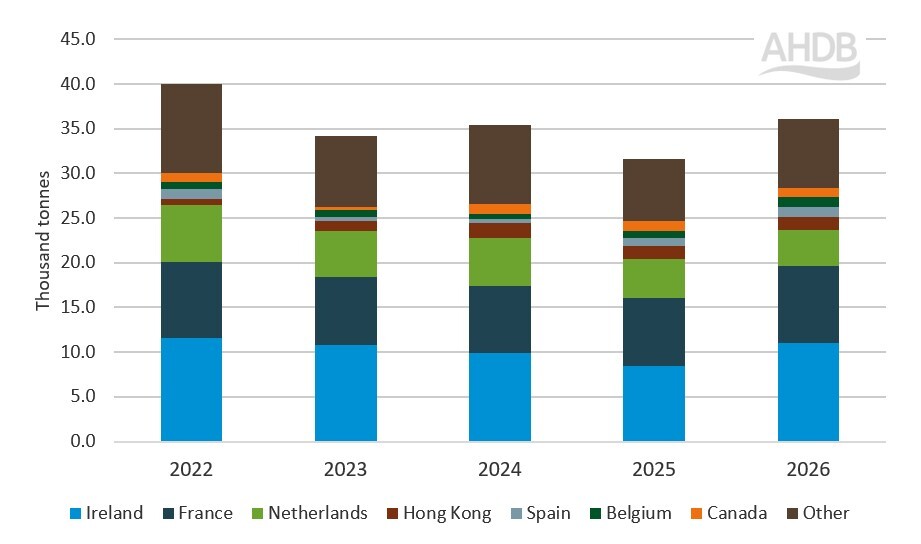
Exports to Ireland and France, the UK’s largest importers, increased to 11,000 and 9,000 tonnes respectively, a rise of 30.7% and 12.9%, indicating continued robust demand for UK beef in this market.

In contrast, shipments to the Netherlands and Italy fell by 6.6% and 26.1% to 4,000 and 500 tonnes respectively. Shipments in Q1 to the Netherlands have been declining since 2022, falling 35.6% compared to 2026.

Beyond Europe, trade flows were also mixed. Exports to Ghana rose by 33.3%, underlining the continued importance of West African markets for UK offal and lower-value cuts. However, shipments to Hong Kong fell by almost 6.6%, and exports to Canada dropped by close to 6.8%.

Figure 4: UK Q1 (January – March) beef exports by destination, 2022-2026

UK Q1 (January – March) beef exports by destination country, 2022-2026

Source: HMRC, compiled by TDM

Figure 4 shows the volume in thousand tonnes of export of fresh, frozen, processed and offal beef in the first quarter of each year 2022-2026 by destination country.

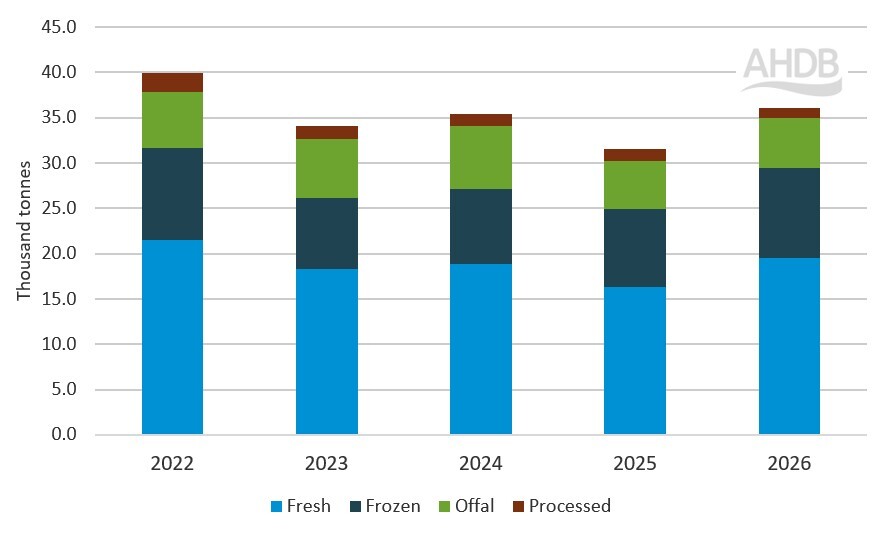
Fresh and frozen beef cuts rose most notably, growing to 20,000 and 10,000 tonnes; increasing 20.1% and 14.7% respectively. Offal grew more steadily to 6,000 tonnes, increasing by 2.7%.

By contrast, processed beef exports declined to 1,000 tonnes, down 11.7% YoY.

Figure 5: UK Q1 (January – March) beef exports by product, 2022-2026

UK Q1 (January – March) beef exports by commodity category, 2022-2026

Source: HMRC, compiled by TDM

Figure 5 shows the export volume in thousand tonnes of UK fresh, frozen, processed and offal beef in the first quarter of each year 2022-2026.

Image of staff member Sebastian Abbott

Sebastian Abbott

Trainee Analyst

See full bio


Sign up for regular updates

You can subscribe to receive Beef and Lamb market news straight to your inbox. Simply fill in your contact details on our online form.

Visit the Keep in touch page

While AHDB seeks to ensure that the information contained on this webpage is accurate at the time of publication, no warranty is given in respect of the information and data provided. You are responsible for how you use the information. To the maximum extent permitted by law, AHDB accepts no liability for loss, damage or injury howsoever caused or suffered (including that caused by negligence) directly or indirectly in relation to the information or data provided in this publication.

All intellectual property rights in the information and data on this webpage belong to or are licensed by AHDB. You are authorised to use such information for your internal business purposes only and you must not provide this information to any other third parties, including further publication of the information, or for commercial gain in any way whatsoever without the prior written permission of AHDB for each third party disclosure, publication or commercial arrangement. For more information, please see our Terms of Use and Privacy Notice or contact the Director of Corporate Affairs at info@ahdb.org.uk  © Agriculture and Horticulture Development Board. All rights reserved. 

×