Flock rebuild on horizon: Australia sheep market update

Thursday, 29 October 2026

Australia's sheep sector is showing early signs of recovery following several challenging years, with improved seasonal conditions supporting flock rebuilding and producer confidence. We examine the latest market outlook from Meat and Livestock Australia (MLA) and consider the potential implications for the UK market.

Key points

  • Australia's sheep flock is expected to begin a gradual recovery, supported by improved seasonal conditions, with flock numbers forecast to rise through 2027 and 2028
  • Lamb and mutton production is forecast to decline in the short term, as tighter sheep supplies and increased retention of breeding stock reduce slaughter numbers. Growth in production is expected in 2028
  • Strong export demand continues to support the market, despite trade uncertainty, with China remaining a key destination and declining New Zealand sheep numbers creating opportunities for Australian exports
  • Tighter Australian supplies may limit exports and contribute to firm global (and by extension UK and European) sheep meat prices. However, risks remain around the fallout of the US safeguard inquiry regarding potential diversion of product
Image of staff member Hannah McLoughlin

Hannah McLoughlin

Trainee Analyst

See full bio

Australian flock enters rebuild phase

The Australian national sheep flock is estimated at 64 million head as of 30 June in 2026, a decrease from the 2025 estimate. The decline is due to the impact of three years of below average rainfall across the key producing regions.

However, more recently rainfall has increased across Australia, and on-farm conditions have improved. Coupled with strong markets of late, farmer sentiment has turned.

Under the assumption that seasonal conditions will return to average over the next two years, it is expected that the national flock will therefore transition into a rebuild phase. MLA forecast that the national flock size will increase by 2% to 66 million head in 2027, with a further increase expected in 2028.

While the flock is expanding, it is likely to remain smaller than previous years following a period of elevated offloading.

Sheep slaughter declines as flock rebuilding begins

In 2026, lamb slaughter is projected to decrease by 11% to just under 22 million head. This is driven by high slaughter rates in previous years, which reduced the number of lambs available. As the flock enters a recovery phase, slaughter numbers are projected to rise modestly in 2027 and 2028.

Mutton slaughter is estimated to decrease by 38% to 6 million head in 2026, with a further decrease of 14% to 5 million head in 2027. This is caused by tightening supply and more core breeding stock being retained.

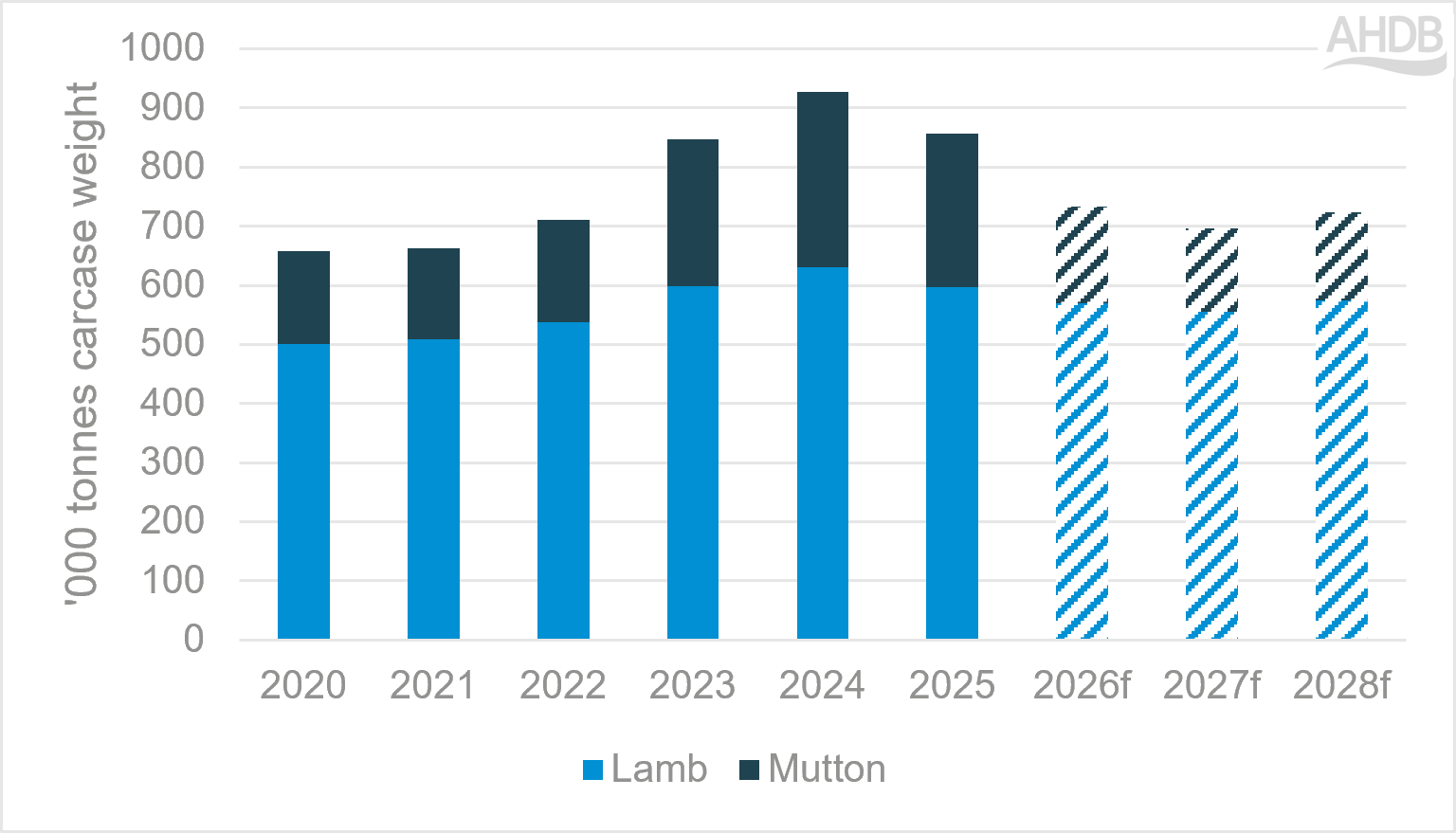
Lamb production is set to decline by 5% to 600 thousand tonnes in 2026, after three years of exceptionally strong production. Despite the decline, this is expected to be the fourth-highest lamb production year on record. This is supported by heavier carcase weights.

For 2027, both lamb and mutton production are forecast to decrease further, but slight gains are anticipated in 2028.

Figure 1. Australian lamb and mutton production for 2020-2028

Australian lamb and mutton production from 2020 to 2028. Lamb accounts for most production in every

Source: Meat and Livestock Australia (MLA)

Figure 1 shows Australian lamb and mutton production from 2020 to 2028. Lamb accounts for most production in every year, while mutton contributes a smaller share.

Export demand remains strong across key global markets

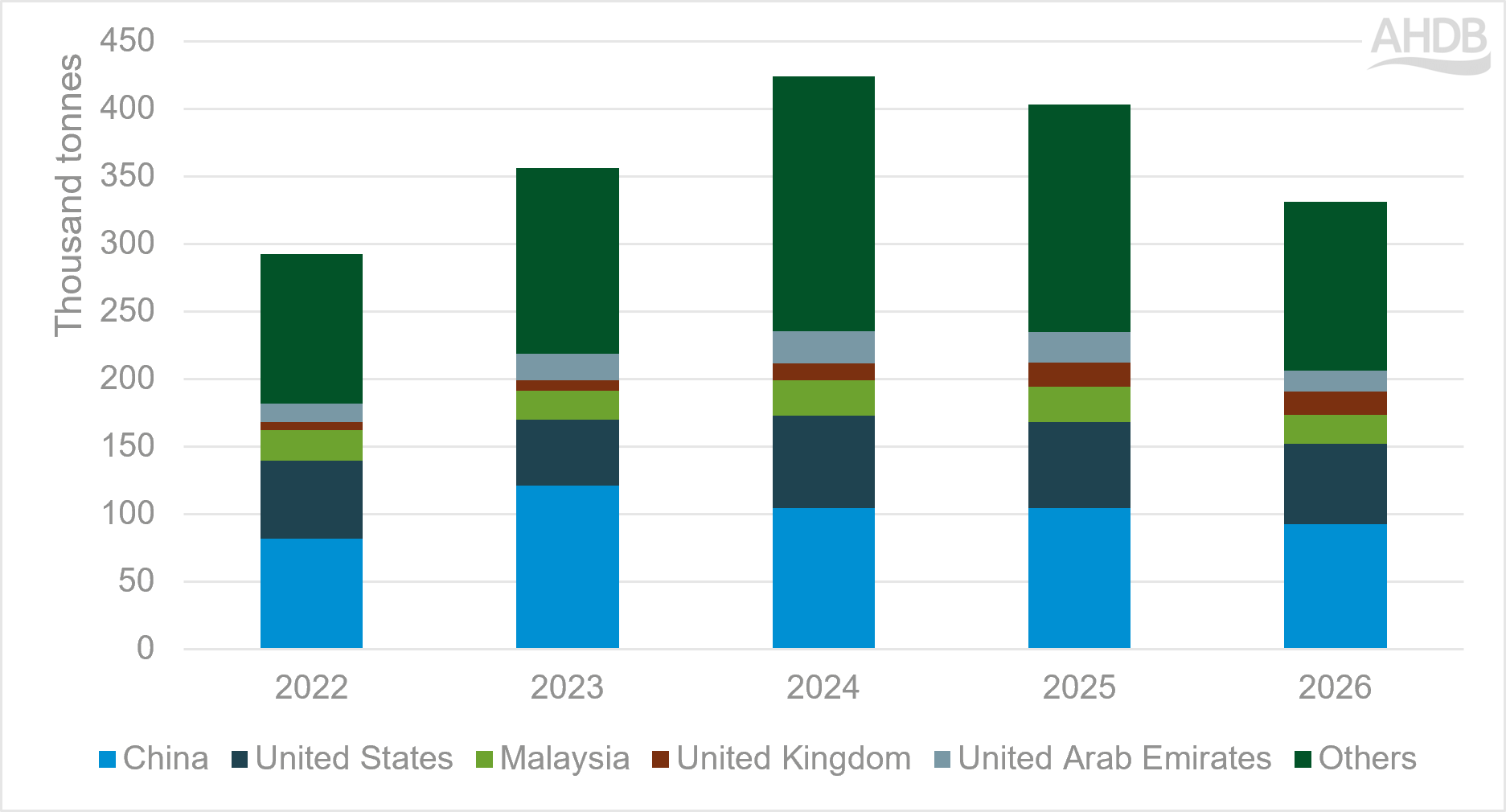
China remains a critical market, maintaining its position as Australia’s largest export opportunity.

North American growth is supported by strong demand and a preference for premium lamb products. Although, competition from New Zealand continues to influence market share.

Figure 2. Australian lamb and mutton exports YTD Jan-Aug for 2022-2026

Australian lamb and mutton export volumes by destination from 2022 to 2026.

Source: TDM

Figure 2 shows Australian lamb and mutton export volumes by destination from 2022 to 2026.

The Australia-United Kingdom Free Trade Agreement (A-UK FTA) has increased the attractiveness of the UK as a destination.

MENA (Middle East and North Africa) remains an important market for mutton and lamb. Ongoing geopolitical tensions have caused shipping disruptions impacting trade flows and limiting export growth to the region.

Looking ahead, global export availability will remain heavily influenced by production in Australia and New Zealand. Declining New Zealand sheep numbers are expected to keep global supply relatively tight, while strong Australian output should support its competitiveness despite elevated prices. Wider economic conditions, geopolitics and trade policy will continue to shape global trade flows and in turn, the UK’s import and export opportunities.

US lamb import safeguard inquiry

The United States Trade Representative (USTR) has recently initiated a safeguard investigation into lamb imports to the US. The aim is to examine if increased imports have had a negative impact on the domestic US sheep industry. The inquiry considers all countries, not just Australia.

Despite the Australia-US Free Trade Agreement providing duty-free access, Australian sheep meat exports to the US have faced increasing tariff pressure, with a 10% tariff introduced and subsequently raised to 12.5% in July 2026.

The result of the investigation is also relevant for the UK. Australia is the world's largest sheep meat exporter by volume, and the US is Australia’s second-largest export market. Depending on the outcome, more restrictive “remedies” could encourage Australia to redirect some export volumes into alternative markets, including the UK or regions where the UK exports to. The outcome of the inquiry is due in November.

What does this mean for the UK?

Tighter Australian sheep supplies and a gradual flock recovery suggest export growth may be constrained in the near term, despite strong demand from key markets. This could limit the volume of Australian lamb available to the UK market.

At a global level, lower slaughter rates in Australia, combined with declining sheep numbers in New Zealand, may contribute to tighten exportable supplies. This could help support international sheep meat prices and provide a more favourable pricing environment for UK producers.

However, improving seasonal conditions and projected flock growth indicate Australia's production potential is strengthening. Monitoring this expansion remains important given the enhanced market access provided under the UK-Australia Free Trade Agreement. The outcome of the US safeguard investigation also remains a key watchpoint.


Sign up for regular updates

You can subscribe to receive Beef and Lamb market news straight to your inbox. Simply fill in your contact details on our online form.

Visit the Keep in touch page

While AHDB seeks to ensure that the information contained on this webpage is accurate at the time of publication, no warranty is given in respect of the information and data provided. You are responsible for how you use the information. To the maximum extent permitted by law, AHDB accepts no liability for loss, damage or injury howsoever caused or suffered (including that caused by negligence) directly or indirectly in relation to the information or data provided in this publication.

All intellectual property rights in the information and data on this webpage belong to or are licensed by AHDB. You are authorised to use such information for your internal business purposes only and you must not provide this information to any other third parties, including further publication of the information, or for commercial gain in any way whatsoever without the prior written permission of AHDB for each third party disclosure, publication or commercial arrangement. For more information, please see our Terms of Use and Privacy Notice or contact the Director of Corporate Affairs at info@ahdb.org.uk  © Agriculture and Horticulture Development Board. All rights reserved. 

×