- Home
- Knowledge library
- Dairy housing cubicles: Layout and dimensions
Dairy housing cubicles: Layout and dimensions
A guide to cubicle design, numbers required and layout.
- Red Tractor standards require at least one cubicle per cow, but recommend 5% more cubicles than cows
- Well-designed and managed cubicles can lead to good occupancy, dry and clean bedding, decreased risk of mastitis and lameness as well as less leg and hock lesions
- At least 0.9 m of lunging room is essential for comfort
Fundamentals of cubicle design
Cubicle design has a big impact on cow welfare. Lying time is closely linked to lameness and cow comfort, so getting your cubicles right for your cows is very important.
Common cubicle design problems
- Too short: Not enough space to lunge when standing or lying. This may cause rubbing and swelling on the hocks, especially where partitions have rear support legs (e.g. Newton Rigg)
- Too long: Cows are more likely to soil bedding, impacting cleanliness and increasing mastitis risk
- Too wide: Cows may turn around, or not lie straight, increasing risk of soiling bedding
- Too narrow: Cows won’t be able to lie comfortably, will rub against partitions, or avoid cubicle entirely
Read more about cubicle design and features
The importance of lunging space
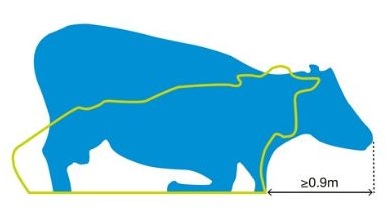
When a cow rises from a lying position, she lunges forward to transfer the weight from her hindquarters onto her front legs.
She will then raise her hindquarters before raising her forequarters.
To accommodate this transfer of weight, the cow thrusts her head forward as she lunges. A cow needs at least 0.9 m of space in front of her to rise easily (Figure 1).
Figure 1. A cow moving from a lying position to a standing position
If the forward lunging space is restricted:
- Standing up becomes difficult
- Cows may throw one foot forward
- The risk of lameness increases
- Reduced cubicle use
Any barriers to this process compromise natural movement and comfort.
Number of cubicles
Red Tractor standards recommend at least 5% more cubicles than cows.
When there is not a cubicle for every cow:
- Lying time reduces, leading to stress and more negative social interactions
- Access to food and water is reduced due to passageway occupation
- Lameness and mastitis increase, caused by increased standing times
- There’s additional soiling of hooves and bedding, as extra slurry is carried into cubicles
All cubicles should be:
- Useable
- Attractive
- Soft and well bedded
Animals lower in the social hierarchy spend 10–45% of the day standing in passages when cubicles are limited. As a result, they suffer more sole, interdigital and heel lesions.
Not all cubicles are occupied to the same degree, with some being more popular. This will also result in subordinate cows standing for longer periods of time.
Providing extra cubicles gives these cows the chance to lie down without risk of aggression.
Number of cubicle rows
There needs to be a balance between:
- Having more cubicles than cows
- Providing sufficient living space
Increasing the number of cubicle rows often reduces passage dimension, limiting space available for loafing.
While the space available may comply with necessary standards and codes of practice, consider the effect it may have on cow behaviour, aggression and feed intake.
Research has shown that more living space:
- Increases lying time
- Reduces time spent standing in passageways
- Lowers aggression and stress
In one research paper, increasing available living space (including passageways and any outdoor loafing space) resulted in an increase in 305-day milk yield.
Yield in heifers increased by 2.1 L per day, while yield in cows increased by 0.3 L per day.
Where less cubicle rows mean larger passageways, slurry is distributed over a larger surface area, reducing slurry depth and the amount lifted into beds.
Standing after milking
Cows should stand for 30 minutes after milking to allow the teat canal to close and reduce the risk of mastitis.
Depending on the layout and number of cubicle rows in the shed, electric fencing, gates or other moveable barriers may be needed to stop cows accessing the cubicles immediately after milking.
Passage widths and layout
Typically, the main types of passages in a shed will be the feed passage, cubicle passage and cross-over passages.
As well as facilitating cow movement and removal of slurry, passages allow the cows to loaf and exhibit social interaction.
Passages should be designed without any dead ends to prevent a dominant cow interacting aggressively with a subordinate cow.
Recommended passage widths
- Passages between rows of cubicles should be a minimum of 3 m with an ideal width of 3.6 m
- Cross-over passages without a water trough should be 2.4 m wide
- Cross-over passages with a water trough should be 3.6 m wide to allow cows to pass behind those drinking
- Feed passages in a three-row system, where cows are backing out of cubicles onto the feed passage, should be at least 5.2 m wide
- Feed passages in a two-row system should be at least 4.6 m wide
Wide passages increase loafing area and can improve positive social interactions and reduce aggression between cows.
However, in hot weather they can be difficult to scrape as slurry is spread over a wider area and can dry out more quickly.
Cross-over passages
- Install cross-over passages at the end of every cubicle row to remove dead ends
- Depending on building layout and size, they should be located approximately every 20 cubicle places
- There should be no more than 25 cubicles without a cross-over passage
For easy cleaning, passages should be the same height as surrounding cubicle beds.
Feed passages
Feed passages must also facilitate vehicle movement. Make sure machinery can enter the building and work easily once inside.
Consideration should be given to potential future requirements, such as increased trailer sizes. Consider the driving skills of the operator/s if you employ multiple staff.
Minimising building dimensions may marginally reduce costs, but tight dimensions will increase the time taken for tasks to be carried out and increase the risk of damage to the building, machinery, staff and cows.
Cubicle dimensions
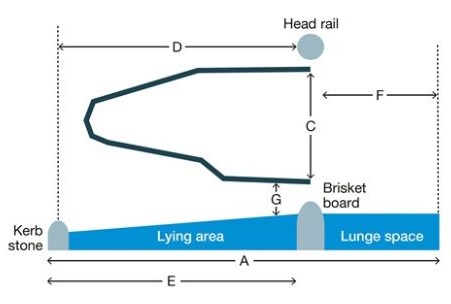
Cubicles should be sized for the largest cows in the group. Dimensions will also depend on its location (e.g. against an outside wall, open fronted facing a feed passage or head-to-head facing another cow).
Figure 2. Guidelines on cubicle dimensions according to cow size
Table 1. Guidelines on cubicle dimensions according to cow size
| Cubicle dimension | Target dimensions (cm) based on bodyweight | ||||
|---|---|---|---|---|---|
|
545 kg |
636 kg |
727 kg |
|||
| A |
Length |
Head to wall Head-to-head |
274 244 |
274 244 |
305 259 |
| B |
Width |
|
114 |
122 |
127 |
| C |
Height (from bed surface to bottom of neck rail) |
|
117 |
122 |
127 |
| D |
Horizontal distance from rear edge of neck rail to edge of cubicle kerb |
Mattresses Deep beds |
168 152 |
173 157 |
178 163 |
| E |
Distance from rear kerb to front of brisket board |
|
168 |
173 |
178 |
| F |
Lunge /bob zone |
|
≥0.9m |
≥0.9m |
≥0.9m |
| G |
Height from bed surface to top of lower rail divider |
|
25 |
31 |
31 |
Source: Dairyland Initiative
The head-to-head length of dimension A refers to one bed only. The total length of two beds in a head-to-head cubicle would be 488 cm for 545 kg cows, 488 cm for 636 kg cows and 518 cm for 727 kg cows.
Sufficient space between the brisket boards allows two cows resting opposite each other to lie straight, but they will use some of the opposite cubicle’s headspace when lunging to rise.
Cubicle length
The total length of the cubicle should provide body space, headspace and lunging space.
Cubicles that are closed at the front, such as those facing a wall, restrict forward lunging. If the cubicle is too short:
- Cows will lunge to the side
- Cows may lie diagonally
- The risk of soiled bedding increases
- Mastitis risk increases
Similarly, in head-to-head cubicles, if the space in the middle of the beds between the brisket boards is too small, cows will lie diagonally.
Avoid reducing cubicle length in head-to-head cubicles. The shared lunging space could cause the cow opposite to rise as well, disrupting her lying time.
As cubicle length increases, so should partition length.
There should be around 0.35 m from the back of the partition to the cubicle kerb. If this distance is greater, cows may walk along the back of the cubicle or try and reverse into the bed.
Cubicle width
Cows should be able to lie down without colliding or rubbing against partitions. This is particularly important as the last stage in the lying movement is uncontrolled.
Where partitions have rear support legs, such as a Newton Rigg partition, install with a clear distance between partitions of 1.2 m. Cubicles for cows less than 600 kg can be 1.15 m wide.
Cubicles need to be wide enough to allow the cow to recline and rise easily. If they are too wide, cows will lie backwards or at an angle, increasing the likelihood of soiled beds.
Further information
Red Tractor dairy standards 2025
Cow comfort technical note (CAFRE)
Best bedding options for cows (Veterinary Practice)
Management of dairy cow cubicles (Vet Times)
- Behavioural needs of the transition cow and considerations for special needs facility design
- Effects of cubicle characteristics on animal welfare indicators in dairy cattle
- Invited review: The welfare of dairy cattle – Key concepts and the role of science
- Effect of overcrowding on claw health in first-calved friesian heifers
- Some effects of housing on the social behaviour of dairy cows
- A randomised controlled trial to evaluate the impact of indoor living space on dairy cow production, reproduction and behaviour
- Bedding on geotextile mattresses: How much is needed to improve cow comfort?