Using Healthy Feet to engage with foot health
Monday, 20 December 2021
As the Healthy Feet Programme reaches its tenth anniversary, vet Owen Atkinson reviews why it remains so important for our UK dairy industry. And maybe give a little push for an even wider uptake and encourage a greater number of Mobility Mentors to join our ranks in delivering it.
Why adopt the Healthy Feet Programme way?
Lameness can’t be solved by selling a vaccine. Or a footbath product, or a novel medicine, or a feed additive. In other words, we all know there are no silver bullets for this problem. However, this is not to say that lameness can’t be solved - far from it. Having a logical approach and confidence in a decent management plan which is evidence-based will be effective to improve hoof health.
The tried and tested framework which works is through the Healthy Feet Programme (HFP). The facilitated approach makes it quite unique and is key to its success. Yes, it takes some time, and some effort, and some commitment from both the deliverer (Mobility Mentor) and their farmer client…but the HFP delivers rewards on this effort and cost many times over (Atkinson, Fisher and Cross, 2013). And that is what we hear time and time again from both you as Mobility Mentors and the farm clients you work with.
Of course, some vets and consultants may try and do it their own way…have a few conversations, a bit of random cajoling, give advice, write reports, try this and that, but frankly, how successful are these approaches? Individuals may be coaxed by farmers to do something for free, or on the cheap. Others may be tempted to go in “softly, softly”, tinker around the edges, but again, how successful are these un-structured interventions?
The thing about the Healthy Feet Programme is that it has been researched, demonstrated to work, and is well supported by technical expertise and experience. It is relevant to UK dairy herds, as it has been developed by people in the UK who understand our dairy systems - whether they be indoors, outdoors or a mix of both.
A Recap: Delivering the Healthy Feet Programme or Healthy Feet Lite
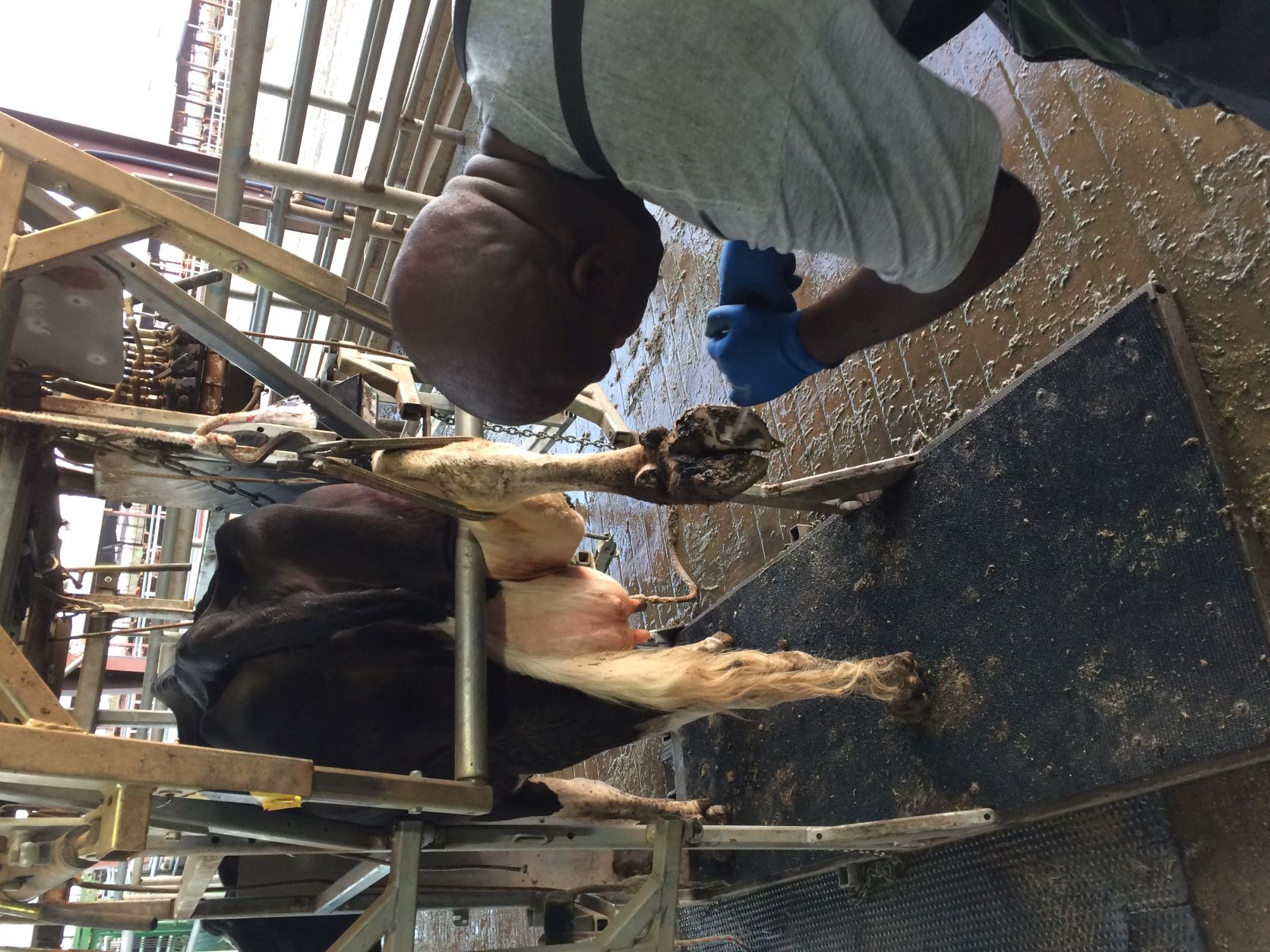
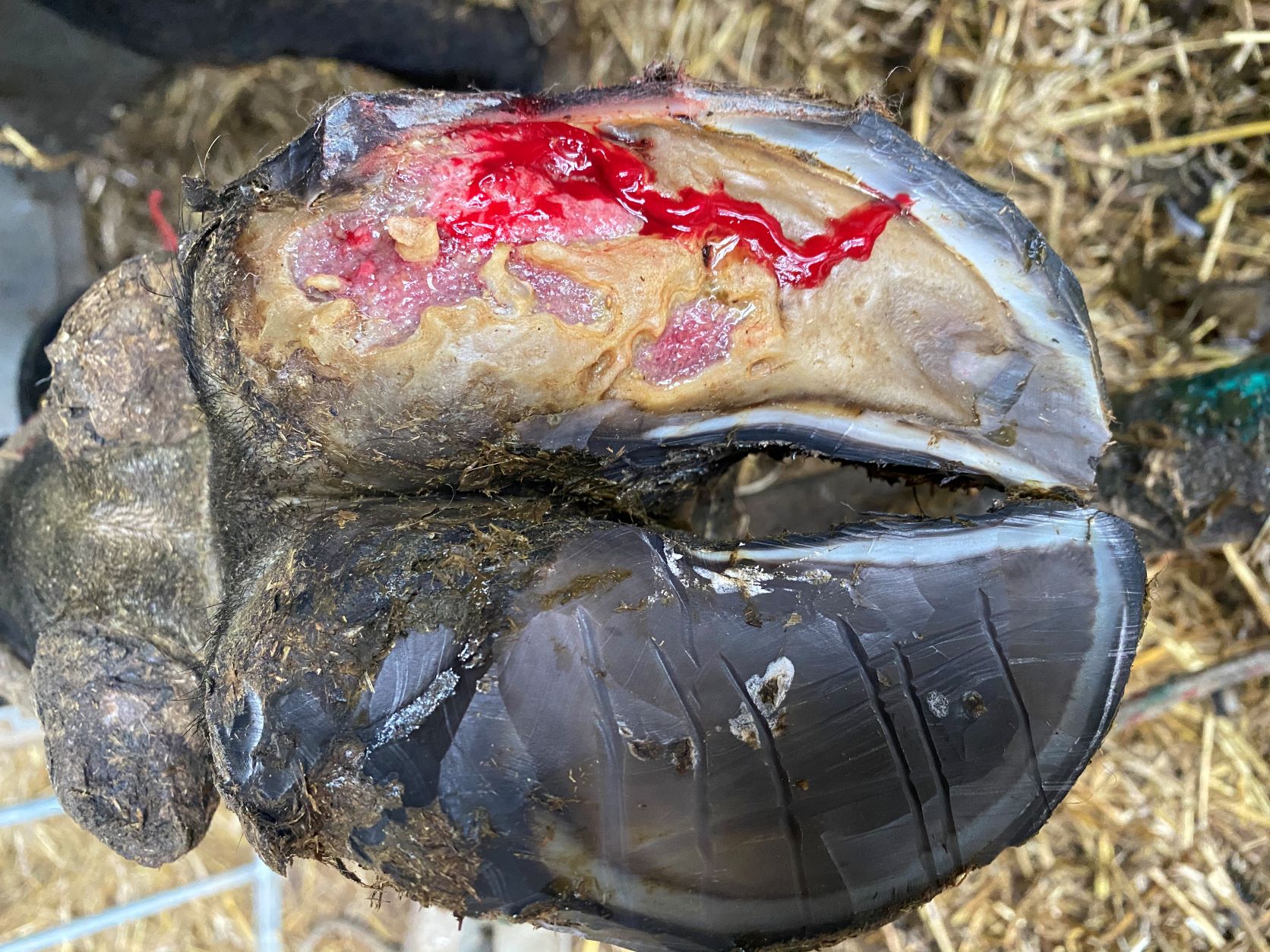
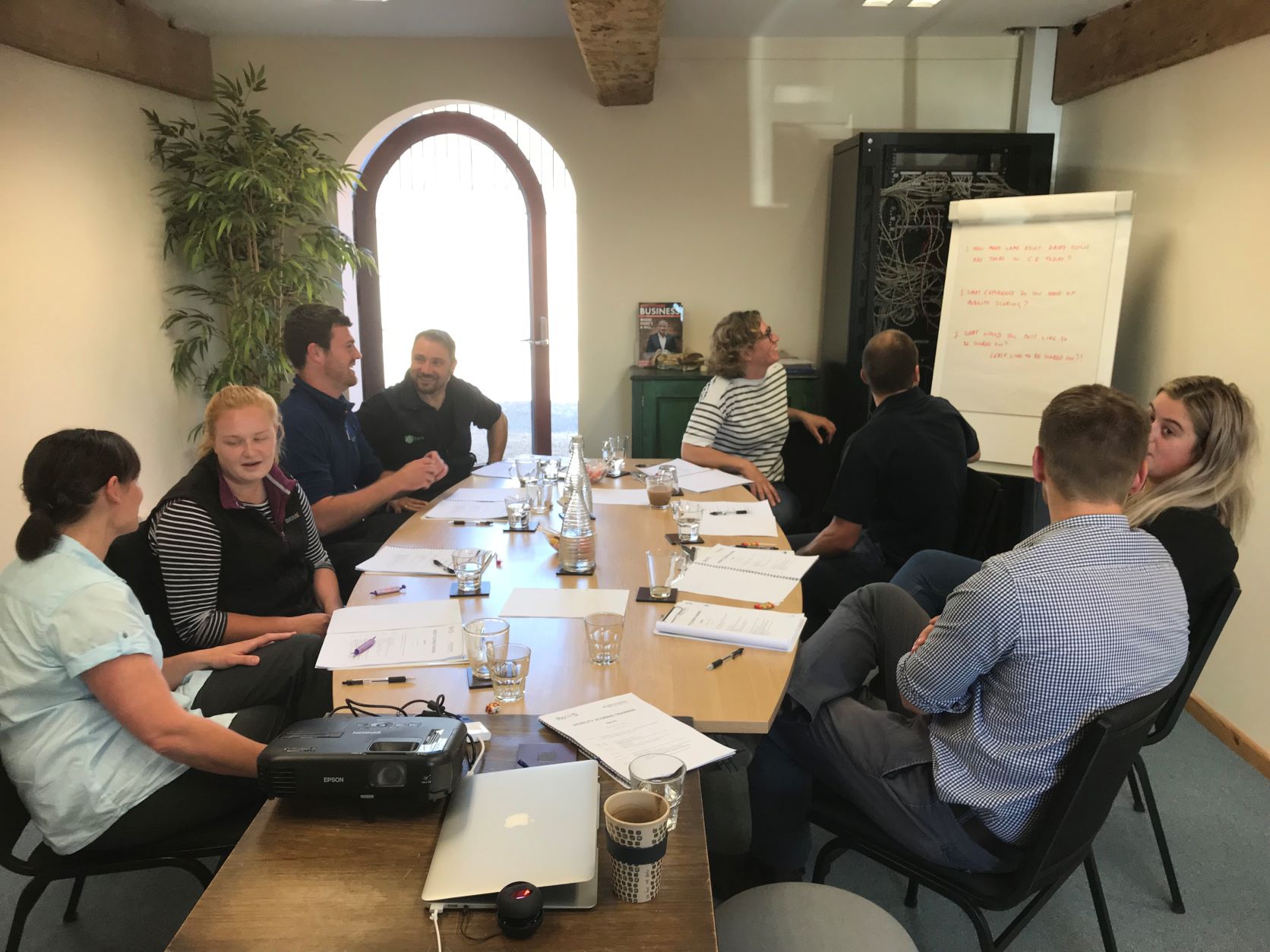
There are certainly many new skills to learn in order to deliver the HFP successfully. The training covers as much about coaching, facilitation and mentoring skills as it does about the technical aspects of lameness management (see Figures 1, 2 and 3). In fact, many of you report back that the technical stuff is probably easier to master than the human elements!
The programme is underpinned by mobility scoring by a trained and independent scorer who should be RoMS accredited. For many vet practices, getting fully on-board with RoMS mobility scoring has been a valuable first step to become more effective in improving foot health on their clients’ farms. An analogy might be that mobility scoring is to lameness management what individual cell counts are to udder health management. The value is in collecting prevalence data, plus being able to identify cows for early treatment.
The Four Success Factors for foot health are central to the programme. As a reminder, these are Low Infection Pressure, A Robust Foot, Low Forces, and EDPET…Early Detection, Prompt Effective Treatment. Individual lameness reduction strategies and interventions fall under each of these four categories. As examples, foot bathing comes under Low Infection Pressure; body condition management comes under A Robust Foot, and cubicle comfort comes under Low Forces.
The Lameness Map, using lesion prevalence data, assists in targeting the actions and changes which will be most beneficial for the particular farm. This can only happen after an appraisal of whatever records there are (and if there are none, by using participatory epidemiology - basically asking the farmer to either say or to point to some pictures of lesions they usually see).
The Lameness Map takes a balanced scorecard approach, to prioritise the interventions and changes which will yield the most beneficial outcomes, and match this with findings from the thorough farm risk-appraisal. For example, a farm which sees a lot of white line lesions will need to focus on horn quality, sole thickness and reducing shearing forces. On such a farm, a major point of attention will probably need to be on stockpersonship skills, and better cow flow.
Regular whole herd mobility scores should be used to track progress and aid discussions about the economic impacts. For this, using the new HFP Cost Calculator is invaluable.
Excepting the mobility scoring, the full programme is designed to be delivered in three distinct chunks initially: a visit for a farm investigation, a visit to check some feet together and review how lesions are being treated, and a visit to facilitate the whole farm team to come up with their initial plan. Thereafter, regular reviews and mobility scoring allow the Mobility Mentor to continue to help their client with implementation of the programme, and further improvements in foot health management on the farm.
Because we are all time-poor, and to reduce barriers to getting started, in 2020 a bite-sized version of the HFP, Healthy Feet Lite, was introduced. HF-Lite just requires a single visit and focuses on just one lesion type.
It is probably fair to say that whatever the entry route - the full programme or HFLite - good foot heath management will benefit from an ongoing input from the Mobility Mentor. The programme is unlikely to unleash its full benefit when it is parachuted in without thought to ongoing support.
Increasing confidence as a Mobility Mentor
No-one expects Mobility Mentors to be immediately perfect, only to be good enough to get out there and start delivering the programme. Something we have learned over the years is that most Mobility Mentors appreciate some support after their initial training - just like farmers who need ongoing bolstering to make changes to improve foot health on their farms. To this end, the new modular Mobility Mentor training includes an on-farm catch-up session once newly trained Mobility Mentors have delivered their first HFP or HF-Lite. This session allows people to share experiences as well as try out a few more coaching techniques in a friendly environment.
All Mobility Mentors - whenever they first became trained - are welcome to join in one of these CPD sessions (Module 4). Mobility Mentors are invited to do so by registering directly with BCVA for the next available course. There are also additional CPD opportunities which will likely make a Mobility Mentor feel they have a more rounded knowledge and expertise. Examples are trimming workshops, and cow flow plus stress-free cow handling.
Mobility Mentors are also encouraged to make full use of the dedicated Whats-App group (message Sara on 07545 431800 if you aren’t involved and would like to join) and the huge online resource library available through the Healthy Feet Website. These are in addition to the materials available exclusively to Mobility Mentors through the AHDB Mobility Mentor Resource Centre.
Increasing farmer engagement
A first logical step for a vet or other suitably qualified professional looking to engage farmers better in foot health is to become a Mobility Mentor. However, the evidence is that the majority of dairy farmers have unfortunately not yet heard of the Healthy Feet Programme (Williams van Dyke, 2020), so the next step is to lay out what it is and what you can offer.
For example, many farmers probably have no idea what their vets could do for them in this area of herd health. However, by becoming a Mobility Mentor and offering the Healthy Feet Programme, we hope that it makes it much easier for a vet to describe a coherent pathway towards better foot health, and how they can help their clients achieve their goals. The opportunities to become a Mobility Mentor have recently become much easier, now that BCVA directly organises the training and it is available in four modules, either online or face-to-face or a mixture of both.
Lameness in dairy cows is a prominent issue, and it isn’t going to become any less so. Cattle vets and other suitably qualified professionals have an important role: farmers need knowledgeable, engaged and confident advisers to help them improve and manage foot health. Whilst it might not initially appear to be the easiest area to become involved in, there is plenty of support out there for those who choose it. The potential rewards are huge.
References
Atkinson O, Fisher G, Cross K (2013). Cattle Mobility: changing behaviour to improve health and welfare and dairy farm businesses.
Williams van Dijk L (2020). Participatory Policy Development with farmers, farm assurance schemes and milk processors. Report for AHDB by the Royal Agricultural University and Bos International Ltd.
Further Resources
Owen Atkinson
Owen Atkinson
Figures 1-3: Becoming a Mobility Mentor involves developing many talents, including appraising hoof care (Figure 1), understanding the reasons for complicated lesions (Figure 2) and learning new communication and people skills (Figure 3).
Sectors: