Margins tighten and supply slows - Rabobank Q2 dairy outlook

Thursday, 2 July 2026

Global dairy markets are showing signs of rebalancing as milk production growth slows, though tighter margins and rising input costs continue to weigh on the outlook.

Key points

  • Global milk production growth is set to slow sharply from the Q4 peak, falling off a lot in Q2 before declining by Q4
  • Farmer margins are tightening as falling milk prices meet rising input costs
  • Commodity markets are split, with protein products maintaining strength, while butter and cheese remain under pressure
  • Demand is fragile, with inflation, geopolitics and El Niño posing key risks

The Big 7*

The Big 7 production region dairy markets are entering a transitional phase as strong 2025 production growth eases. Milk output is forecast to rise by around 1% in 2026, down from 3.1% in 2025, with production peaking in Q2, flattening in Q3 and contracting in Q4.

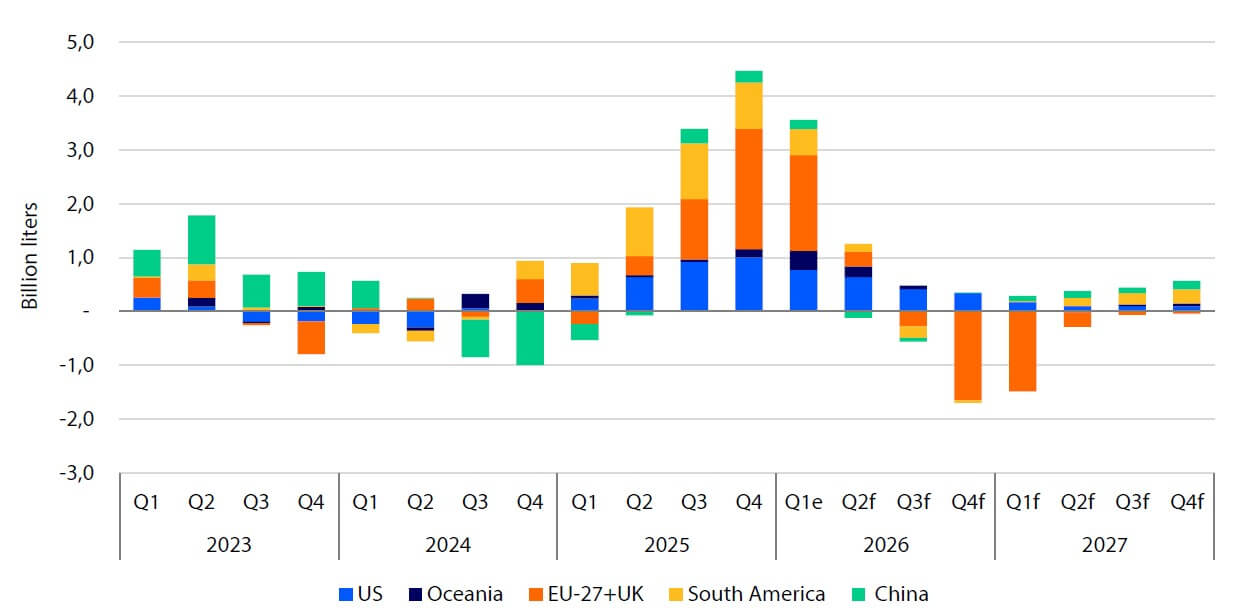
Figure 1: Milk production growth, Big-7 exporters and China (actual and RaboResearch forecast), 2023–2027f

Milk production growth, Big-7 exporters and China (actual and RaboResearch forecast), 2023–2027f

Figure 1 shows the change in milk production every quarter for the Big 7 producing regions, from 2023 to a forecast 2027 Q4. The graph shows strong growth in 2025 and the start of 2026, with forecasts of reductions mostly for the European Union in the second half of 2026.

This signals gradual rebalancing, although supply remains ample following last year’s surge. Skimmed milk powder (SMP) and whey are strengthening on protein demand, while butter and cheese continue to face pressure from oversupply.

Farm profitability is tightening across most regions as milk prices weaken and input costs rise. Energy, fertiliser and interest rates remain key pressures, compounded by geopolitical uncertainty.

Inflation and uneven consumer spending are shaping demand, although the “protein trend” continues to support higher-value dairy. While oversupply is easing, markets are entering a more uncertain, margin-driven phase.

European Union and UK

Milk production across the EU-27 and UK remains high but is losing momentum after prolonged expansion, driven largely by productivity gains. The forecast expects slight growth in Q2, around 0.2%, with reductions around 1% in the second half of 2026.

Margins have tightened sharply, with milk prices down around 17% since September and energy and fertiliser costs rising. This has led to excess supply being channelled into processing, boosting SMP and butter output and weighing on prices.

Demand has improved slightly at lower prices but remains insufficient to absorb the surplus. Supply is expected to slow gradually, while exports offer some support amid ongoing geopolitical disruption.

USA

The US continues strong growth, with output forecast to rise by around 2% in 2026, supported by a record herd of 9.7 million head and higher yields.

Margins remain relatively resilient, helped by lower feed costs and additional income streams such as beef-on-dairy systems.

High milk supply has driven near-record cheese and butter output, while whey and protein products expand on strong demand. Non-fat dry milk prices have firmed due to tighter supply.

Demand remains solid domestically and internationally, helping absorb production. Prices are expected to stay close to long-term averages.

New Zealand

New Zealand is coming off a strong season, with output up around 3.5% year-on-year and on track for a record, while milk production growth is forecast to moderate to around 1.0% in 2026/27.

Farmgate prices remain high (around NZD 9.7–9.75/kgMS), supporting profitability, though growth is expected to slow to about 1% due to the high base.

Exports remain strong, particularly whole milk powder, though rising energy costs pose a risk to margins and future expansion.

Australia

Production has been slightly below prior-year levels, down 0.3% season-to-date through April, and is forecast to decline by a further 0.3% in 2026/27, despite some late-season recovery.

Rising input costs and flat milk prices are keeping many farmers near breakeven, with output forecast to decline slightly in 2026/27.

A potential El Niño raises feed risks, while domestic prices are rising and imports increasing.

Brazil

Brazil’s rapid growth is slowing after an 8.0% increase in 2025, with milk production expected to remain constant in 2026 and decline during the second half of the year.

Margins are stabilising somewhat as prices recover, but demand remains weak due to inflation and high debt levels. Imports are expected to stay elevated.

Weather remains a key uncertainty, particularly the risk of El Niño disruption.

Argentina

Production growth is weakening, with Rabobank expecting only low single-digit growth of around 1-2% in 2026, before output declines later in the year. Margins remain under pressure from weaker prices.

Demand is steady but focused on lower-value products, limiting value growth. Export volumes are strong, though competitiveness is constrained by currency dynamics.

Industry consolidation continues to shape the outlook.

China

Milk production is expected to remain broadly flat at around 40.9 million tonnes in 2026, as productivity gains offset declining herd size.

Demand is recovering, with consumption forecast to grow around 2% in 2026, led by foodservice and higher-value products.

Whole milk powder imports are rising while SMP imports fall, reflecting shifting preferences. Net imports are expected to increase overall.

Sector consolidation is improving efficiency and supporting a more balanced medium-term outlook.

* The Big 7 includes the EU, the US, New Zealand, Australia, Brazil, Argentina, and Uruguay

Image of staff member Sebastian Abbott

Sebastian Abbott

Trainee Analyst

See full bio


Sign up to receive the latest information from AHDB.

While AHDB seeks to ensure that the information contained on this webpage is accurate at the time of publication, no warranty is given in respect of the information and data provided. You are responsible for how you use the information. To the maximum extent permitted by law, AHDB accepts no liability for loss, damage or injury howsoever caused or suffered (including that caused by negligence) directly or indirectly in relation to the information or data provided in this publication.

All intellectual property rights in the information and data on this webpage belong to or are licensed by AHDB. You are authorised to use such information for your internal business purposes only and you must not provide this information to any other third parties, including further publication of the information, or for commercial gain in any way whatsoever without the prior written permission of AHDB for each third party disclosure, publication or commercial arrangement. For more information, please see our Terms of Use and Privacy Notice or contact the Director of Corporate Affairs at info@ahdb.org.uk  © Agriculture and Horticulture Development Board. All rights reserved. 

Topics:

Sectors:

Tags:

×