How have agri-environment schemes impacted arable land availability for harvest 2025? Grain market daily

Wednesday, 6 August 2025

Market commentary

  • UK feed wheat futures (Nov-25) finished at a contract low of £172.60/t down £2.00/t (1.2%) on the previous day
  • Domestic feed wheat futures have come under pressure, influenced by declines in US wheat markets. Chicago feed wheat futures (Dec-25) hit a contract low at $194.17/t down $3.12/t (-1.6%), weighed on by strong yield forecasts for both wheat and corn
  • Paris rapeseed futures (Nov-25) closed at €475.50/t down €0.75/t (-0.2%) on the previous day, holding its current support level for the last three months
  • Attention turns to soyabeans in the USA as they reach their critical flowering stage in August. Chicago soyabeans (Nov-25) down -0.4% compared to Monday
Image of staff member George Craddock

George Craddock

Analyst (Cereals & Oilseeds)

See full bio

Sign up to receive the Weekly Market Report and Grain Market Daily from AHDB.

Subscribe

How have agri-environment schemes impacted arable land availability for harvest 2025?

A change in land use across the UK remains a key topic of discussion in the sector, and as such, so does information on uptake of agri-environment schemes, particularly the Sustainable Farming Incentive.

The Sustainable Farming Incentive (SFI), introduced in England to incentivise farmers to deliver environmental benefits such as improved soil health and enhanced biodiversity, has seen growing uptake since its expansion in 2024. New insights from AHDB’s Spring 2025 Planting and Variety Survey released last month, reveal how farmers are responding to this evolving landscape of agricultural support as the UK continues its transition away from the Basic Payment Scheme (BPS).

Just over half of English farmers use agri-environment schemes to target less productive land

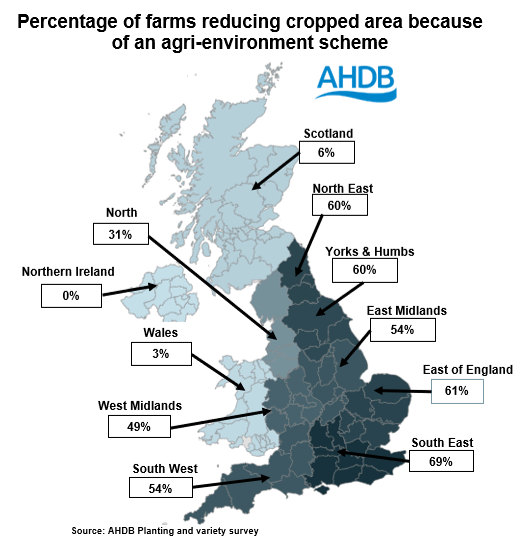
According to the survey, just over half of English farmers (56.1%) have reduced their cropped arable area to take part in agri-environment schemes for harvest 2025, across the UK this figure is 42.3%. It would appear farmers target less productive or marginal land for environmental conversion. This making the most economical sense, balancing the dual goals of sustainability and farm profitability. The extent of this uptake varies significantly across regions.

UK map of Agri-scheme participation

Regions with traditionally intensive arable farming are most likely to shift their land use.

The South East and East of England show particularly high scheme participation, likely aided by strong advisory networks and greater on-farm labour capacity, averaging 3.6 and 3.3 workers per farm, respectively (Defra, 2024).

This additional workforce may give time-pressed farmers more opportunity to engage with the time-intensive requirements of agri-environment schemes.

The data suggests that while reductions in cropped area are widespread, most are modest in scale. Of those who reduced cropped area:

  • 53% did so by less than 10%
  • Only 3% removed all cropped land from production

Farms who have reduced cropped area in a scheme

A key concern is ensuring government incentives don’t encourage farmers to withdraw productive land from use. Payment structures should be balanced to make it financially viable to retire less productive areas, while preserving the most productive land for continued production.

Regional differences may be shaped by policy timelines

While England is ahead with the SFI, the picture is more fragmented across the devolved nations. Lower uptake elsewhere is less surprising when viewed in the context of differing timelines and policy structures:

  • Wales: Preparing for the rollout of the Sustainable Farming Scheme (SFS) in 2026. Earlier in July, it was announced that BPS will be reduced to 60% of its current levels a larger decrease than many were expecting, which may incentivise uptake when the scheme comes in
  • Scotland: Farmers access support through the Agri-Environment Climate Scheme (AECS), which reopened in February 2025, offering a different structure and eligibility criteria
  • Northern Ireland: Launched the Farming with Nature (FwNT) scheme in June 2025, with a strong focus on environmental delivery and low-carbon practices

These regional policy differences provide important context for interpreting uptake levels. England’s more advanced implementation is most likely to have driven faster engagement, while other nations remain in earlier stages of scheme development.

Private nature markets and future shifts

Notably, while 84% of participating English farmers cited the SFI as their reason for reducing cropped area, 16% were influenced by other tools, likely including private nature markets and Countryside Stewardship.

Private schemes are expanding rapidly and may offer flexible or competitive alternatives, especially amid recent adjustments and uncertainty surrounding SFI terms.

Looking ahead

Going forward, the relationship between public and private environmental schemes will be key.

Ideally, they should work together to deliver meaningful benefits without compromising food production. As both systems develop, farmer preferences and participation rates will be central to how agricultural land use evolves.

Find out if nature markets might be a tool you can use on your farm

AHDB provides up to date information on the Sustainable Farming Incentive (SFI) for England and the Sustainable Farming Scheme (SFS) for Wales.

Review of agri-environment schemes (AES)

In 2025, AHDB worked with Harper Adams University to review government reports and scientific studies to understand the current AES landscape.

How agri-environment schemes affect farm resilience (news item)


Sign up to receive the latest information from AHDB.

While AHDB seeks to ensure that the information contained on this webpage is accurate at the time of publication, no warranty is given in respect of the information and data provided. You are responsible for how you use the information. To the maximum extent permitted by law, AHDB accepts no liability for loss, damage or injury howsoever caused or suffered (including that caused by negligence) directly or indirectly in relation to the information or data provided in this publication.

All intellectual property rights in the information and data on this webpage belong to or are licensed by AHDB. You are authorised to use such information for your internal business purposes only and you must not provide this information to any other third parties, including further publication of the information, or for commercial gain in any way whatsoever without the prior written permission of AHDB for each third party disclosure, publication or commercial arrangement. For more information, please see our Terms of Use and Privacy Notice or contact the Director of Corporate Affairs at info@ahdb.org.uk  © Agriculture and Horticulture Development Board. All rights reserved. 

×