Arable Market Report – 10 August 2026

Monday, 10 August 2026

This week's view of grain and oilseed markets, including a summary of both UK and global activity.

Grains

UK feed wheat futures (Nov-26)

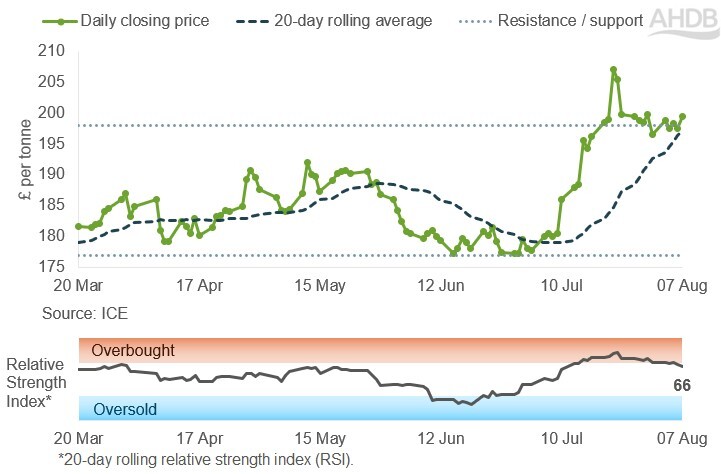
Figure 1. UK feed wheat futures prices, Nov-26 contract (£/tonne)

Nov-26 UK feed wheat futures gained £3.00/t (1.5%) last week to end Friday at £199.50/t. 

Last week, the Nov-26 prices (green line with markers, Figure 1) stayed close to the current resistance line (horizontal grey dashed line, Figure 1) at £198/t. Resistance lines are levels that prices may find it harder to move above.

Meanwhile, the 20-day rolling average price is now also close to the resistance line. Together, these suggest more potential for a change in the price trend soon, so it’s likely to be worth paying closer attention to markets.

Meanwhile, the Relative Strength Index (RSI) remained close to the overbought zone (70) through last week. The RSI was 66 on Friday.

Find out more about the graphs in this report and how to use them

Market drivers

European wheat prices rose last week after further attacks on shipping and ports in the Black Sea. The conflict continues to restrict exports and push up shipping costs from the region. However, expectations of good crops in both countries limited the price rises.

AKP-Inform increased its estimate of the Ukrainian 2026 wheat crop by 0.2 Mt to 22.6 Mt and barley crop by 0.9 Mt to 6.3 Mt this morning. But the company cut its export forecasts by 1.8 Mt for wheat and 0.8 Mt for barley due to the challenges shipping from Black Sea ports.

The conflict will remain a key driver in the weeks ahead.

Dec-26 Paris milling wheat futures gained 1.8% between 31 July and 7 August.

Nov-26 Paris maize futures gained 2.3% over the same period as crop forecasts slipped further due to the hot, dry weather, especially in France.

Expana cuts its forecast of the 2026 EU-27 maize crop by 4.6 Mt from last month to 49.1 Mt, now down 14% year-on-year. Argus Media forecast the crop 20% below last year at 48.0 Mt.

Meanwhile, Dec-26 Chicago wheat futures only gained 0.1% last week, and Dec-26 Chicago maize futures fell by 0.4%. The different trend likely, in part, reflects a rise in the strength of the US dollar and better (wetter) weather for US maize crops.

Also last week, StoneX predicted a US maize yield 1% higher than the USDA’s July forecast.

However, US maize crop condition ratings have dipped in the past three weeks after periods of hotter weather. As a result, a poll by Reuters shows a wide range of expectations for the US maize yield, with the average expectation 0.3% below the USDA’s July forecast.

The USDA data is due at 5 pm on Wednesday.

Table 1. Global grain futures prices

Futures marketUK feed wheatParis milling wheatChicago wheatChicago maize
Contract month Nov-26 Dec-26 Dec-26 Dec-26
Price (per tonne) £199.50 €232.00 $241.84 $181.89
Change on week +£3.00 +€4.00 +$0.28 -$0.79

UK delivered cereal prices

The price for bread wheat to be delivered into Northamptonshire in November was reported at £215.50/t as of Thursday’s close.

The price equated to an £18.00/t premium over the Nov-26 UK feed wheat futures prices (£197.50/t) on Thursday. This is a decline from the £30.00/t premium for the same delivery period reported in early July.

Meanwhile, bread wheat to be delivered into Yorkshire in November was £222.50/t, equating to a £25.00/t premium over Nov-26 UK feed futures on the same day.

Table 2. UK delivered cereal prices

Delivery specificationN'hants bread wheatE. Anglia feed wheatYorkshire feed wheatE. Anglia feed barley
Delivery month Nov-26 Nov-26 Nov-26 Nov-26
Price (per tonne) £215.50 n/a n/a n/a
Change on week n/c n/a n/a n/a

n/a = not available

n/c = no comparison available.

Rapeseed

Paris rapeseed futures in £/t (Nov-26)

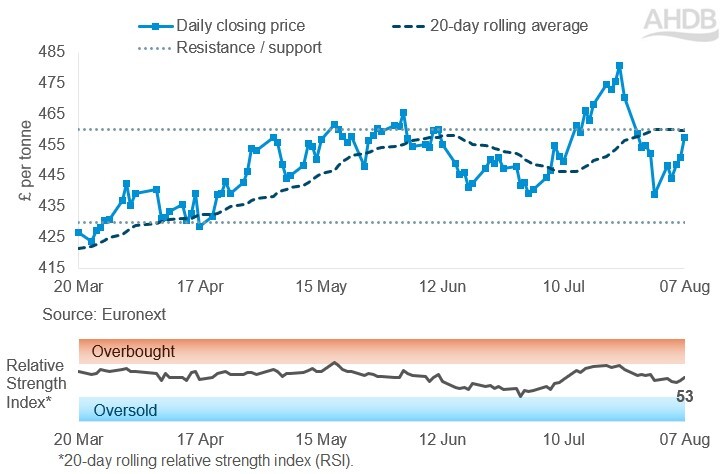
Figure 2. Paris rapeseed futures prices, Nov-26 contract (£/tonne)

Nov-26 Paris rapeseed futures (blue line with markers, Figure 2) gained 4% last week in £/t to end Friday’s trading at a little over £457/t. 

The contract has again moved closer to a resistance line (horizontal grey dashed line, Figure 2) at £460/t and the 20-day rolling average (black dashed line). Resistance lines are levels that prices may find it harder to move above.

The market news this week will be important to determine if prices can push above the resistance line, or if they remain below it.

The Relative Strength Index (RSI) was 53 on Friday 7 August. While up from 49 a week earlier (31 July), this still indicates relatively limited market momentum.

Find out more about the graphs in this report and how to use them

Market drivers

Rapeseed futures prices rose last week, recovering some of the previous week’s losses. Nov-26 Paris rapeseed futures rose 4.0%, while Winnipeg canola futures gained 2.9% over the week.

Exports of rapeseed and sunflower oil from the Black Sea are being disrupted by the ongoing conflict, adding support to prices. Trade within Europe is also having to contend with low water levels, including in the Rhine and Danube, impacting transport.

However, lower crude oil prices and high expectations for Black Sea crops limited price gains.

Brent crude oil futures (Oct-26) fell 5% between 31 July and 7 August to $83.55/barrel. Optimism over negotiations between the US and Iran pushed prices below $80/barrel mid-week. But reports that traffic through the Strait of Hormuz remains below peak levels helped prices to recover slightly towards the end of the week. 

Meanwhile, Nov-26 Chicago soyabean futures fell 1% over the same period. Some crop optimism, plus selling by speculative traders, contributed to the decline in prices, though export sales helped limit losses.

US soyabean crop condition scores remained stable in last Monday’s report (3 August) with 63% in good or excellent condition. This, plus forecasts of rain as crops reach key development stages, is supporting crop expectations.

A poll of analysts by Reuters shows expectations for the USDA to keep its forecast of the US soyabean yield and crop broadly stable from July.

China booked 0.98 Mt of US soyabeans from private exporters last week according to USDA sales announcements.

The ongoing conflicts in the Black Sea and Iran are likely to continue to influence prices this week. Wednesday evening’s updated world agricultural supply and demand estimates from the USDA and weather for US soyabean crops will also be watched closely.

Table 3. Global oilseed and oil futures prices

Futures marketParis rapeseedChicago soyabeansChicago soyabean oilBrent crude oil*
Contract month Nov-26 Nov-26 Dec-26 nearby
Price (per tonne) €533.25 $432.15 $1,496.48 $83.55
Change on week +€20.25 -$4.13 +$21.61 -$4.38

*Brent crude oil price per barrel

UK delivered rapeseed prices

Rapeseed delivered into Erith in November was reported at £464.50/t in Friday’s survey. This is up £8.00/t from the survey on 31 July. 

There were slightly smaller rises for Liverpool delivery and East Anglia delivery as the regional relationships shifted slightly.

The November delivered price for Liverpool was £464.50/t on Friday, with East Anglia reported at £462.00/t.

Table 4. UK delivered rapeseed prices

Delivery specificationErithLiverpoolEast Anglia
Delivery month Nov-26 Nov-26 Nov-26
Price (per tonne) £464.50 £464.50 £462.00
Change on week +£8.00 +£7.50 +£6.50

Extra information

On Thursday last week, AHDB published UK cereals usage statistics for June 2026, so we now have data for the full 2025/26 season.

UK human and industrial usage:

  • Brewers, maltsters and distillers (BMD) used 18% less barley in June 2026 than a year earlier as pressure continued on the sector. Total season (July 2025-June 2026) usage by BMD came to 1.44 Mt, a 19% drop from 2024/25.
  • UK flour millers (including for starch and bioethanol) used 8% less wheat in the 2025/26 season than in 2024/25, driven by the decline in bioethanol demand.
  • UK oat millers milled 4% more oats in the April-June quarter than the same period a year ago. This took the full season total to 521 Kt, up 6% on the year.

GB animal feed production in June 2026 was 7% below a year earlier after good grass growth earlier in 2026 and livestock margins came under pressure. Total production for the 2025/26 season is down just over 1%.

Meanwhile, feed production by integrated poultry units (IPUs) continued to show growth in June, up 16% year-on-year. The season (July-June) total for IPUs was up 15% from 2024/25, led by broilers.

AHDB’s monitoring of Cabbage Stem Flea Beetle (CSFB) migration has started for this year.

AHDB’s next report on UK harvest progress and results is due out this Friday (14 August).

Northern Ireland

Table 5. Delivered prices into Belfast*

Delivery specification**Feed barley  - spotFeed barley  - forwardFeed wheat  - spotFeed wheat  - forward
Delivery month Spot Nov-26 Spot Nov-26
Price (per tonne) n/a £203.50 £217.00 n/a
Change on week n/a -£1.50 -£2.00 n/a

*Prices provided for indicative purposes

**Basis is imported/home-grown

n/a = not available


Sign up to receive the latest information from AHDB

While AHDB seeks to ensure that the information contained on this webpage is accurate at the time of publication, no warranty is given in respect of the information and data provided. You are responsible for how you use the information. To the maximum extent permitted by law, AHDB accepts no liability for loss, damage or injury howsoever caused or suffered (including that caused by negligence) directly or indirectly in relation to the information or data provided in this publication.

All intellectual property rights in the information and data on this webpage belong to or are licensed by AHDB. You are authorised to use such information for your internal business purposes only and you must not provide this information to any other third parties, including further publication of the information, or for commercial gain in any way whatsoever without the prior written permission of AHDB for each third party disclosure, publication or commercial arrangement. For more information, please see our Terms of Use and Privacy Notice or contact the Director of Corporate Affairs at info@ahdb.org.uk  © Agriculture and Horticulture Development Board. All rights reserved. 

×