Analyst insight: UK grain supplies tightening

Thursday, 28 May 2026

AHDB’s latest estimates of UK cereal supply and demand show lower stocks at the end of this (2025/26) season than we forecast in March for wheat, barley and oats. The stocks are also forecast to be lower than in 2024/25.

This change reflects survey data, market conditions, increased consumption for bioethanol, and revisions to estimates of grain fed on farm this season.

The geopolitical backdrop to UK cereal supply and demand estimates has changed since the last estimates were made in March, adding complexity to markets, supply chains and forecasting.

Following government support, bioethanol production at Ensus resumed in April. These forecasts include usage estimates for the rest of the season (end-June), increasing wheat and, to a lesser extent, maize demand for human and industrial (H&I) use.

As a result:

  • Wheat stocks are now forecast at 1.919 Mt. This is 235 Kt lower than in March due to stronger demand, including from the bioethanol and starch sectors, but also higher usage for animal feed. If confirmed, stocks at the end of June 2026 would be the lowest since 2023.
  • Barley stocks are forecast at 1.266 Mt, down 47 Kt from March. Further pressure on the human and industrial (H&I) demand is more than offset by lower imports and increased usage of barley as animal feed on farm. Imports are lower than expected previously due to GB barley replacing some imports into Northern Ireland.
  • Oats stocks are now forecast at 87 Kt, down 6 Kt from March due to higher demand and exports. This would be the lowest level since 2012/13. Meanwhile, milling usage remains supported in part due to the quality of the 2025 crop.

Get more details on the changes and download the estimates.

Lower stocks at the end of the season mean less cushion to any potential issues with the 2026 crops and puts more focus on when harvest starts and how it progresses. But the extent of both these depends on how low stocks are.

Areas of uncertainty

Though these forecasts show tightening supplies for wheat and barley, the predicted stocks remain close to the five-year averages.

However, some in industry report particularly tight market conditions.

So, how tight might the market be?

Most of the statistics used to produce the supply and demand estimates are collected through surveys. There is always some uncertainty typically with surveys as, unlike a census, surveys don’t include data from every business.

We can be fairly confident in the reliability of the trade data and cereal usage surveys as it’s a requirement to submit data.

We estimate how much grain is Fed on Farm each season, so there is more uncertainty over this figure than the usage surveys. However, we increased our estimate from March to reflect that less wheat and barley was in stock on farms in England and Wales (according to Defra’s end-February survey). So, this is unlikely to be contributing to the difference between the sentiment and forecasts.

The impact on grass growth of current hot temperatures and low rainfall in certain regions may also impact usage going forward.

So, let’s look at the production and on-farm stocks.

Production

AHDB produces the supply and demand estimates on behalf of Defra and uses Defra’s crop production estimates. The estimates are produced from surveys by Defra, the Scottish Government, the Welsh Assembly, and DEARA in each of the nations of the UK.

The extreme weather last year meant yields were highly variable and added to the challenge of fully understanding the UK 2025 crops. Crop areas have also varied over recent years due to extreme weather, plus changes in demand, profitability and policy.

We get an idea of the potential uncertainty around English production from the Confidence Interval (CI). Defra’s estimate of the English wheat crop in 2025 was 10.677 Mt and the 95% CI was +/- 226 Kt. This statistic shows that we can be 95% confident the English wheat crop was between 10.452 Mt and 10.903 Mt.

With a tight market reported and old crop delivered prices again higher than new crop prices, production is more likely to be towards the lower end of the range. This price difference means grain is more wanted in the current season and financially disincentivises the storage of grain into the new season.

Stocks

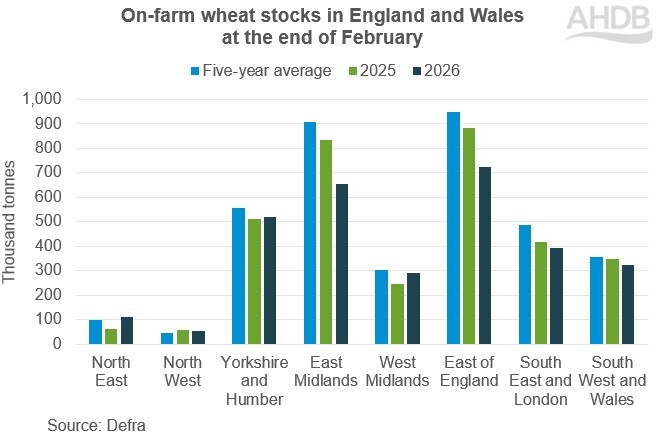
Defra reported on-farm wheat stocks at the end of February 2026 in England and Wales 9% lower than February 2025, with a 25% fall for barley. However, there was also some variability across the regions for both wheat (Figure 1) and barley.

Figure 1. On-farm wheat stocks at the end of February in England and Wales

Bar chart showing on-farm wheat stocks in England and Wales at the end of February.

Table 1. On-farm wheat stocks in England and Wales at the end of February (thousand tonnes)

RegionFive-year average20252026
North East 98 61 112
North West 47 56 52
Yorkshire and Humber 558 511 519
East Midlands 908 832 655
West Midlands 302 248 292
East of England 949 884 724
South East and London 487 416 392
South West and Wales 357 347 322

Source: Defra

Meanwhile, Scotland harvested its largest cereal crop in ten years in 2025. With distilling demand badly impacted this season, this raises questions about if stocks could look different in England and Scotland.

There is also some uncertainty around what stocks were carried into this season (2025/26). In theory, at the end of a season, the data on supply should match the data on demand and stocks. Some residual is always likely due to using survey data. However, with a 531 Kt residual left after all the data for last season (2024/25) was tallied, it leaves some uncertainty over last season’s production or closing stocks.

What does this mean?

With the estimated stocks of wheat and barley seeming not to fully reflect how the market is trading, this does give us some uncertainty over how much less stock we may carry into the new season.

Being aware of the figures that are subject to higher uncertainty is important to help inform your view on the market and to support your decisions.

How you can help

  • Growers. If you’re asked to take part in a survey by Defra, the Scottish Government, Welsh Assembly or DAERA, please think about taking part, as this will help to increase the robustness of the data sets.
  • Traders and industry. We speak to people across the industry about the market trends in the season so far and what may change in the months ahead as part of the supply and demand forecasting process. If you don’t already and are willing to get involved, please email me.

Meanwhile, AHDB, the industry and Defra will continue to work through the Audit Function Group to improve the accuracy of the data which is fed into the balance sheets.

In September, AHDB will release the collated supply and demand data on the 2025/26 season.

Image of staff member Helen Plant

Helen Plant

Lead Analyst (Cereals & Oilseeds)

See full bio

Sign up to receive the latest analysis and more from AHDB.

Subscribe

Sign up to receive the latest information from AHDB.

While AHDB seeks to ensure that the information contained on this webpage is accurate at the time of publication, no warranty is given in respect of the information and data provided. You are responsible for how you use the information. To the maximum extent permitted by law, AHDB accepts no liability for loss, damage or injury howsoever caused or suffered (including that caused by negligence) directly or indirectly in relation to the information or data provided in this publication.

All intellectual property rights in the information and data on this webpage belong to or are licensed by AHDB. You are authorised to use such information for your internal business purposes only and you must not provide this information to any other third parties, including further publication of the information, or for commercial gain in any way whatsoever without the prior written permission of AHDB for each third party disclosure, publication or commercial arrangement. For more information, please see our Terms of Use and Privacy Notice or contact the Director of Corporate Affairs at info@ahdb.org.uk  © Agriculture and Horticulture Development Board. All rights reserved. 

×