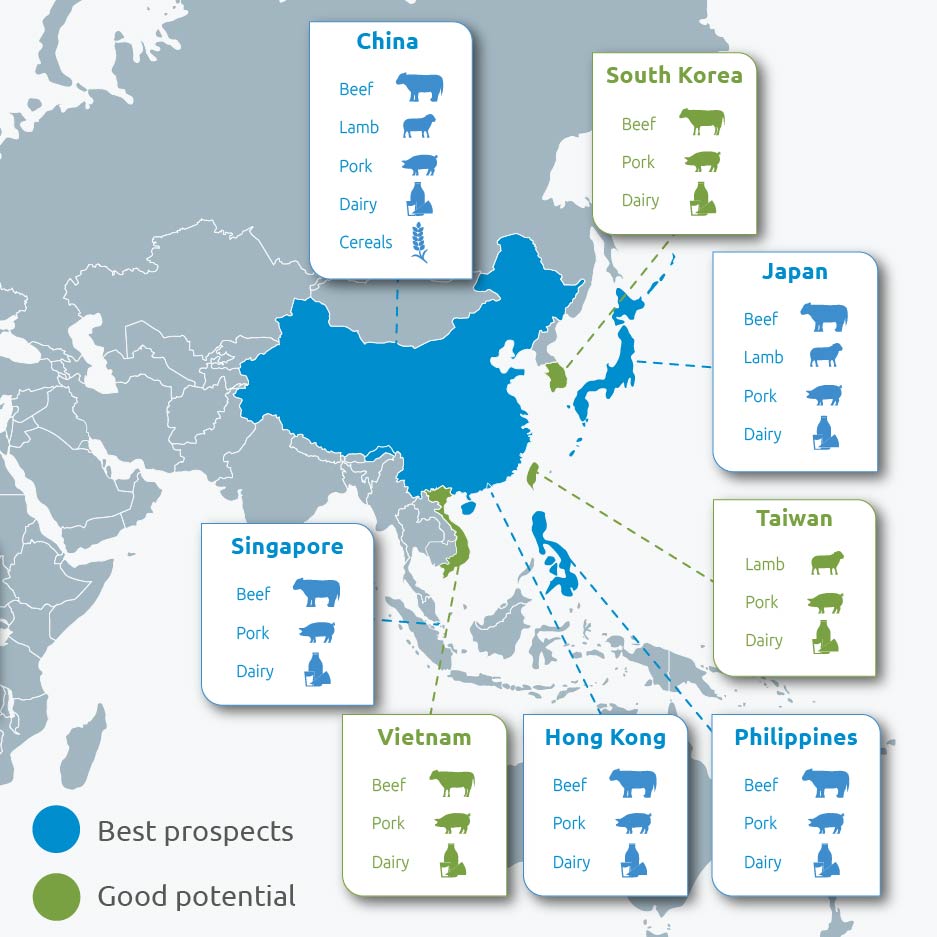
Asia: Where the opportunities lie, by country

We present an overview of export opportunities in Asia, by country.

China

China is at the top of the list when it comes to opportunities for meat exports to Asia.

The size of the population, high consumption and import levels make it an attractive prospect, even though there are challenges in market access and sizeable competition from other exporters.   

Pork is the main meat consumed in China, and the country is the UK’s biggest pork export market outside the EU.

While African swine fever (ASF) resulted in a reduction in local production and compressed availability for consumers, it has since recovered and stabilised. During ASF, as Chinese consumers increased their consumption of poultry and other meats, imports of pork into China still reached record highs to fill the gap left by the drop in ASF-hit domestic production.

In 2018, Chinese beef imports totalled just over 1 million tonnes (Mt). Between 2023 and 2025, Chinese beef imports averaged 2.8 Mt.

In 2026, Chinese beef imports (January–August 2026) were 7% higher year-on-year and 4% higher than the 2023-2025 average.   

Opportunities for British beef and sheep meat to China lie with forequarter cuts of beef and lamb, which will help with overall carcase balance. However, the UK currently does not have export health certificates (EHCs) to ship beef and lamb to China.

Likewise, demand for offal in China is robust and provides an avenue for UK-produced offal, which is not widely consumed in the domestic market.

Looking ahead, China’s GDP growth is slowing down, and there will be demand for affordable proteins. The UK can target this demand with cuts and products not favoured domestically. 

China is also an important market for UK dairy exports within Asia. UK dairy exports to China averaged £46.3 million between 2023 and 2025. 

While the UK already exports some dairy products to China, quantities are relatively modest. High food safety and production standards hold UK dairy in good stead with Chinese consumers and there are opportunities for dairy in both retail and food service.

Sweeter products such as blended fruit cheeses and mild cheddars perform well in this market, alongside smaller products aimed at convenience and snacking ‒ but the challenge is competition from New Zealand.   

There is also great potential for UK barley exports to China for both feed and malting purposes.

France is one of the UK’s key competitors for the Chinese barley market. An area where the UK has a competitive advantage over France is its farm and trade assurance schemes ‒ known among Chinese barley customers to be the best in Europe and often discussed as a point of difference.

Hong Kong and Singapore

Hong Kong’s beef and pork consumption are the highest in Asia.

The main target for UK red meat is the foodservice sector and high-end retailers.

Hong Kong’s population is less than 7.5 million, but it attracts almost 50 million tourists annually. It also has a considerable financially comfortable expat population.   

Singapore is a similar market in this respect but with a proportionally higher expat population (just under 30% in 2020).

Again, premium cuts for foodservice and high-end retailers represent the best opportunity for UK red meat. 

Hong Kong and Singapore are also important dairy importers in the region.  

As is the case for meat, relatively affluent consumers inclined to Western culture would be targets for premium British products such as cheese. Shorter shelf life products, such as yogurts, can also be airfreighted to Hong Kong and Singapore and command a premium.

The UK has beef, pork, sheep meat and dairy access in both markets: there are no import tariffs on these products. While there is considerable competition for exports to Hong Kong and Singapore, there is certainly a niche the UK can carve.

Japan

There are opportunities for UK pork, beef and sheep meat in Japan, which is a high-value economy and net importer.

In 2019, the UK gained market access for beef and lamb, having already acquired access for pork in 2011.

Japan is one of the strongest markets globally for beef tongues, which is positive from a UK perspective in terms of carcase balance.  

The UK sends some pork to Japan, mainly femur bones and some pork shoulders, which helps to balance the mainly loin-driven UK market.

A potential selling point for UK pork in the Japanese market is its high-welfare production. 

The Japanese prefer grain-fed beef, which poses a challenge for UK producers, especially as the main beef suppliers to Japan are Australia and the USA. 

Japan is not a big sheep meat importer, but there is some regional consumption and an interest in quality, lean carcases, which are considered a healthy option. 

For dairy, Japan is the top cheese importer in Asia and imports are expected to grow by 14% by 2035 compared with the 2023–25 average.    

UK cheese exports to Japan averaged 123 tonnes per year between 2023 and 2025 – considerably less than the tens of thousands being shipped from New Zealand, Australia, the USA and some EU countries (particularly Denmark, Germany, Italy and France).

As a result, it will be difficult for the UK to considerably expand its share of the Japanese cheese market. The recently strengthened UK–Japan trade agreement, however, could increase exports of organic UK dairy products to Japan. 

In general terms, Japan is placing increasing importance on food produced in an environmentally sustainable manner, and the UK is in a position to fulfil this requirement. 

Practically, there can be challenges in conducting business with Japan, where trust is built on face-to-face meetings and developing strong long-term relationships.

Philippines

The Philippines has considerable export potential for UK pork and lower-value beef products.

Pork jowls, livers and offal are popular and bought from local markets.

Demand for beef has been strong since ASF took hold across the region.

The Philippines is a price-sensitive market, and ‒ while it has a large population (115 million people based on the 2023-2025 average of UN data) ‒ budgets are generally tight.  

The Philippines is part of the Regional Comprehensive and Economic Partnership (RCEP), a trade bloc which includes Australia and New Zealand.

This, in addition to the short distance between these countries, gives Australia and New Zealand (both large beef exporters in the region) a further advantage in supplying beef to the Philippines.

For dairy products, the Philippines is a large skimmed milk powder (SMP) importer within Asia. Cheese imports are lower in comparison but are expected to increase by 49% by 2035 compared with the 2023-2025 average.

South Korea

South Korea’s pork and beef consumption are among the highest in Asia.

The UK has market access for pork and we are currently progressing access discussions for beef, which will be important going forward as South Korea is a considerable beef importer. 

British pork is perceived to be expensive by Korean importers. Trade with South Korea works particularly well when the pound is weak (as exports are more competitive then) and when the UK has an exportable surplus.

The main competitor for pork exports is Germany, which is a larger producer than the UK.  

The UK has an agreement with South Korea – a continuity deal from its time as a member of the EU. Under this agreement, UK cheese can enter the South Korean market tariff-free from 2027, which is a favourable prospect given that it is the third-highest cheese importer in Asia after Japan and China (based on 2023–2025 average annual figures).

Vietnam

Vietnamese consumers prefer fresh meat, usually bought locally in wet markets. However, due to growing concerns over food safety, there is increasing interest in chilled products. 

Beef flank, chuck and other steak cuts are popular among consumers; for pork, belly cuts rate highly. This benefits carcase balance, given the lower demand for pork belly in the UK. 

Beef imports are mainly frozen, boneless cuts.

As there is strong competition in the retail sector, foodservice is likely to offer the best opportunity, particularly for high-quality beef cuts. 

Production costs are high in Vietnam, so the country requires a high level of beef imports to meet domestic demand. Most imports are from India (mainly buffalo). 

The UK does not have market access for beef (or sheep meat) in Vietnam but does for pork.

Vietnam’s pork consumption per capita is among the highest in Asia and is forecast to grow by 14% by 2035 compared with the 2023-2025 average.  

While Vietnamese consumption of dairy products is not among the highest in Asia, it is a developing market with potential.

Consumption is increasing and domestic production is inadequate to satisfy demand. For the UK, cheese probably has the best export potential among dairy products.

Taiwan (Republic of China)

Taiwan’s high meat consumption makes it an attractive target for UK red meat exports, particularly pork.

The UK has market access for pork and sheep meat. Pork collars are the main UK pork product imported.

New Zealand and Australia account for almost all of Taiwan’s sheep meat imports (99%).

The UK exported a few hundred tonnes of sheep meat to Taiwan in both 2024 and 2025 (market access was granted in late 2023).

Between January and September 2026, the UK exported 286 tonnes of sheep meat to Taiwan, above the full year totals for 2024 and 2025 (254 tonnes and 207 tonnes, respectively).

While Taiwan’s population is considered small (about 24 million), it is a relatively Westernised Asian market. Low-value offal, not in demand in the UK, is also a good export for the Taiwanese market. The country’s beef imports mainly come from the USA. 

Demand for dairy products in Taiwan has grown as consumers shift further towards Western cuisine, and there is a buoyant drinks and coffee market.

Cheese consumption is growing in Taiwan and there is potential for the UK to expand on what it currently exports (260 tonnes based on 2023–2025 average).

India

Beef is a certain ‘no’ for the Indian market, but there is some potential for pork and sheep meat.

Under the UK–India trade deal, which entered into force on 15 July 2026, the UK will be able to export sheep meat to India at a lower tariff than the 33% duty in place for imports under most favoured nation (MFN) World Trade Organization (WTO) rules.

However, at the time of writing (November 2026), some non-tariff barriers remain. The UK–India trade deal will not benefit UK dairy exports to India.

India’s huge population is a big plus, and its many international businesses and five-star hotels mean the hospitality and foodservice sectors offer some promise for UK exporters.

In the short term, logistics are challenging. UK sheep meat exports may benefit in the long term, although, currently, India only imports a few hundred tonnes at most, mainly from New Zealand.

Malaysia, Indonesia, Thailand

While the UK has halal certification for Malaysia and Indonesia, currently there is no market access in place to facilitate trade, except for pork to Malaysia. High-end retail or low-value cuts/offal are the areas to target in the future.

Although export health certificates (EHC) for Thailand are in place for beef and sheep meat, high tariff rates disincentivise exports there. The UK’s membership of the Comprehensive and Progressive Agreement for Trans-Pacific Partnership may help exports to Malaysia and Indonesia in the future, but the first step here is to acquire necessary market access.

Consumption and imports of dairy products in Malaysia, Indonesia and Thailand are expected to increase by 2035. Although milk powders are the main imported dairy products in these countries, cheese imports are forecast to show the largest growth in percentage terms.

Related material

Export team reports

The pork market in Korea, July 2020 (PDF 1 MB)

The beef market in China, June 2020 (PDF 1.4 MB)

Need this information in a different format? Although these PDFs are not currently available in an accessible format, we can provide support and alternative formats on request.

International consumers

News and research about consumers in other countries

Harnessing consumer buying behaviour for British exports, March 2022

Understanding red meat buying behaviours in Southeast Asia, May 2022

Where are the opportunities for UK exports to Asia?

Figure 1. Opportunities for UK exports in Asia by country.

×