Planning for efficient use of forage

Wednesday, 16 March 2022

Improving efficiency is a constant challenge. While milk prices are currently high, for many, this has been off-set by the rising costs of production, particularly when it comes to feed costs. Ensuring the efficient use of forage across your system is more important than ever for improving your margins.

AHDB Knowledge Exchange Manager, Steve West, recently met with nutritional consultant Roy Eastlake to explore the decisions farmers can be making now to maximise forage use this year.

Improving forage use to offset feed costs

“Whilst we've got healthy looking milk prices, we've seen farm gate cost prices increase, with fuel increasing by 54%, fertilizer increasing by a whopping 238%, and, of course, feed increasing by 12.5%. So, margins and cash flows are tight,” says Steve. “In 2018-2019 feed costs for all year-round calving, high yielding herds accounted for 45% to 49% of cash costs on farm. And these are likely to have risen further. Forage quality is critical to ensuring businesses can stay profitable.”

Last year proved a particularly challenging year for silage making, with many facing a difficult decision as to when to make the first cut. “Those farmers that got in early on a multi-cut system achieved a number of cuts of high-quality silage, but they're few and far between,” says Roy. “Those that didn’t cut early got the quantity of fewer cuts, but not the quality. And this has impacted on their margins in their purchase feed costs. A client in Shropshire who took his first cut on 26 April was able to get five cuts with an average 11.83 ME. This has enabled him to improve his production from forage this winter and reduce his purchase feed costs, meaning he's holding on to his margins despite the rising cost of production.”

For Roy, the key to successful and efficient use of forage is taking the time to plan early in the season. “Those farmers who achieve a lower cost of production are the ones that planned early. They cut higher quality forages and pay much more attention to detail, including forage waste.

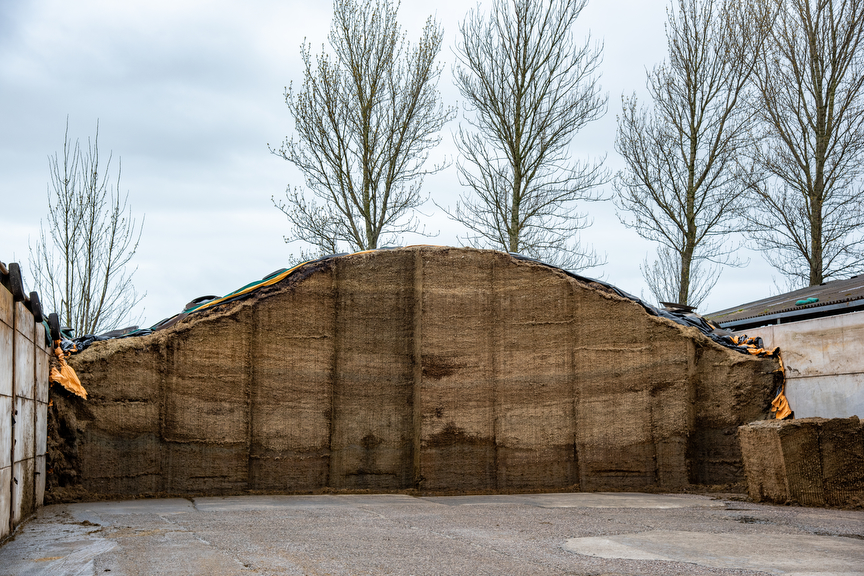
“Waste in the UK can be as much as 30%. We've got to cut out that waste to be much more efficient in utilizing our home-grown feeds,” says Roy. “It is important to consider all aspects of the forage plan from harvesting and ensiling, through to the feed out phases and ask how much is being wasted. For instance, how much waste is on top of the clamp? If we can cut waste, we have extra forage to feed to the cows to reduce purchase feeds and can become a more efficient milk production unit.”

Increasing milk from forage

“In 2021, the top 10% of herds ranked by milk from forage in the Kingshay costed herds produced 4,446 litres from forage,” says Roy. “The effect of this was that these farms had a 4.36 pence per litre higher margin than the bottom 25%, who only produced 1,400 litres from forage. That's a huge difference in potential margin from maximizing forage and silage.”

Roy recommends taking the time to sit down with your contractor, nutritionist, and agronomist to understand the quantity and quality of silage that will be required for the coming year. This will provide a baseline that can be re-visited throughout the season. AHDBs online forage and feed calculator can also help you understand your feed demand, make decisions and plan for purchasing feed or stock sales.

Including maize in forage

Maize can be an important addition to your forage believes Roy, but only if it can be grown well. To ensure maximum availability of starch, it is important to only feed maize silage that has been ensiled for a minimum of 8 weeks. If maize is fed too soon, when starch availability is low, it can result in a detrimental effect on milk yields and ultimately, on your bottom line.

“In my opinion, mixed forages stimulate dry matter intake, and that's the key to good milk production. Maize provides an incredibly good source of starch, which promotes good milk production, herd fertility and health,” says Roy.

AHDB strategic dairy farm host, Joe Carter, has been successfully including maize in his forage ration for several years. Farming in partnership with his parents at Carpenter’s Farm in Wiltshire, Joe runs a fully housed herd of 300 cows with 240 followers, mostly Holstein with some Brown Swiss.

Cattle are fed at a flat rate with two feeding groups in the milking herd; a main group and a second group consisting of subordinates and heifers. Currently, the herd is producing an average of 10,500 litres per year. Over winter, Joe would expect to see an average of 34 litres per cow per day, but in 2021/22, while quality remained high, yield dropped to 32 litres although this could also be explained by a greater proportion of heifers in the herd.

Previously working on a standard three cut system, five years ago the team at Carpenters moved to a multi-cut approach, getting four to five cuts across the year. This saw a notable increase in the quality of the silage they were able to produce. However, growing herd numbers was putting pressure on their home-grown forage. “With growing numbers, we were buying in a lot of forage,” says Joe. “So we are now renting a further 36 hectares of arable land to grow maize, where we are also able to spread slurry.” The team now grow 58 hectares of grass and a total of 90 hectares of maize, 54 of which is on their own land.

Joe and his team have tried a number of different maize varieties to ensure the right fit for their system. Recently, they have focused on early maturing crops. Harvested in September, they have found that this helps reduce mud left on the road and allows for a crop of winter wheat to be planted on the rented arable land.

It has not all been plain sailing, however. “In 2021, a section of maize was harvested later than we had hoped for,” says Joe. “This resulted in 40% dry matter content. We saw problems with the butterfat percentage in the milk and a drop in overall yield as well as problems with calving and fresh cows as our transitions diet consists of mainly maize silage.” Ideally, Roy would recommend aiming for 32% dry matter and 32% starch content within the maize silage.

Efficiency is key

Roy is adamant that you can’t afford not to apply fertiliser. Even at current prices, it is more cost efficient to grow your own forage than it is to rely on buying it in. And key to this is a comprehensive and efficient forage plan.  “Every farmer should be calculating their requirements to improve their production from forage,” says Roy. “Improving production and forage to reduce purchase feed costs improves your margins.”

Learn more about optimising grass production and utilisation of grass

Discover more about Carpenters Farm

Sectors:

×