Arable Market Report – 9 March 2026

Monday, 9 March 2026

This week's view of grain and oilseed markets, including a summary of both UK and global activity.

Grains

UK feed wheat futures (May-26)

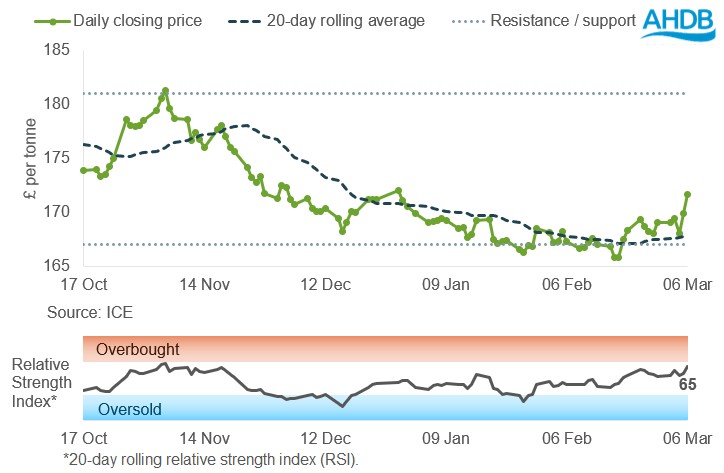
Figure 1. UK feed wheat futures prices, May-26 contract (£/tonne)

UK feed wheat futures (May-26) closed Friday at £171.60/t, gaining £2.60/t from 27 February to 6 March, the highest closing price this year. The relative strength index (RSI) for the May-26 contract gained from 52 on 27 February to 65 on 6 March (Figure 1).

Due to the surge in crude oil prices this morning, there is support across the grain futures complex.

May-26 futures were trading at £174.95/t (11:00am) this morning, the highest level since November 2025, and Nov-26 futures were trading as high as £185.00/t (10:00am), the highest level since August 2025.

Find out more about the graphs in this report and how to use them

Market drivers

While fundamentally global grain markets are well supplied, the current geo-politics with US–Iran and wider Middle East tensions are driving the global grain markets higher, as markets build in a risk premium from the uncertainty.

From this, global grain markets have been supported, with Paris milling wheat futures (May-26) gaining 3.2% week-on-week last week. This is all feeding into price uncertainty, and volatility will prevail as this conflict unfolds.

The main cause for the volatility is the price of energy, which in turn feeds into grain prices.

Nearby Brent crude oil futures are currently trading at $105.20/barrel (11:00am), up 22% on Friday’s close, but traded as high as $116.67/barrel this morning (04:00am).

The military escalation involving Iran has disrupted exports and raised fears about supplies from the Gulf. The near‑closure or severe risk around the Strait of Hormuz is key for driving markets. This is due to large amounts of both crude oil and Liquefied Natural Gas (LNG) that usually pass through the Strait; therefore, the market is adding a risk premium.

Investment flows from funds and short covering of positions are also likely driving some of the grain price gain, as ‘managed money’ has been heavily net short in Chicago wheat.

Further to that, due to the increase in energy prices, grain prices have been supported due to their role as a feedstock for biofuels. For example, Chicago maize prices are stronger from expectations for firmer ethanol margins and demand, which supports the global grain complex.

The longer the conflict goes on, the greater the potential implications for new crop prices, production and margins.

Impacts could be most notable for the 2027 harvest, as input costs into these crops could be significantly higher if escalations continue.

The war has closed fertiliser plants in the Middle East, which has led to a surge in both natural gas and fertiliser prices. Around 30% of global fertiliser trade passes through this region (LSEG).

Table 1. Global grain futures prices

Futures marketUK feed wheatParis milling wheatChicago wheatChicago maize
Contract month May-26 May-26 May-26 May-26
Price (per tonne) £171.60 €208.00 $226.59 $181.30
Change on week +£2.60 +€6.50 +$9.28 +$4.72

UK delivered cereal prices

Delivered prices gained last week following the gain in the UK feed wheat futures market (Thursday–Thursday).

Prices for feed wheat to be delivered in Mar-26 in East Anglia gained £3.00/t, to be reported at £172.50/t on Thursday, while Hvst-26 gained £3.50/t over the same period to be reported at £173.00/t.

Delivered feed wheat (Mar-26) into Avonmouth was reported at £179.50/t, up £2.00/t week-on-week.

For bread wheat, Mar-26 delivery into the North West was quoted at £192.00/t, up £0.50/t week-on-week. Meanwhile, Nov-26 delivery into the North West was quoted at £215.50/t, equating to a £36.00/t premium over Nov-26 UK futures.

Table 2. UK delivered cereal prices

Delivery specificationN. West bread wheatE. Anglia feed wheatYorkshire feed wheatE. Anglia feed barley
Delivery month May-26 May-26 May-26 May-26
Price (per tonne) £196.50 £174.50 £183.00
Change on week +£1.00 +£3.00 +£1.50

Rapeseed

Paris rapeseed futures in £/t (May-26)

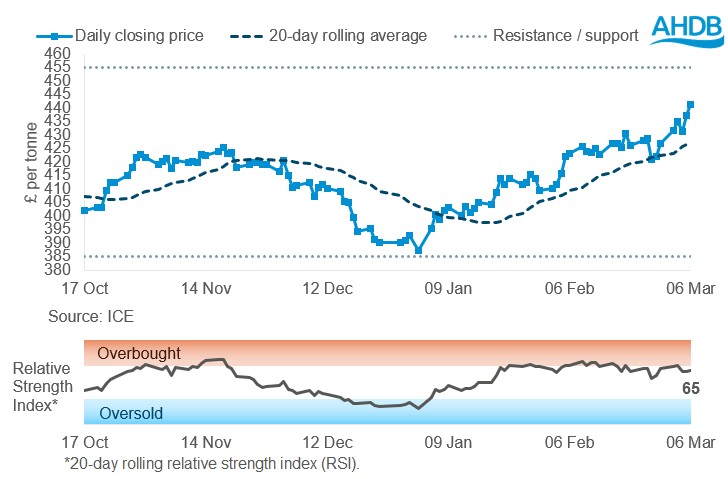
Figure 2. Paris rapeseed futures prices, May-26 contract (£/tonne)

May-26 Paris rapeseed futures in £/t gained last week, Friday to Friday. Stronger sterling against the euro over the week limited increases for prices in £/t. However, the market has still moved above the previous resistance level of £435/t.

The nearest new resistance level shown is £455/t (Figure 2). The new resistance level in £/t was calculated based on the significant resistance level of €522/t in the Paris futures market, as well as the average parity of sterling against the euro.

The relative strength index (RSI) fell from 66 to 65 between Friday and Friday but remains close to the oversold zone (70).

Find out more about the graphs in this report and how to use them

Market drivers

Paris rapeseed futures May-26 ended the week up 4.6% at €509.25/t, while the Nov-26 contract gained 4.1% to €493.00/t.

Prices for both old and new crops have increased significantly due to the strong rally in the crude oil market, particularly for crops with the nearest delivery dates. Rapeseed prices have followed those of the global oilseeds complex. The lower euro against the US dollar also supported Paris futures.

Nearby Brent crude oil futures rose last week, reaching $92.69/barrel on Friday. However, crude oil prices opened strongly at the start of this week due to the situation in the Middle East and ongoing disruption to shipping through the Strait of Hormuz.

Since the beginning of March, oil prices have surged by nearly 40%, reaching their highest levels since mid-2022 amid growing concerns about crude oil delivery via the Strait of Hormuz. Stronger crude oil futures make vegetable oils a more appealing choice for producing biodiesel.

Chicago soya bean futures and Winnipeg canola futures (May-26) gained over the week (27 Feb to 06 Mar) by 2.6% and 6.3%, respectively.

In the USA net export sales of soya bean for 2025/26 totalled 383.5 Kt for the week ending 26 February, which was lower than the previous week and close to the lower end of analysts’ estimates. This fact limited the upside movement of Chicago soya bean futures last week.

Attention is now turning to the World Agricultural Supply and Demand Estimates report from the USDA due on Tuesday (10 March). Ahead of the report, the consensus among global analysts is that 2025/26 global and US soya bean stocks will be decreased marginally.

Other key areas to watch are soya bean production in Brazil and Argentina. Some experts are predicting a fall in soya bean production in Brazil compared to previous forecasts for the current season and an increase in production in Argentina.

Canadian farmers intend to plant 8.84 Mha of canola for the 2026 harvest, which is higher than 8.75 Mha planted last season, according to Statistics Canada figures released last Thursday.

Table 3. Global oilseed and oil futures prices

Futures marketParis rapeseedChicago soya beansChicago soya bean oilBrent crude oil*
Contract month May-26 May-26 May-26 nearby
Price (per tonne) €509.25 $441.16 $1,467.82 $92.69
Change on week +€22.25 +$11.02 +$104.28 +$19.82

*Brent crude oil price per barrel

UK delivered rapeseed prices

Rapeseed to be delivered to Erith in March was reported at £458.50/t in Friday’s survey, up £13.00/t from the previous week.

The price for November delivery (the 2026 crop) gained £10.50/t to £438.50/t. The price difference between the 2025 and 2026 crops has widened, with the old crop showing stronger upside price movement than the new crop in Paris rapeseed futures.

These values are based on a survey conducted mid to late Friday morning and may not fully capture movements in Paris futures by the close of trading.

It is very important to be aware during this volatile period.

Table 4. UK delivered rapeseed prices

Delivery specificationErithLiverpoolEast Anglia
Delivery month May-26 May-26 May-26
Price (per tonne) £460.50 £460.00 £460.00
Change on week +£14.00 +£15.00 +£15.00

Extra information

On Thursday 5 March, we published UK cereal usage data for January, covering human and industrial consumption, as well as GB animal feed production. Compared to the previous season, the volume of home-grown wheat milled from July to January (including for bioethanol production) decreased by 2.4%. For imported wheat, the volume milled decreased by 30.0% over the same period. Brewers, maltsters and distillers’ barley usage for the season to date (July–January) was down 19.2% on the same period in 2024/25. 

HMRC will publish trade data for January on 13 March.

In our latest article, we looked at the potential implications of the escalation in the Middle East for nitrogen and farm costs, as well as the potential implications of the Spring Statement for agriculture.


Sign up to receive the latest information from AHDB

While AHDB seeks to ensure that the information contained on this webpage is accurate at the time of publication, no warranty is given in respect of the information and data provided. You are responsible for how you use the information. To the maximum extent permitted by law, AHDB accepts no liability for loss, damage or injury howsoever caused or suffered (including that caused by negligence) directly or indirectly in relation to the information or data provided in this publication.

All intellectual property rights in the information and data on this webpage belong to or are licensed by AHDB. You are authorised to use such information for your internal business purposes only and you must not provide this information to any other third parties, including further publication of the information, or for commercial gain in any way whatsoever without the prior written permission of AHDB for each third party disclosure, publication or commercial arrangement. For more information, please see our Terms of Use and Privacy Notice or contact the Director of Corporate Affairs at info@ahdb.org.uk  © Agriculture and Horticulture Development Board. All rights reserved. 

×