 

Analyst insight: UK cereal supply forecast at 15-year low

Thursday, 26 November 2026

AHDB forecasts total supply of wheat, barley, maize, oats and other cereals in 2026/27 at the lowest level since 2011/12.

The first estimates of total UK cereal supply and demand in 2026/27 are produced on behalf of Defra and have been released this morning.

With lower opening stocks and production, the UK’s reliance on imports remains high. These forecasts include the first estimates for maize and oats for 2026/27.

For wheat and barley, the estimates for both supply and demand are very similar to those in AHDB’s Early balance sheets.

The forecasts underline the impact of consecutive very challenging years for growing crops on supply. Meanwhile, demand, particularly for bioethanol, remains a key area of uncertainty.

Supply at a 15-year low

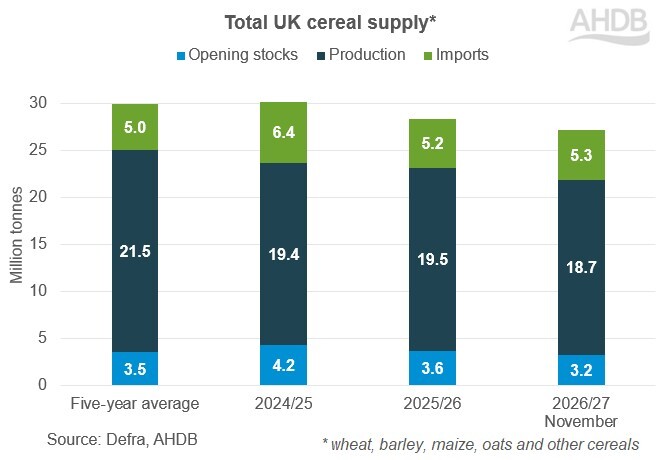
At 27.135 Mt, total cereal supply in 2026/27 is forecast to be 4% below last year and 9% below the five-year average, driven by smaller barley and oat crops.

Figure 1. Total UK cereal supply

Table 1. Total UK cereal supply, including wheat, barley, maize oats and other cereals

All numbers are in million tonnes.

Crop yearOpening stocksProductionImportsTotal availability
Five-year average* 3.5 21.5 5.0 30.0
2024/25 4.2 19.5 6.4 30.1
2025/26 3.6 19.5 5.3 28.4
2026/27, November estimates 3.2 18.7 5.3 27.1

Source: Defra, AHDB

*2021/22-2025/26

This follows sharp falls in the cropped areas of these crops for harvest 2026 and the impact of the drought on English yields as reported by Defra.

AHDB’s first estimate of the 2026 UK oat crop puts it at 727 Kt, down 25% from last year and the smallest crop since 2012/13 (627 Kt).

Last month, AHDB estimated a 12% fall in the UK barley crop in its Early Balance Sheets, with wheat production up slightly.

Imports remain high

Meanwhile, total cereal imports are forecast at 5.271 Mt. This is slightly above last season’s 5.248 Mt but below the modern record of 6.428 Mt, set in 2024/25.

We expect the exceptionally high wheat quality in 2026 to minimise imports for use by the UK flour milling industry.

But imports of feed grains are still needed to avoid a larger fall in supply and to meet demand.

Wheat and barley imports are forecast at 2.750 Mt and 250 Kt this season. These forecasts are the same as in AHDB’s Early Balance sheet last month, and notably above average.

Oat imports by the end of September 2026 had already exceeded last year’s total of 18.7 Kt. As such, 2026/27 oat imports are predicted to reach 65 Kt, the highest level since 2012/13, though the pace will be monitored.

Conversely, after a strong start, maize imports slowed in September. Total maize imports in 2026/27 are forecast to return to a more typical 2.20 Mt, down 8% from last season and 12% below the five-year average.

Total demand also falls

Table 2. UK demand for wheat, barley, maize and oats

All numbers are in million tonnes.

Crop yearHuman and industrial demandAnimal feed demand
2021/22 10.4 13.1
2022/23 10.6 12.4
2023/24 10.8 12.9
2024/25 10.5 13.4
2025/26 9.1 13.5
2026/27 November estimates 8.9 13.4

Source: Defra, AHDB

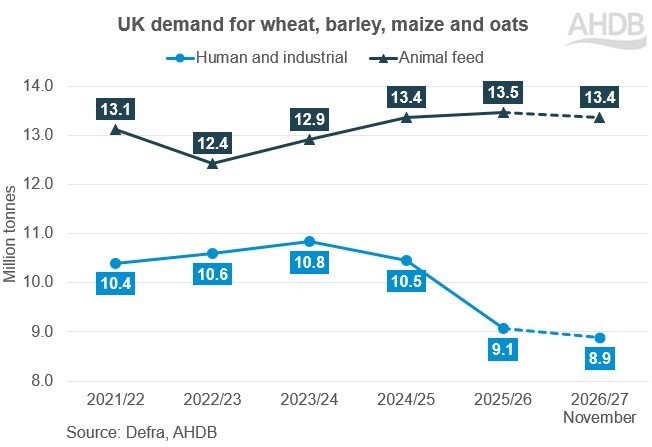
Total domestic demand for cereals in 2026/27 is forecast at 23.057 Mt. This represents a further 1% decline from last season, and the lowest domestic demand since 2011/12.

Last year, demand from the human and industrial sectors fell to the lowest level on record since 1999/00. A further 2% fall is forecast for 2026/27 (Figure 2).

Figure 2. UK demand for wheat, barley, maize and oats

Bioethanol uncertainty

Bioethanol demand is expected to dip following the closure of Vivergo in August 2025. Meanwhile, the brewing, malting and distilling sectors remain under pressure due to the cost of living.

Demand by flour millers is expected to be slightly lower this season, on the back of changing consumer diets and good extraction rates

Bioethanol is a key area of uncertainty this season. After the UK removed tariffs on imported US bioethanol in 2025, it created incredibly tough operating conditions for this sector.

Following government support to bolster UK CO2 production, bioethanol production at Ensus resumed in April. CO2 is a byproduct of bioethanol production, and its availability has been disrupted by the Iran war.

But the situation remains uncertain and demand from Ensus is currently only included in the forecasts through to the end of November.

Weather focus for animal feed

In 2026/27 total cereals demand for animal feed is estimated at 13.374 Mt, 1% lower than 2025/26 and similar to 2024/25.

Broiler feed production, particularly for integrated poultry units, is expected to increase this season. The cost-of-living crisis continues to support demand for poultry meat.

In contrast, demand for feed by the cattle and pig sectors is forecast lower with reduced populations recorded in the June survey.

Read more on the outlook for the livestock sectors in the latest Agri market outlook

However, the drought this year has led to tighter forage supplies in some regions. Therefore, winter conditions and the timing of spring turnout will determine how much additional feed is required.

Price relationships currently indicate more usage of wheat, at the expense of maize, barley and oats in animal feed. But this will be monitored in the coming months.

Next estimates

The next estimates of UK cereal supply and demand are due on Thursday 28 January 2027.

These will reflect the official UK crop estimates from Defra, due out on Thursday 10 December, plus the latest data on demand and imports.

Image of staff member Helen Plant
Helen Plant

Lead Analyst (Cereals & Oilseeds)

See full bio of Helen Plant

Subscribe

Sign up to receive the latest analysis and more from AHDB.


Sign up to receive the latest information from AHDB.

While AHDB seeks to ensure that the information contained on this webpage is accurate at the time of publication, no warranty is given in respect of the information and data provided. You are responsible for how you use the information. To the maximum extent permitted by law, AHDB accepts no liability for loss, damage or injury howsoever caused or suffered (including that caused by negligence) directly or indirectly in relation to the information or data provided in this publication.

All intellectual property rights in the information and data on this webpage belong to or are licensed by AHDB. You are authorised to use such information for your internal business purposes only and you must not provide this information to any other third parties, including further publication of the information, or for commercial gain in any way whatsoever without the prior written permission of AHDB for each third party disclosure, publication or commercial arrangement. For more information, please see our Terms of Use and Privacy Notice or contact the Director of Corporate Affairs at info@ahdb.org.uk  © Agriculture and Horticulture Development Board. All rights reserved. 

×