Analyst insight: Dry start to May hits UK crop conditions

Friday, 29 May 2026

UK spring crops are struggling, while winter crop condition scores have reduced further since April, according to the AHDB’s May crop development report.

Dry weather in the first three weeks of May, after the drier-than-usual April, has negatively impacted all crops.

The shift to much wetter conditions in week three was very welcome, though rainfall varied by locality. Where sufficient rainfall occurred, crops recovered, though some still lack biomass and tiller development. Overall, crops are growing well.

However, even with this late surge in rainfall, some areas, especially those with lighter soils, remain moisture-limited, so future rainfall is key.

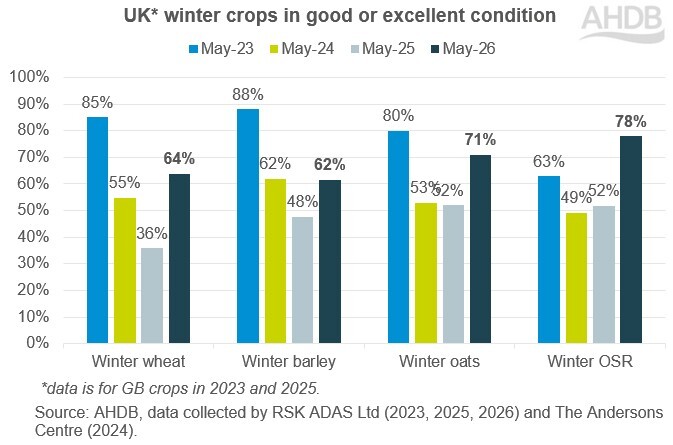
As a result of the earlier dry weather, the proportions of winter cereal crops rated in good or excellent condition are lower than last month:

  • 64% of winter wheat is now rated good or excellent, down from 74% a month ago.
  • 62% of winter barley is now rated good or excellent, down from 70% a month ago.
  • 71% of winter oats are now rated good or excellent, down from 81% a month ago.

These conditions are still better than in 2025 and 2024 for wheat and barley but lower than last year for winter oats (Figure 1).

Figure 1. Proportion of UK winter crops in good or excellent condition in late May

Bar chart showing the proportion of UK winter crops in good or excellent condition in late May

Table 1. Proportion of UK* winter crops in good or excellent condition

CropMay-23May-24May-25May-26
Winter wheat 85% 55% 36% 64%
Winter barley 88% 62% 48% 62%
Winter oats 80% 53% 52% 71%
Winter OSR 63% 49% 52% 78%

* Data is for GB crops in 2023 and 2025.

Source: AHDB, data collected by RSK ADAS Ltd (2023, 2025, 2026) and The Andersons Centre (2024).

Meanwhile, the proportion of winter oilseed rape (OSR) in good or excellent condition is lower than last month’s 84% at 78% but continues to show good yield potential.

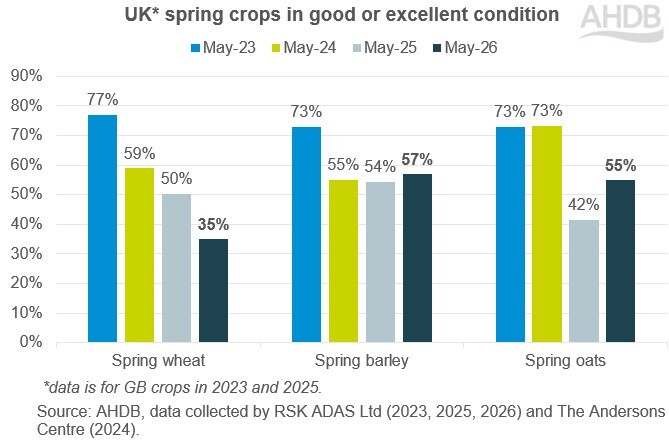
Spring crop establishment and early development was also hit by the dry conditions, with most crops struggling with moisture stress. The impact of this stress is reflected in crop condition scores compared to recent years (Figure 2).

Figure 2. Proportion of UK spring crops in good or excellent condition in late May

Bar chart showing the proportion of UK spring cereal crops in good-excellent condition in late May

Table 2. Proportion of UK* spring cereal crops in good or excellent condition

CropMay-23May-24May-25May-26
Spring wheat 77% 59% 50% 35%
Spring barley 73% 55% 54% 57%
Spring oats 73% 73% 42% 55%

*Data is for GB crops in 2023 and 2025.

Source: AHDB, data collected by RSK ADAS Ltd (2023, 2025, 2026) and The Andersons Centre (2024).

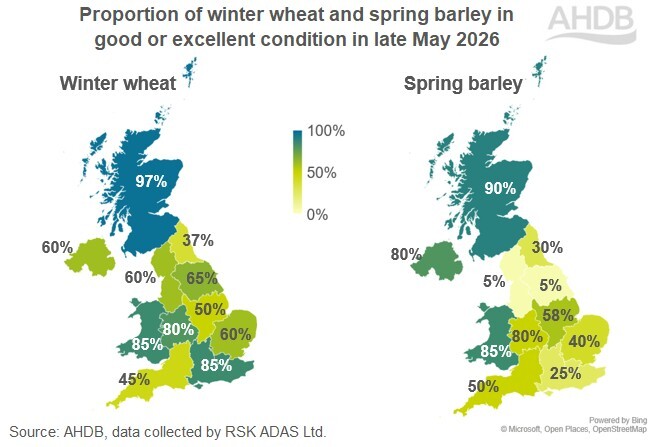
However, like the rainfall, crop conditions are not universal, with poorer scores in some regions of England than others and variation by crop. Meanwhile, crop scores are generally stronger in Scotland, Northern Ireland and Wales.

Figure 3 shows how the proportion of winter wheat and spring barley crops in good or excellent condition varies across the UK.

Figure 3. Proportion of winter wheat and spring barley in good or excellent condition across the UK

Annotated map showing the variation in winter wheat and spring barley condtion across the UK

Table 3. Proportion of  winter wheat and spring barley in good or excellent condition in late May 2026

Region/country of the UKWinter wheatSpring barley
East Midlands 50% 58%
East of England 60% 40%
North East England 37% 30%
North West England 60% 5%
Northern Ireland 60% 80%
Scotland 97% 90%
South East England 85% 25%
South West England 45% 50%
Wales 85% 85%
West Midlands 80% 50%
Yorkshire and the Humber 65% 5%

Source: AHDB, data collected by RSK ADAS Ltd.

This report captures crop conditions up to Monday 25 May 2026. Recent high temperatures have increased crop stress, with visible leaf rolling in wheat crops, indicating benefits from recent rainfall may be short-lived.

Next few weeks critical

More rainfall will be needed to sustain crops through to harvest, and the next two to three weeks will be critical.

It’s worth noting that so far, fewer nationally crops are in poor or very poor condition than last year, with more crops in ‘fair’ condition. This offers some hope that timely and adequate rainfall could help to stabilise or support crop potential, though for winter cereals this window of opportunity is not large.

The current challenge to yield potential is not what was hoped for after several years of pressured farm margins due to extreme weather and low grain prices.  Against this backdrop, and with input costs up sharply due to the war in Iran, higher yields are needed to help support farm profitability and cash flow.

See AHDB’s latest fertiliser prices

Meanwhile, feed wheat prices for the coming harvest (Nov-26 UK futures) are only up 5% compared to the equivalent price a year ago (Nov-25 UK futures).

Without adequate rain in the next few weeks to support crop yields, there is a risk of further pressure on farm profitability and cash flow. This could in turn, make cropping decisions for harvest 2027 even harder.

But we may get some relief with the heatwave now breaking, and if the rain falls as forecast for many areas.

AHDB’s final report on the 2026 crop development and conditions is planned for 26 June.

Image of staff member Helen Plant

Helen Plant

Lead Analyst (Cereals & Oilseeds)

See full bio

Subscribe

Sign up to receive the latest analysis and more from AHDB.


Sign up to receive the latest information from AHDB.

While AHDB seeks to ensure that the information contained on this webpage is accurate at the time of publication, no warranty is given in respect of the information and data provided. You are responsible for how you use the information. To the maximum extent permitted by law, AHDB accepts no liability for loss, damage or injury howsoever caused or suffered (including that caused by negligence) directly or indirectly in relation to the information or data provided in this publication.

All intellectual property rights in the information and data on this webpage belong to or are licensed by AHDB. You are authorised to use such information for your internal business purposes only and you must not provide this information to any other third parties, including further publication of the information, or for commercial gain in any way whatsoever without the prior written permission of AHDB for each third party disclosure, publication or commercial arrangement. For more information, please see our Terms of Use and Privacy Notice or contact the Director of Corporate Affairs at info@ahdb.org.uk  © Agriculture and Horticulture Development Board. All rights reserved. 

×