- Home
- Meat shopper journey: The planning process
Meat shopper journey: The planning process
The first stage of the meat shopper journey is pre-store. It is important to understand how shoppers plan their meals, at what level and what influences their decisions.
How do they decide what proteins and cuts make it onto their shopping lists? How do they research products and prices to determine where to shop? Have these factors changed since 2018?
Meal planning at home
Our research shows that 65% of consumers plan their weekly meals to some degree. This is a conscious decision to make life easier during the week, save time and money, and reduce food waste.
In terms of key considerations, 67% of consumers say taste and 64% say quality are the most important factors when preparing meals the whole family will enjoy.
Alongside this, consumers say value for money, ease of cooking, convenience and health are also significant factors for them, especially during the week.
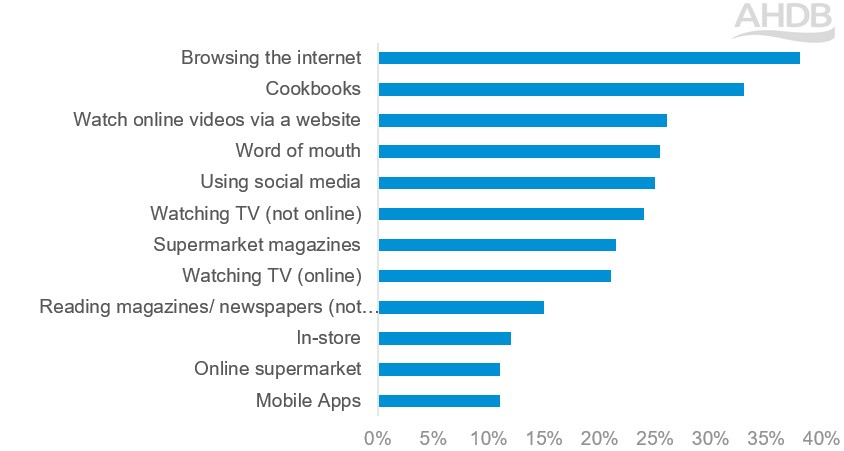
Consumers get recipe inspiration from a variety of sources – browsing the internet, cookbooks, online videos, word of mouth, social media, TV and retailer magazines (AHDB Recipe research 2024).
This creates plenty of opportunities to influence consumers before they shop by using online content, social media and retailer apps to promote quick, simple and healthy red meat recipe ideas.
There is an opportunity to tailor messaging around weekday needs of value and convenience and to weekend needs, when people want more variety and treat-style options. We provide recipe inspiration through our Let’s Eat Balanced and Simply Beef and Lamb campaigns.
Figure 1. Sources of recipe inspiration for consumers
Source: Sparkminds, Recipe research 2024
Figure 1 compares where people look for recipe inspiration. Browsing the internet is the most common source (about 37%), followed by cookbooks (32%) and online videos (27%). Mobile apps are the least used (around 9%).
During the week, 53% of consumers are increasingly looking to use ingredients they already have at home in a bid to save money. This differs to 2018 when type of protein and cut were their primary considerations. Today, some consumers are more likely to choose versatile cuts of meat like mince or chicken breasts because they are affordable, flexible, can be adapted to taste with herbs and spices, and can easily fit into a range of everyday meals.
Conversely at the weekend, some consumers are looking for a treat or something a bit different. This provides a real opportunity for premium cuts, new cuisines and added-value meals as a tasty reward or an alternative, potentially cheaper option to dining out.
Table 1. Key criteria that always apply while meal planning
|
Always |
During the week (vs weekend) |
At the weekend (vs weekday) |
|||
|
Tasty – 67% |
Good value +9% |
A bit of a treat + 22% |
|||
|
Good quality – 64% |
Easy to cook +14 |
Something a bit different +12% |
|||
|
For the whole family – 41% |
Convenience +14% |
A bit of a challenge + 4% |
|||
|
– |
– |
Healthy +8% |
– |
– |
|
|
– |
– |
Quick to cook +13% |
– |
– |
|
Protein planning
Consumers are more likely to have a strict shopping list compared with 2018 because of cost-of-living pressures.
When it comes to grocery shopping, 43% of consumers use a strict list while 52% have a flexible plan.
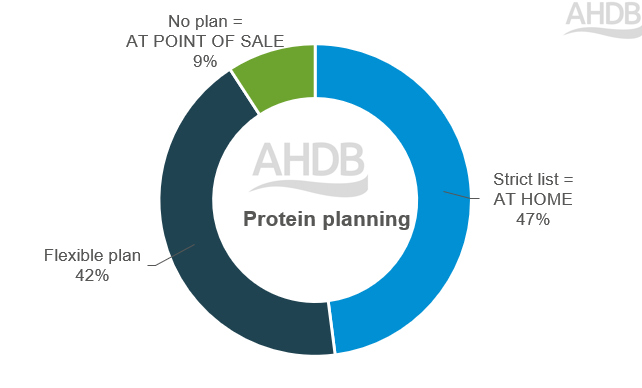
When shopping for meat, consumers using a strict list increases to 47% and only 42% having a flexible plan (see figure 2 below).
Figure 2. Is meat likely to be on a strict or flexible shopping list?
Figure 2 shows how people plan their protein purchases. 47% follow a strict list, 42% use a flexible plan, and 9% make decisions at the point of sale.
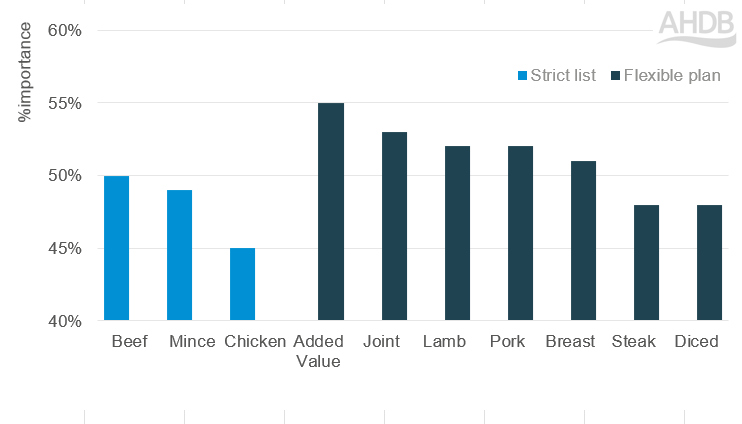
The results show that proteins like beef mince and chicken are more likely to be planned in advance and included on a strict shopping list. These are more often the purchases made for convenient, healthy weekday family meals.
In comparison, the flexible shopping list is more likely to contain lamb, pork, breast, added value, steak and diced proteins because shoppers are more open to choosing these when in-store. Our This is British Pork campaign highlights a range of versatile, nutritious and affordable pork dishes.
Figure 3. Percentage of proteins/cuts on the strict list or flexible shopping lists
Figure 3 compares how important different meat types are to shoppers with strict lists (light blue bars) versus flexible plans (dark blue bars). Added‑value products (55%), joints (53%) and lamb (52%) score highest for flexible planners, while beef (50%), mince (49%) and chicken (45%) rank slightly higher for strict‑list shoppers.
As 42% of consumers shopping for meat have a flexible plan and 9% have no plan, there is an opportunity for the industry to influence their choices at home and again in-store.
Consumers are more likely to decide which mealtime, recipe, protein and cut are to be bought at home and leave the finer details like pricing, pack size/weight and quality of the meat until they are in-store.
Shopping trips
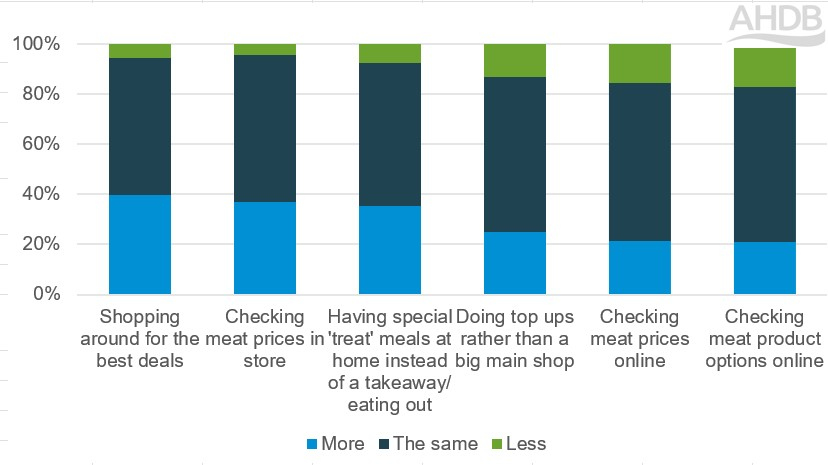
With the ongoing cost-of-living crisis, it is no surprise that shoppers have become savvier by regularly checking prices, shopping around for the best deals and having ‘treat’ meals at home rather than eating out or having a takeaway.
Figure 4. Consumer behaviour changes when shopping for the best deal
Figure 4 shows how shopping behaviours are changing. The light blue bar indicates more, dark blue is the same and green is less. More people are shopping around for deals (40%) and checking meat prices, both in‑store (37%) and online (21%). Treat meals at home are also more common (35%), while fewer people report doing these activities less often.
Because of this, shoppers are now less loyal to one retailer and often shop at more stores, including discounters to get better value for money and find products that suit their tastes.
Our research shows that 88% of consumers do ‘main’ shops in more than one retailer and are doing top-up shops more frequently.
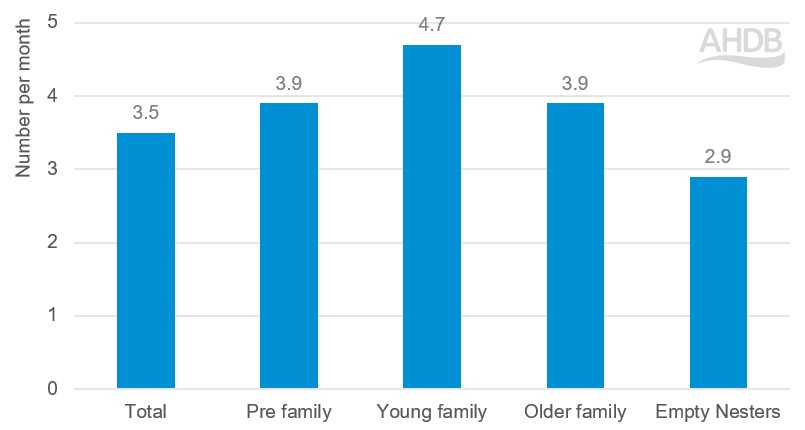
On average shoppers visit 3.5 different retailers per month, increasing to 4.7 for those with young families, while pre-families and older families average around 3.9 and empty nesters the least with 2.9 visits per month (see figure 5).
Figure 5. Average number of main shop retailers per month
Pre-families and young families are more likely to be shopping around for the best deals, checking meat prices online and choosing special treat meals at home.
Because people are shopping around more and doing more top-up shops, it’s important to clearly show the quality, range and value of meat products in your store. Offering loyalty prices or incentives could help draw shoppers into store.
Read more about the meat shopper journey