What do farmers want to know about hoof trimming?

Tuesday, 12 April 2022

Some of the most rewarding pieces of research are those that are directly applicable on farm and lead to tangible positive change. Vet Sara Pedersen gives an update on some of her ongoing research about hoof trimming.

Engaging farmers in new practices can sometimes be challenging, especially if it means changing long established practices. Whilst some previous surveys have aimed to gain a greater understanding of how farmers could be encouraged to implement research findings, they have not specifically asked farmers where future lameness research should be focused. Such participatory research methods have been used extensively across many different sectors, both in the veterinary and external fields – it’s even been used as part of the Healthy Feet Programme. By gaining a greater understanding of farmers’ main areas of interest and their key questions for research it has the potential to achieve farmer support at an early stage, prior to involvement of expert opinion. Ultimately this has the potential to improve uptake of any positive research findings.

This was the focus of a recently published paper from my AHDB/University of Nottingham PhD project: Preventive hoof trimming in dairy cattle: Determining current practices and identifying future research areas. The aim of the paper was to determine current preventive foot trimming practices on dairy farms in Great Britain (GB) as well as identify key areas for future research. The survey was undertaken in early 2017 and more than 330 dairy farmers from across GB responded. The herds represented ranged from extensive grazing systems to herds housed all year round, with an average herd size of 270 dairy cows and average yield of 9,272 litres sold per cow per year.

Current Preventive Trimming Practices

When are farmers undertaking preventive trimming?

Overall, 82% of respondents said that they were undertaking preventive trimming and this was significantly related to herd yield i.e., higher yielding herds were more likely to undertake preventive trimming. Although this finding was perhaps unsurprising, it was beyond the scope of the survey to determine the reasons for this association. There was also a trend towards herds where cows were housed for longer periods of time being more likely to undertake preventive trimming.

Although the vast majority of farmers were implementing preventive trimming, there was a large variation in terms of when this was undertaken both in terms of frequency and also its timing within the management cycle. Of those implementing preventive trimming, the majority carried it out at dry off (72%) with just under half doing a trim at a particular stage during lactation (44%). Perhaps a little surprising given the importance of reducing lameness in 1st lactation, trimming heifers pre-calving was only undertaken by a small proportion of herds (6%). A low number of herds didn’t base their trimming protocols on stage of lactation but instead trimmed the entire herd at regular intervals (5%).

Who is undertaking preventive trimming?

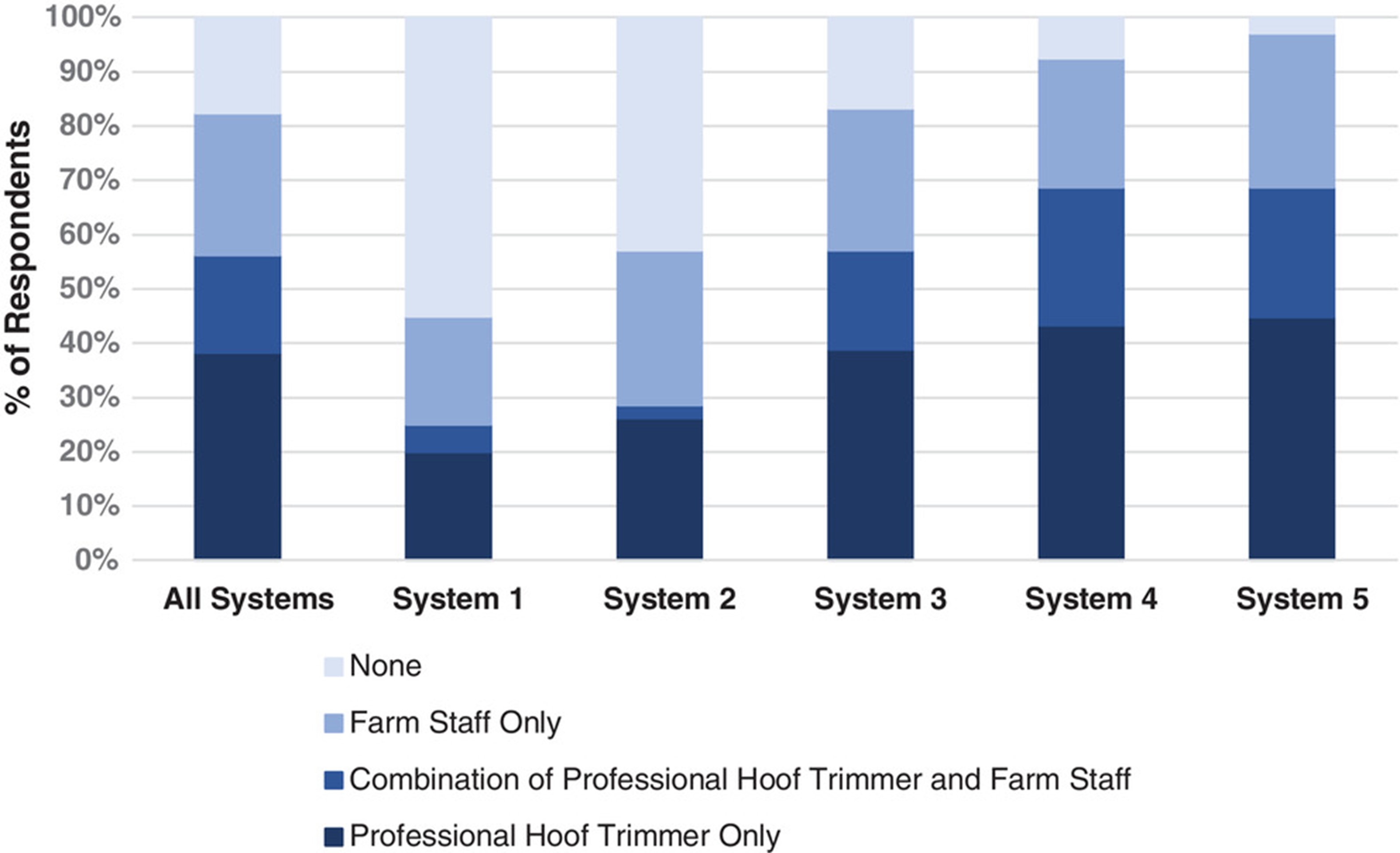
There has been limited information previously about who undertakes preventive trimming on GB dairy herds: a report in the 1990s indicated that a large proportion was undertaken by vets. Not surprisingly, the results of this recent survey reflect a shift away from this with a rise in the number of farms employing professional hoof trimmers. Overall, on 46% of farms preventive hoof trimming was undertaken solely by a professional hoof trimmer, 32% used farm staff only for this task and 22% used a combination of both (Figure One). This was quite interesting and demonstrates the importance of not just targeting professional hoof trimmers when it comes to knowledge exchange and improving standards; there is also a need to involve farm staff too.

Figure One: The proportion of respondents from a survey on preventive cattle hoof trimming that either did not undertake preventive hoof trimming or did, and used an external professional hoof trimmer, internal farm staff or a combination of both, to undertake this procedure on their farms (n = 322). Results for all systems and by each Agriculture and Horticulture Development Board (AHDB) management system are shown. System 1: Spring calving, >274 days grazing. Limited supplementary concentrates and conserved forage only fed during shortfall in grazed forage; System 2: Block calving. 183–274 days grazing. More use of conserved forage/supplementary concentrates; System 3: Block/All-year-round calving. 91–182 days grazing. Use of partial mixed ration and supplementary concentrates; System 4: All-year-round calving. 0–90 days grazing. Limited use of grazed grass. Total mixed ration or partial mixed ration with supplementary concentrates; System 5: All-year-round calving. Housed. No use of grazed grass. Total mixed ration or partial mixed ration with relatively high use of supplementary concentrates. From Pedersen et al., 2022.

Future research areas: What do farmers want to know?

The final part of the survey were two open questions: What questions do you have regarding routine trimming protocols?/What areas of routine foot trimming would you like to see researched?

Respondents were able to provide as many questions as they liked and a total of 483 were submitted. Not all responses related to preventive hoof trimming and some had perhaps already been answered through previous research (e.g., best way to treat a claw horn lesion). This highlights the need to continue promoting previous research findings alongside new ones.

Four clear themes emerged from the responses:

  • When should we trim?
  • How should we trim?
  • Why should we trim? and
  • Who (which animals) should we trim?

Within each theme there were multiple subthemes. Table One shows the themes and subthemes along with example questions.

Table One: The themes and subthemes relating to preventive hoof trimming with example questions derived from thematic analysis of answers provided during a survey of Great Britain's (GB) dairy farmers regarding the areas they would like to see researched in the future (n = 289). From Pedersen et al., 2022. 

Theme

Subtheme

Example question(s)

How should we trim?

Method

“Are some methods better than others?”

“Is the Dutch Method best?”

Toe Length

“What toe length is best to use when trimming?”

“What is the optimum length of toe on larger cows?”

Equipment

“Can grinders cause damage?”

“Knife or grinder?”

Over-trimming

“Is over-trimming as bad as never trimming?”

“Is grinding the foot into shape a good idea?”

When should we trim?

Frequency

“How often should they be done?”

“Is twice a year trimming enough?”

Timing in Management Cycle

“Is pre-drying off trimming necessary?”

“Would we benefit from a routine trim at 100 days calved?”

Concerns

“What effect does routine trimming during the service period have on conception rates?”

“What stress is caused by trimming and can it reduce fertility?”

Management System

“We have robots, when is the best time to trim?”

“Should the protocol differ between robot, housed and extensive systems?”

Why should we trim?

Outcome

“Is routine trimming of benefit?”

“Will it reduce lameness?”

Economics

“How much is not routinely trimming costing me?”

“Cost analysis of frequency of foot trimming”

Trimming sound animals

“Should cows be trimmed if they appear OK?”

“Is mobility scoring better than routine trimming?”

Who (i.e., which animals) should we trim?

Pre- vs post-calving

“Do heifers benefit from trimming pre-calving, post-calving or not at all?”

Trimming pre-calving

“Would trimming heifers at 20 months of age prevent lameness in 1st lactation?”

“Is trimming heifers pre-calving economically viable?”

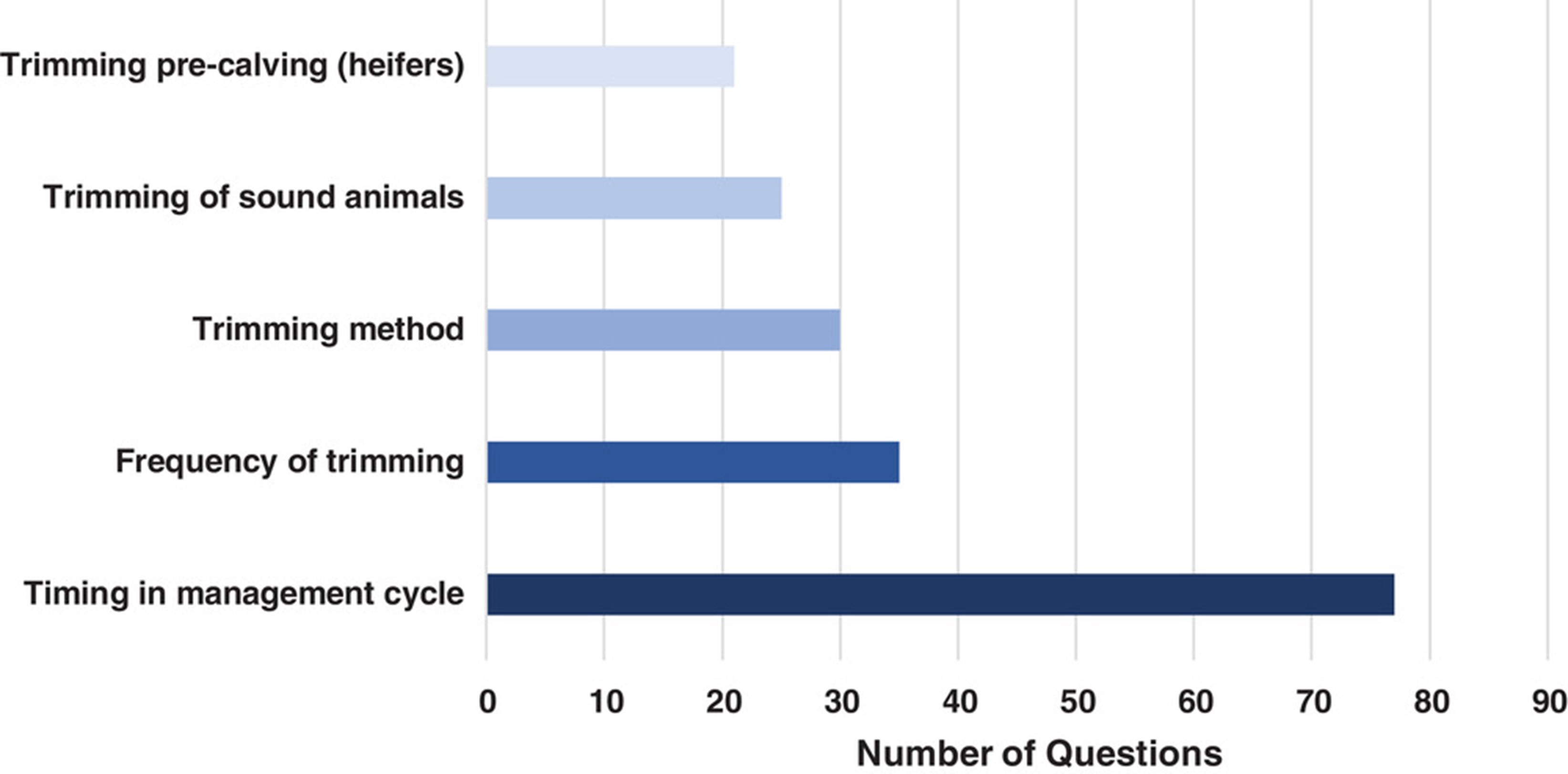
Overall, the most frequently asked questions related to when in the management cycle was the optimal time to preventively trim cows e.g., is 60-70 days in milk better than 100 days (Figure Two). This is interesting considering that a large proportion of farmers are already undertaking trimming at set time points, and highlights that uncertainty remains as to the optimal time for this intervention.

Figure Two: A bar chart showing the top five most frequent question subthemes on future research topics for preventive hoof trimming, which were provided as part of a survey of dairy farmers on preventive hoof trimming practices and research areas (n = 289). From Pedersen et al., 2022.

Summary

This survey has shown that routine cattle hoof trimming is a widespread practice, adopted on the majority of GB dairy farms, yet we have limited evidence about some of the key aspects of this. The most common approach is to trim at specific stages in the management cycle and this is the area that farmers would most like to see as the focus of future research. Additionally, they would like to know whether it is beneficial to trim pre-calving heifers, which is something very few respondents were doing.

The results of this survey have already been used to develop and shape a randomised control trial on pre-calving heifers that helps to address whether we should trim them, and if so, the optimal technique to use. Full results are expected later in 2022 so watch this space…

Sectors:

×