Arable Market Report – 13 April 2026

Monday, 13 April 2026

This week's view of grain and oilseed markets, including a summary of both UK and global activity.

Grains

UK feed wheat futures (May-26)

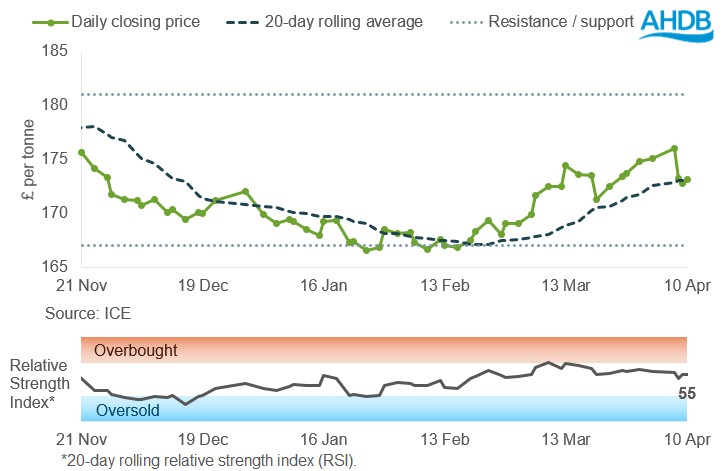
Figure 1. UK feed wheat futures prices, May-26 contract (£/tonne)

May-26 UK feed wheat futures ended the week down £1.95/t at £173.15/t on Friday (02 April to 10 April) (Figure 1). The domestic market ended down after two consecutive weeks of support.

UK feed wheat futures broadly tracked the pressure in global grain markets.

Based on Fridays’ close, the relative strength index (RSI) was 55, down from 60 from Thursday 02 April (Figure 1).

Find out more about the graphs in this report and how to use them

Market drivers

Pressure across the week for global grain markets, with the main drivers being geo-politics, global weather and markets re-focusing on the fact that global grain markets are well-supplied. Across the week (02 Apr to 10 Apr) Chicago and Paris milling wheat futures (May-26) were pressured by 4.6% and 3.8% respectively. 

Firstly, the release of the USDA April World Agricultural Supply and Demand Estimates last Thursday put pressure on the market. The report was broadly neutral-to-bearish for grains, with U.S. maize stocks unchanged, at a seven-year high. Further to that, increases to global wheat and maize ending stocks for the 2025/26 marketing year, reinforced a comfortable global supply outlook and limiting any upside for wheat and maize futures.

The main weather story now for grains is the recent drought in the US. Storms crossed portions of eastern Kansas and Oklahoma last Friday, bringing beneficial rains to areas where developing US winter wheat has struggled with drought.

This beneficial rain will also aid US maize plantings which are just underway now, markets will become increasingly more interested in this data in the coming weeks. Further updates will be released in the USDA crop progress report published this evening (21:00 BST).

Tensions between the USA and Iran have remained elevated, with markets closely watching developments around the Strait of Hormuz and the risk of wider regional disruption.

A fragile two-week ceasefire and talks in Islamabad briefly eased concerns throughout last week, but the situation remains highly uncertain, with both sides still exchanging hardline rhetoric and the possibility of renewed escalation hanging over the region.

For grain markets, the main relevance is the potential impact on energy prices, shipping costs, and broader risk sentiment, all of which can feed through into commodity pricing.

Table 1. Global grain futures prices

Futures marketUK feed wheatParis milling wheatChicago wheatChicago maize
Contract month May-26 May-26 May-26 May-26
Price (per tonne) £173.15 €194.75 $209.79 $173.62
Change on week -£1.95 -€7.75 -$10.01 -$4.43

UK delivered cereal prices

Delivered bread wheat (North-West, Apr-26) was quoted at £198.00/t last Thursday with no comparison across the week.

Delivered feed wheat (Yorkshire, Apr-26) was quoted at £190.50/t, gaining £4.00/t week-on-week, despite May-26 UK feed wheat futures being marginally down Wednesday (01 Apr) to Thursday (09 Apr).

Table 2. UK delivered cereal prices

Delivery specificationN. West bread wheatE. Anglia feed wheatYorkshire feed wheatE. Anglia feed barley
Delivery month Apr-26 Apr-26 Apr-26 Apr-26
Price (per tonne) £198.00 £190.50
Change on week n/c +£4.00

Rapeseed

Paris rapeseed futures in £/t (May-26)

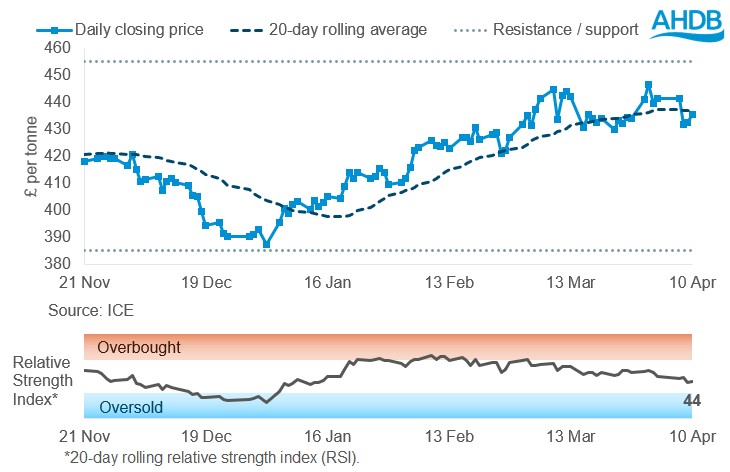
Figure 2. Paris rapeseed futures prices, May-26 contract (£/tonne)

Paris rapeseed futures for May-26 equated to approximately over £435.31/t on Friday, a drop of almost £6/t or 1.4% compared to Thursday 2 April (Figure 2).

The prices fell below the 20-day moving average last week, though they had closed the gap by Friday’s close. Unless the contract remains below the 20-day moving average this week, this could now act as a resistance line (a level that prices find it harder to move above) at least in in the short-term.

Reflecting the change in price direction, the Relative Strength Index (RSI) dropped from 52 on at the close of trading 2 April to 44 on 10 April (Figure 2).

Find out more about the graphs in this report and how to use them

Market drivers

Rapeseed prices lost ground last week as crude oil prices retreated on the announcement of a ceasefire between the USA and Iran on Wednesday. However, uncertainty over if this truce can be turned into a lasting agreement underpinned markets.

Nearby Brent crude oil futures fell $14.52/barrel on Wednesday after the announcement $94.75/barrel, before lifting slightly to end the week at $95.20/barrel. While last week’s fall is welcome, the price is still over 30% higher than it was at the end of February.

May-26 Paris rapeseed futures fell 1.2% from Thursday 2 to Friday 10 April, while May-26 Winnipeg canola futures fell 3.1% from 3 to 10 April.

In contrast, buoyed by a weaker US dollar and the largest single export sale of US soya meal since 2019 (100Kt to Italy), Chicago soya bean futures gained 1.1% (2–10 April).

The market reaction to the latest monthly estimates of global supply and demand from the USDA was muted.

The USDA trimmed its estimate of global soya bean stocks at the end of the 2025/26 season by 0.5 Mt from March to 124.8 Mt, due to higher expected crush demand. For the USA, an increased crush demand estimate offset a drop in expected exports, to leave the end-of-season stock forecast unchanged.

Crude oil and the situation in the Middle East are likely to remain key drivers for oilseed markets in the coming weeks.

The risk to demand from higher prices also gained attention late last week. After high exports in March driven by Iran war, Malaysian palm oil exports are notably down in first ten days of April.

With the peak production months ahead, this news pressured palm oil futures prices on Friday and could be a driver of vegetable oil prices into this week.

In addition, Rabobank report that disruption to global fertiliser markets is likely to continue, in part due to the time needed to potentially repair damage and restart shuttered production facilities in the Middle East.

This disruption and previous fertiliser price rises keep uncertainty over global cropped areas for the 2026/27 harvests.

The USDA is due to start reporting on progress planting the 2026 US soya bean crop this evening.

Table 3. Global oilseed and oil futures prices

Futures marketParis rapeseedChicago soya beansChicago soya bean oilBrent crude oil
Contract month May-26 May-26 May-26 nearby
Price (per tonne) €499.75 $431.97 $1,479.07 $95.20
Change on week -€6.00 +$4.50 -$40.79 -$13.83

*Brent crude oil price per barrel

UK delivered rapeseed prices

Domestic markets remained quiet last week and there was little difference between the prices for the remaining old crop delivery months.

Both old and new crop prices were down from the previous survey on 2 April, driven lower by the global market. There were slightly larger falls in new crop rapeseed prices than old crop, echoing the trend in the Paris futures market.

Rapeseed to be delivered into Erith in May was reported at £460.00/t on Friday, a fall of £8.50/t from the previous survey on Thursday 2 April.

Meanwhile, the prices reported for rapeseed delivered into Erith at harvest and in November were both £10.50/t lower than on 2 April, at £434.50/t and £444.00/t respectively.

Table 4. UK delivered rapeseed prices

Delivery specificationErithLiverpoolEast Anglia
Delivery month May-26 May-26 May-26
Price (per tonne) £460.00 £459.50 £458.50
Change on week -£8.50 -£8.50 -£9.00

Extra information

The latest weekly GB fertiliser prices from AHDB showed broadly stable ammonium nitrate (AN) prices. UK produced AN (34.5% N) was reported as averaging £521/t in the week ending 2 April, with imported AN (34.5% N) at £530/t. However, the prices are still considerably, 30 and 31% respectively, higher than before the war in Iran began.

Meanwhile, granular urea (46% N) is up almost 39% compared to the February average to £631/t in the week ending 2 April.

There were also week-on-week rises for potash, phosphate and polysulphate prices.

HMRC is due to release data on UK imports and exports in February on Thursday 16 April.

Northern Ireland

Table 5. Delivered prices into Belfast*

Delivery specification**Feed barley – spotFeed barley – forwardFeed wheat – spotFeed wheat – forward
Delivery month Spot May-26 Spot May-26
Price (per tonne) £201.50 £205.50 £203.50 £209.50
Change on week n/c n/c n/c n/c

*Prices provided for indicative purposes

**Basis is imported/home-grown

n/c: no comparison

unch: no change in price compared to last week


Sign up to receive the latest information from AHDB

While AHDB seeks to ensure that the information contained on this webpage is accurate at the time of publication, no warranty is given in respect of the information and data provided. You are responsible for how you use the information. To the maximum extent permitted by law, AHDB accepts no liability for loss, damage or injury howsoever caused or suffered (including that caused by negligence) directly or indirectly in relation to the information or data provided in this publication.

All intellectual property rights in the information and data on this webpage belong to or are licensed by AHDB. You are authorised to use such information for your internal business purposes only and you must not provide this information to any other third parties, including further publication of the information, or for commercial gain in any way whatsoever without the prior written permission of AHDB for each third party disclosure, publication or commercial arrangement. For more information, please see our Terms of Use and Privacy Notice or contact the Director of Corporate Affairs at info@ahdb.org.uk  © Agriculture and Horticulture Development Board. All rights reserved. 

×